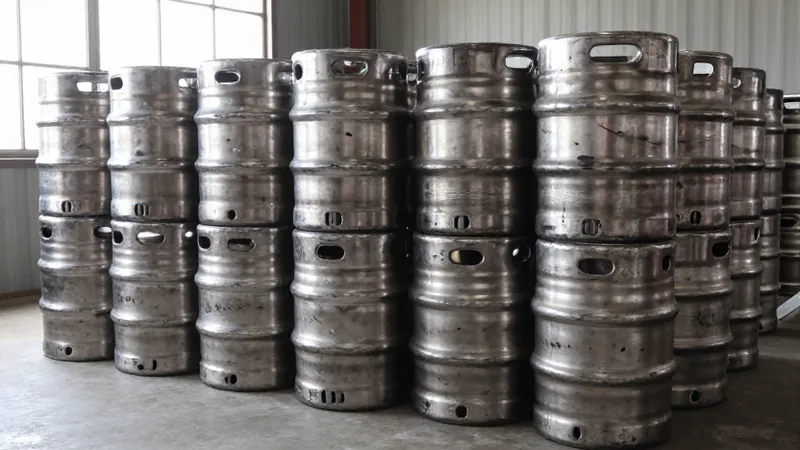
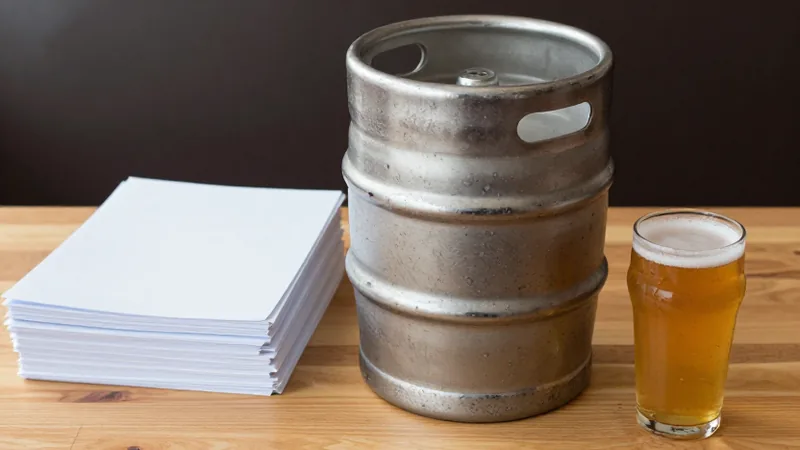
Federal beer excise tax is three posted rates, not a single national price. Alcohol and Tobacco Tax and Trade Bureau lists $3.5, $16.0, and $18.0 per barrel for calendar years 2018 to the present. The barrel in that table is the unit in eCFR: 31 U.S. gallons. It is not the keg in the cooler. A half-barrel keg holds 15.5 gallons, which is half of 31, so two half-barrels are one tax barrel. A sixth-barrel holds about 5.16 gallons, and six of those are one tax barrel. People mix those package sizes up with the tax unit. The tax is computed on barrels removed, then you can translate the result into gallons or into a 12 ounce bottle if you want a smaller picture. This page does that translation and stops there. It is not a filing guide, and it is not the state excise tax. State rates are a separate map, in the state beer tax guide.
The $3.5 rate is the narrow one. Alcohol and Tobacco Tax and Trade Bureau gives it to beer produced and removed by a domestic brewer who produces 2000000 barrels or less in the calendar year, and only on the first 60000 barrels. The production test and the removal band are different gates. A brewer can produce 2000000 barrels and still owe the higher small-brewer rate on everything after barrel 60000. Cross 60000 and the same brewer pays $16.0 on the rest of that reduced schedule. A brewer who produces more than 2000000 barrels does not get the $3.5 band. That larger brewer, if they produced the beer, and an electing importer with a foreign brewer's assignment, gets $16.0 on the first 6000000 barrels. Six million barrels is the top of that assigned or large-brewer reduced band on the TTB table. It is not a statement about what counts as a craft brewer. The Brewers Association uses a 6 million barrel line for a different definition, covered in the craft-brewer article on this site.
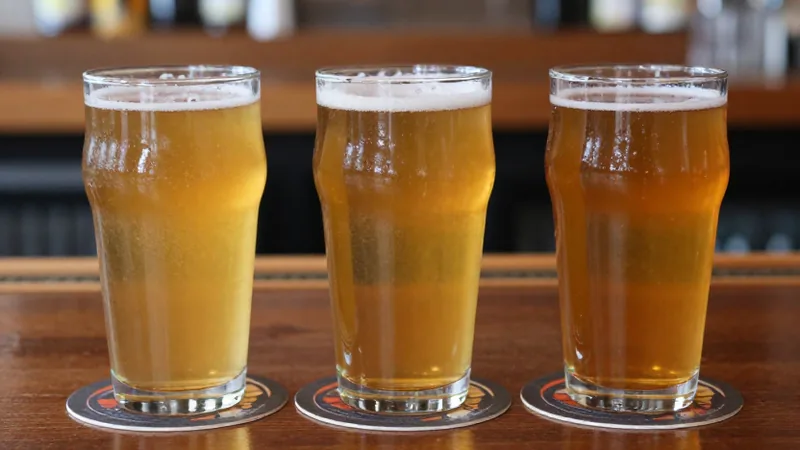
The $18.0 figure is the general rate. Alcohol and Tobacco Tax and Trade Bureau applies it to every barrel removed by a domestic brewer who did not produce the beer, by a U.S. importer with no reduced-rate assignment, and by anyone who has already used the reduced-rate entitlement for the year. The "did not produce" line matters for contract and alternating-proprietorship beer. The brand owner and the brewery that fermented the batch are not always the same taxpayer. This article does not sort a particular contract. If you remove beer you did not produce, the table's general rate is the one to read first. The same page warns that controlled groups and single-taxpayer arrangements can limit reduced rates, and it points readers to the CBMA instructions. Do not apply the unadjusted bands to a controlled group and call the result a tax return. The numbers below assume the brewer is allowed to use the schedule as printed.
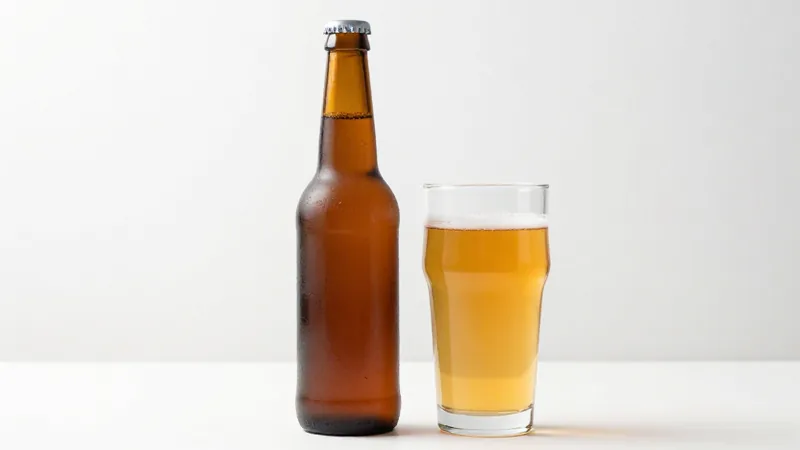
Divide the general rate by the gallons in a barrel. $18.0 split across 31 gallons is $0.5806 a gallon. The $16.0 rate is $0.5161 a gallon. The $3.5 rate is $0.1129 a gallon. A U.S. gallon is 128 fluid ounces, so a 12 ounce bottle is 12/128 of a gallon. At the general rate that bottle carries $5.44 cents of federal beer excise tax. At the $3.5 rate the same bottle carries $1.06 cents. Both cent figures are the formula in the fact sheet, rounded to the nearest hundredth of a cent's dollar... they are cents, rounded to two decimals. They are not the shelf price. They do not include state tax, distributor margin, or sales tax. A six-pack at the general rate is six times $5.44 cents, which is 32.66 cents of federal tax before any other charge. A case of 24 is 24 times that bottle figure, $1.306 of federal tax at the general rate. Useful for a back-of-the-envelope check. Useless as a price quote.

A few removals, worked on the small-brewer schedule
Take 1,000 barrels from a brewer who produces well under 2000000 and who produced the beer. All 1,000 sit inside the first 60000, so the tax is 1,000 times $3.5, or $3,500. Take 10,000 barrels on the same schedule: still inside the first band, 10,000 times $3.5 is $35,000. Take exactly 60000 barrels: 60000 times $3.5 is $210,000. The next barrel, number 60,001, is the first one at $16.0.
A removal of 70,000 barrels on that small-brewer schedule is two pieces. The first 60000 barrels at $3.5 are $210,000. The other 10,000 barrels at $16.0 are $160,000. Together that is $370,000. The same 70,000 barrels at the general $18.0 rate, if the reduced schedule does not apply, are 70,000 times 18, or $1,260,000. The gap between those two bills is why the band exists, and why it is worth reading the "who produced the beer" line before you use the smaller number.
A removal of 100,000 barrels on the small-brewer schedule is 60000 times $3.5 plus 40,000 times $16.0: $210,000 plus $640,000, or $850,000. At $18.0 straight through, 100,000 barrels are $1,800,000. None of these examples is a filled-in TTB form. Each one is multiplication of the posted rate by a barrel count that sits in a named band.
Get the beer data notes
Brewers Association and TTB figures as they are published, with the source for every number. Free, unsubscribe from any email.
No fixed schedule. Unsubscribe from any email. 21+ only.
The 6 million barrel band, as arithmetic
A brewer who produces more than 2000000 barrels, and who produced the beer, does not use the $3.5 row. On the TTB table that brewer pays $16.0 on the first 6000000 barrels. One million barrels at $16.0 is $16,000,000. Two million barrels at that rate, for a brewer who does not qualify for the small-brewer row, is $32,000,000. The same two million barrels on the small-brewer schedule, which this brewer cannot use once production is over 2000000, would have been 60000 times $3.5 plus the rest at $16.0. That comparison is only a way to see the size of the first band. It is not a tax plan, and it ignores controlled-group limits the TTB page flags.
An importer with no assignment pays $18.0 on all barrels. Ten thousand imported barrels at that rate are $180,000. The same ten thousand, if a foreign brewer had assigned a reduced rate and the importer elected to use it, could fall in the $16.0 row instead, for $160,000, until the assignment and the 6000000 cap say otherwise. The $20,000 gap on that example is 10,000 times the $2 difference between $18.0 and $16.0. Assignment rules are on the TTB page. This paragraph only multiplies the two rates.
Per gallon, the three rates stay $0.1129, $0.5161, and $0.5806. Multiply any of those by 31 and you are back at the per-barrel rate, within rounding. $0.5806 times 31 is 18.00 dollars when you undo the four-decimal rounding. That check is how you know the gallon split did not drift.
What the table does not say
The TTB page says the rates are for information and that the real tax can differ. It says some reduced rates exist only if you meet production, processing, or foreign-assignment tests. It says a controlled group can change the answer. It does not say a taproom price should be any particular number. It does not say a state may not charge its own excise tax on top. It does not convert the barrel into kegs for you. The 31-gallon definition is in the regulations, and the package sizes brewers actually fill are in the keg size guide.
If you only remember three sentences, remember these. The tax barrel is 31 gallons. The printed rates are $3.5, $16.0, and $18.0. The $3.5 rate covers only the first 60000 barrels, and only for a domestic brewer who produces 2000000 barrels or less and who produced the beer being removed. Everything else on the page is a limit on those sentences.
Frequently Asked Questions
What are the federal beer excise tax rates per barrel?
TTB lists $3.5 on the first 60000 barrels for a qualifying small domestic brewer, $16.0 on the rest of that small-brewer schedule and on the first 6000000 barrels in the large-producer or assigned-importer row, and $18.0 when the reduced rate does not apply. Source: Alcohol and Tobacco Tax and Trade Bureau.
How many gallons are in the barrel used for this tax?
eCFR defines a barrel, as a unit of measure, as 31 U.S. gallons. That is the barrel the per-barrel rates divide into.
Does the $3.50 rate cover every barrel a small brewer removes?
No. It covers the first 60000 barrels in the calendar year for a domestic brewer who produces 2000000 barrels or less and who produced the beer. Further barrels on that schedule are at $16.0.
How much federal tax is in a 12 ounce bottle at the general rate?
About 5.44 cents. That is $18.0 divided by 31 gallons, times 12/128 of a gallon, times 100 to reach cents. At the $3.5 rate the same bottle is about 1.06 cents.
Does this include state beer tax?
No. These are federal rates from TTB. State excise taxes are separate. See the state beer tax guide.
Sources
- Tax Rates. Alcohol and Tobacco Tax and Trade Bureau.
See the related article: /blog/home-beer-production-gallon-limits