Great American Beer Festival competition statistics and entries. See gabf-2025-competition-numbers See history-of-us-craft-beer
The 2025 Great American Beer Festival winners page does more than list medals. Its statistics block says judges evaluated 8315 beers, and that the average category held 71 entries. The busiest beer category was category 107, Juicy or Hazy India Pale Ale, with 301 entries. West Coast India Pale Ale followed at 300. Brewers Association is an archive of that Brewers Association page captured on 15 October 2025. Checked on 2026-10-27, the live association path redirected to the festival homepage and no longer served these sentences, so the citation is the archive of the winners page rather than the redirect.
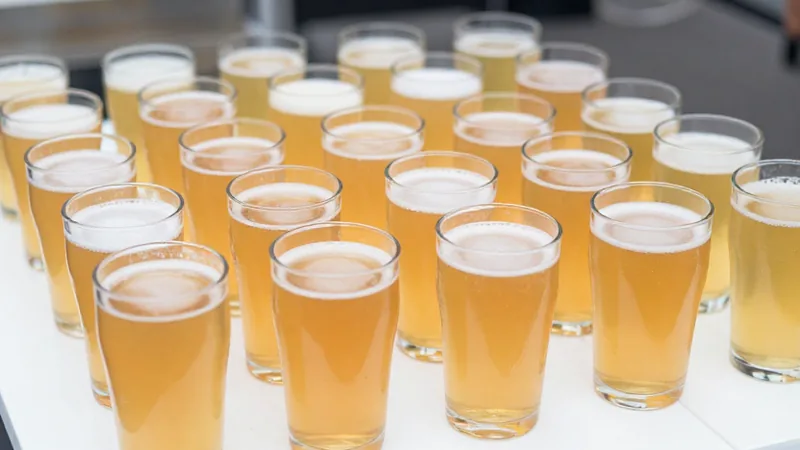
The page then names the five most-entered beer categories: Juicy or Hazy IPA at 301, West Coast IPA at 300, Dortmunder or German-style Oktoberfest at 186, German-style pilsener at 184, and hoppy lager at 171. Those five sum to 1142 entries, which is 13.73 percent of the 8315 beers judged. The hazy category alone is 3.62 percent of beers judged, and it is 4.24 times the 71 entry average. 301 minus 300 is 1 entry. The two IPA categories are adjacent, not in different leagues. The chart is those five counts. It is not a quality ranking.
Collaboration, Pro-Am, and cider are different rows
The opening paragraph of the archived release says the 8315 beer and cider entries include 68 Collaboration submissions and 40 Pro-Am submissions. Those are submission types inside the total, not extra categories on the five-bar chart. The statistics block also says the competition had 6 cider categories and 3 new categories: Vera Hop, Mexican-style pale lager, and international amber lager. The most-entered cider category on the page is fruited cider at 53 entries. 53 is an entry count, like the beer bars, but it is cider, so it stays off the beer chart. Putting it on the same axis would look like a sixth beer style.
Get the beer data notes
Brewers Association and TTB figures as they are published, with the source for every number. Free, unsubscribe from any email.
No fixed schedule. Unsubscribe from any email. 21+ only.
What a medal is, and what this page will not copy
The archive lists a gold, a silver, and a bronze under each of those busy categories. Copying that whole medal table would only repeat the association's list. The count is the part that answers "what was crowded." For the record, the archive names TourBus Double Dry Hopped Hazy IPA from DESTIHL Brewery in Normal, Illinois, as the gold in the 301 entry category. That is one result the page records. It is not a claim that the beer is healthier, safer, or the one anyone should drink. A medal is a competition result among the entries that showed up. 301 entries in one category means a lot of beers were judged against each other. It does not mean a reader should seek out 301 pints.
The competition totals article keeps the edition, the judge count, the medal count, and the first-time counts. This page does not rebuild those. It uses 8315 only as the denominator under the category bars. If you cite a category, cite its own count: 301, 300, 186, 184, or 171. If you cite the average, cite 71. Dividing a medal by 71 does not produce an odds figure the page published. The page did not print a probability. 4.24 is this sheet's division of the hazy count by the printed average, rounded to two decimals, so a reader can see the multiple. It is not a forecast for the next festival.
How to read the chart without inventing a trend
301 and 300 are IPAs. 186, 184, and 171 are lagers of different names. The page does not say IPA "won" or lager "won." It says which categories received how many entries. A category with fewer entries can still medal three beers. The medal count per category is not on this chart. Busy means entered, not awarded. Collaboration's 68 and Pro-Am's 40 are easy to misread as category sizes. They are labeled submissions in the sentence that also contains 8315. Keep the noun. Entries, submissions, categories, and medals are four units the page is careful about, and this article follows that care.
The tool multiplies a selected count by a number you type. Multiplying 301 by a number of years does not predict the next hazy flight. The archive is one edition. The temperature and tax pages on this site are equally unwilling to turn one published figure into a forecast, and this page is the same. Leave the multiplier at one if you only wanted to see 301 beside 300. The one-entry gap, 1, is the whole distance between those two bars.
A walk through the five bars
Start at the right-hand end of the chart only after you have read the left-hand end, because the story is the gap, not the winner's name. 301 and 300 differ by 1 entry. That is the entire IPA argument the page's own counts support: two very large categories, almost the same size. The next bar, Oktoberfest at 186, is a long step down. Pilsener at 184 sits beside it. Hoppy lager at 171 is the last of the five and still well above the printed average of 71. If you only remember one comparison, remember 301 against 71, which this sheet states as 4.24 times, rounded to two decimals. If you remember a second, remember that five categories hold 1142 entries, 13.73 percent of the 8315 beers judged. The other categories share the rest. The page's average of 71 already told you the typical category is much smaller than the hazy bar. The percent makes that concrete.
Do not turn 13.73 into a claim about sales. An entry is a beer sent to a competition, not a barrel sold and not a tap handle. A brewery can enter one beer in a busy category and many beers in quiet ones. The statistics block does not give entries per brewery inside category 107. The competition totals article has the count of breweries and cideries in the whole competition. It does not have a per-category brewery count either. Leave that cell blank. Inventing it would be a new number, and this page does not publish new numbers except the five divisions written on the fact sheet.
Collaboration and Pro-Am need the same restraint. 68 collaboration submissions and 40 Pro-Am submissions are inside the 8315 figure the release names in one sentence. Adding them on top of 8315 would double count. Adding them to 1142 would mix a submission type with a style category. The cider side is similar. 6 cider categories and a busiest cider category of 53 fruited-cider entries are real lines on the page. They answer a cider question. They do not move the beer bars. 3 new categories, named on the page as Vera Hop, Mexican-style pale lager, and international amber lager, explain that the category list is not identical to the prior year. They do not come with entry counts in the statistics block this article uses, so they do not get bars. A category without a printed count stays off the chart.
The gold named earlier is one medal in one category. The archive also names a silver and a bronze, and it names medalists for the other four busy categories. Those names are on Brewers Association. Repeating all of them here would turn this page into a second copy of the winners list. The useful original work is the arithmetic: the one-entry gap, the five-category sum, and the share of 8315. If you need the medalists, open the archive. If you need the crowding, stay on this chart. Either way, a medal is not a health claim, not a reason to drink more, and not evidence about any state. The competition-totals article is the place for the size of the field. This article still does not split 301 by state, because the category lines do not.
Checked on 2026-10-27. The Brewers Association page is cited through Brewers Association because that archive still contains the statistics block and the five category lines. If the association republishes the same sentences at a stable URL, a later edit can point there. Until then, do not cite the festival homepage as the source of 301 or 71. The homepage is a different document. Numbers in this sheet that are not printed on the archive are the derived ones: 1142, 13.73, 3.62, 4.24, and 1. Each formula is on the fact sheet. No state-by-state split is included, because this archive's statistics block does not give one.
How to use each figure
301 entries in category 107 is the largest beer category the page lists. 300 is one entry behind, the gap 1. 4.24 is 301 divided by the printed average of 71, rounded to two decimals.
1142 is the sum of the five beer bars. 13.73 percent is that sum divided by 8315 beers judged. Collaboration (68) and Pro-Am (40) sit inside the total and are not bars. Fruited cider at 53 is the cider note, off the beer chart.
Frequently Asked Questions
Which 2025 GABF beer category had the most entries?
Category 107, Juicy or Hazy India Pale Ale, with 301 entries. Source: Brewers Association.
How did that compare with the average category?
The page says the average category had 71 entries. 301 divided by 71 is 4.24, rounded to two decimals.
How many entries did the five busiest beer categories hold together?
1142, which is 13.73 percent of the 8315 beers judged.
Does a high entry count mean the medal beer is better for you?
No. An entry count is how many beers were judged in that category. A medal is a competition result, not a health claim.
Sources
- 2025 GABF Winners, archived 15 October 2025. Brewers Association.