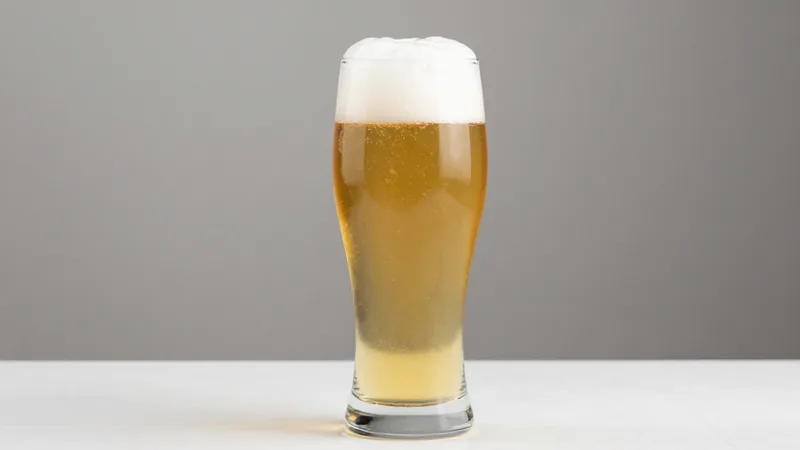
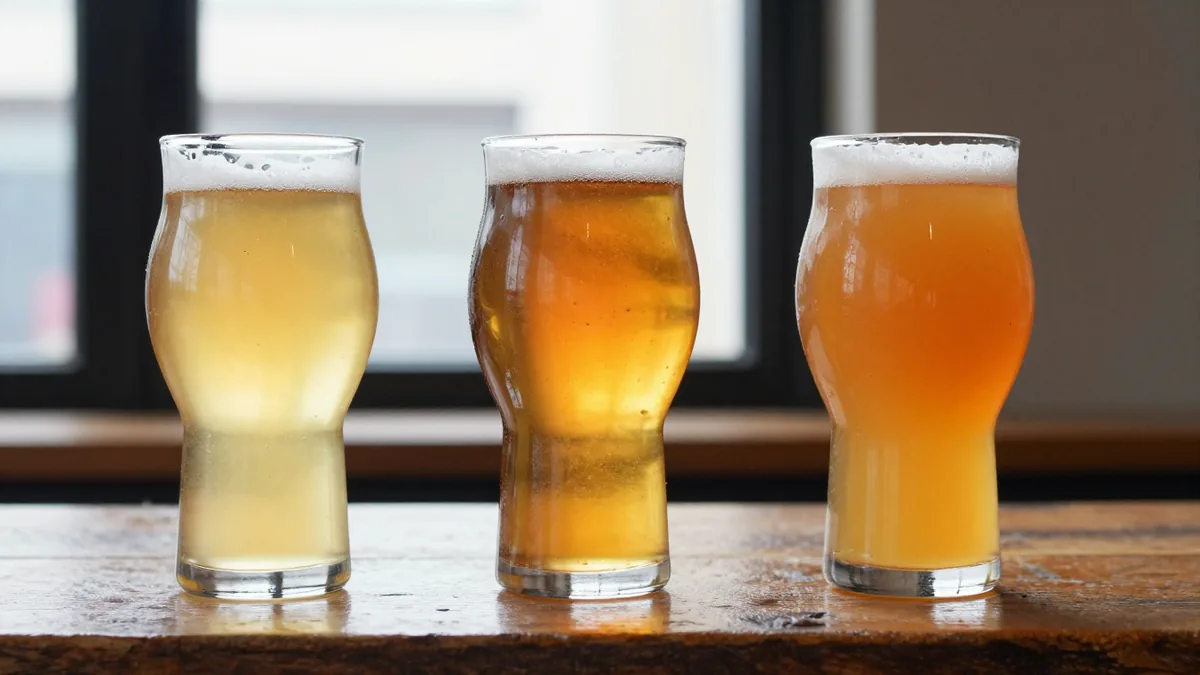
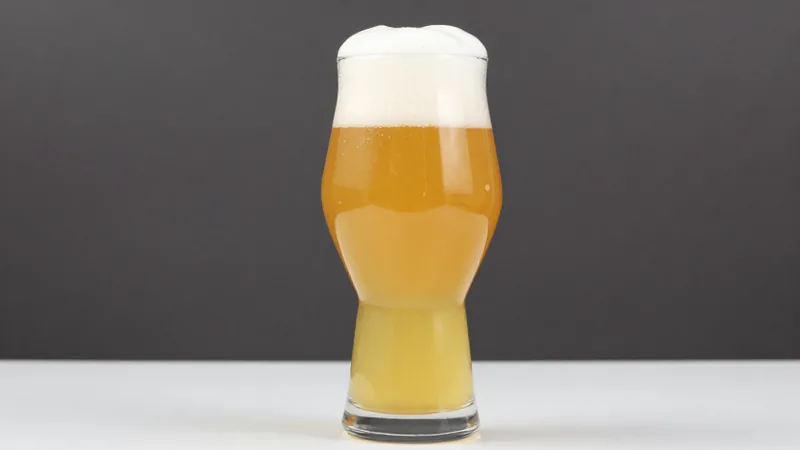
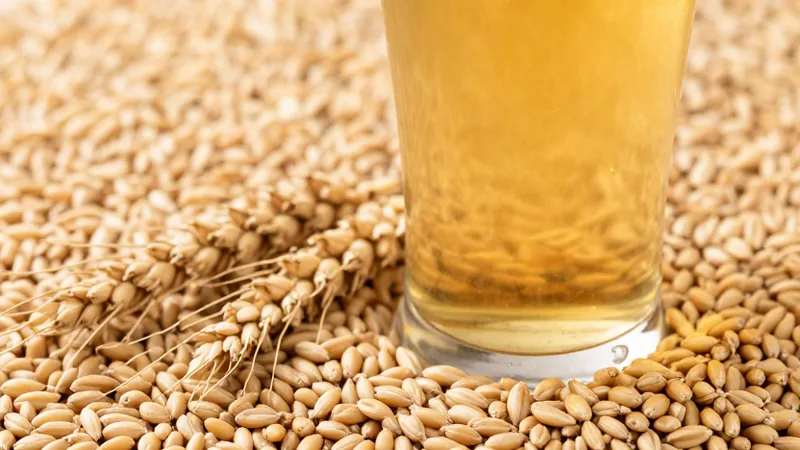
Weissbier, BJCP 2021 style 10A, is the pale German wheat beer whose vital statistics stay low in bitterness and light in color. The page lists IBU 8 to 15, SRM 2 to 6, original gravity 1.044 to 1.053, final gravity 1.008 to 1.014, and alcohol 4.3 to 5.6 percent by volume. Beer Judge Certification Program is that page. The chart is the IBU pair. 7 IBU from 8 to 15 is a short box next to a German pils, which is allowed to run much higher. Color runs 4 SRM from 2 to 6. The beer in the photographs is cloudy gold because that is the ordinary look of the style. Cloudiness is not an SRM. SRM is the printed color range. Haze is a separate impression, and this article does not assign it a number the page does not print.
Alcohol sits at 4.3 to 5.6 percent, a width of 1.3 percentage points. That is the style's strength box for a judge. It is not a statement that wheat beer is light in any nutritional sense, and it is not permission or advice to drink a particular number of glasses. Original gravity 1.044 to 1.053 and final gravity 1.008 to 1.014 are specific-gravity ranges. They are not a sugar target and not a Balling conversion. Commercial examples on the page include Weihenstephaner Hefeweissbier and Ayinger Bräu Weisse. The guide lists them as examples. This page does not rank them and does not tell you which to order.
Set it beside German pils without merging the styles
German pils, style 5D, shares a pale color and a similar alcohol neighborhood, and its own page is here. The bitterness boxes do not match. Weissbier stops at 15 IBU. A pils that is inside its own IBU box can sit well above 15. If you only compared color, 2 to 6 SRM overlaps the pale end of other lagers. Color overlap is not the same style. Wheat beer in this guideline is also top-fermented. The attribute list on the page says so. This article does not turn that word into a yeast pitch rate. There is no cell count in the vital statistics. Do not invent one.
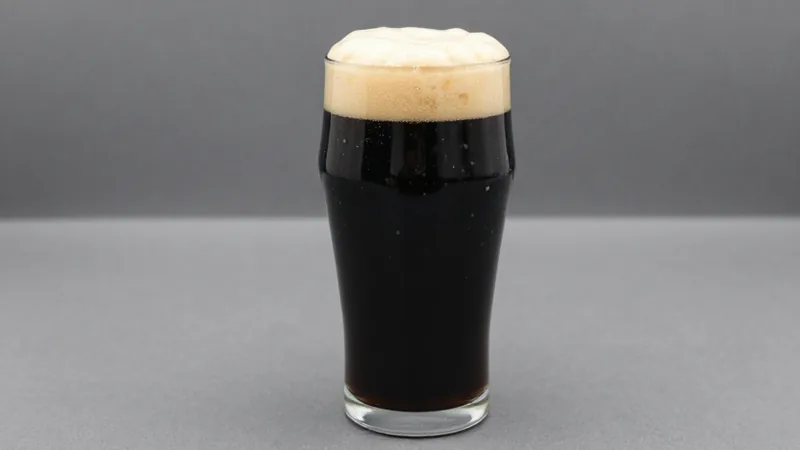
Irish stout is the contrast in the other direction: dark, with an SRM floor far above 6. Its page is here. A beer cannot be inside both color boxes at once. That is useful in a flight. It is not a reason to call one of them better. Different boxes are different styles.
Get beer science and style notes
How beer gets its bitterness, color and aroma, explained with numbers and sources. Free, unsubscribe from any email.
No fixed schedule. Unsubscribe from any email. 21+ only.
Yeast character is not a number on this line
Weissbier is known for clove and banana impressions from the yeast. The vital-statistics line does not print a milligram of either compound, so this fact sheet does not have one. If a lab report gives those compounds, cite the lab report. Do not hang them on style 10A's IBU line. The numbers you can check against the guideline without another source are 8, 15, 2, 6, 1.044, 1.053, 1.008, 1.014, 4.3, and 5.6. Derived widths are 7 IBU, 4 SRM, and 1.3 percentage points. Widths are not ideals. The guideline does not say the center of the IBU box is more correct than 8 or 15.
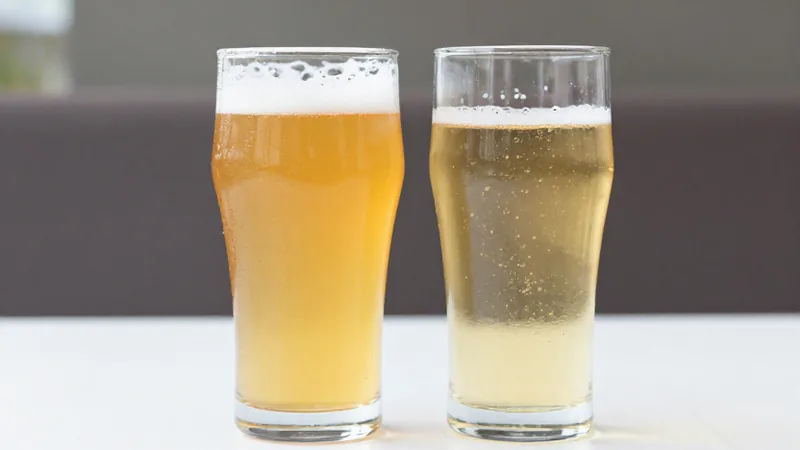
A competition entry outside the box can still be a wheat beer someone wants to drink. The box is for placing the entry in 10A. Brewers brew outside boxes on purpose. Nothing in the vital statistics makes that illegal, unsafe, or required. Federal limits on home production, when that is even the question, are in 27 CFR 25.205 and on this site's home-production page. Style 10A does not change those limits and does not suggest producing up to them. It also does not say a cloudy beer has gone bad. Haze is part of how this style presents. Infection and haze are not the same observation, and this page does not give you a test for telling them apart. That would be a lab method, not a style range.
The tool multiplies a selected statistic. 15 times a number of kegs is not a hopping recipe. 5.6 times a number of glasses is not an intake plan, and the control is not there to build one. It shows the published end, times one, unless you change the quantity. If you change the quantity, you are doing arithmetic on a style statistic. Say so. Do not call the product a BJCP number. The BJCP numbers are the ends themselves.
What to write on a score sheet, and what to leave off
The numbers that can move from this page to a score sheet without a second source are the ends. IBU 8 to 15. SRM 2 to 6. Original gravity 1.044 to 1.053. Final gravity 1.008 to 1.014. Alcohol 4.3 to 5.6 percent. If you want the width instead of the ends, use the derived figures and say they are widths: 7 IBU, 4 SRM, 1.3 percentage points. Do not write a clove level, a banana level, a wheat percentage, or a yeast generation. Style 10A's vital statistics do not include them. A brewer's wheat bill is a recipe. The guideline's impression of clove and banana is description. Both can be discussed. Neither becomes a fact on this sheet by being famous.
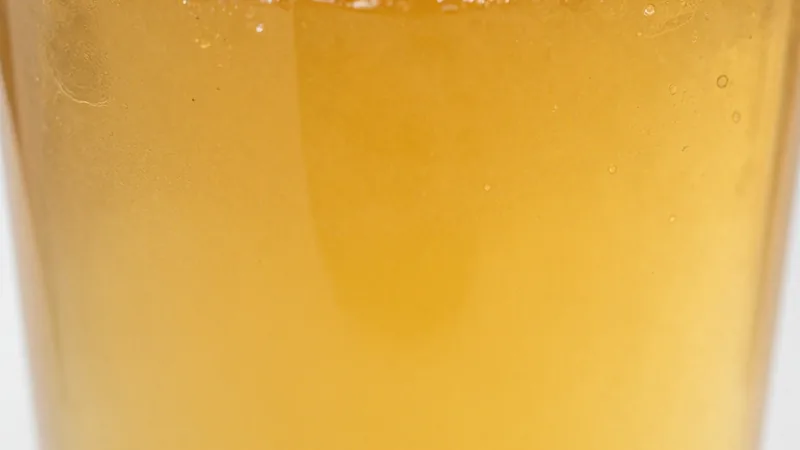
Haze gets the same treatment. The photographs show a cloudy gold beer because that is the usual presentation, and the alt text says cloudy or hazy. The fact sheet does not convert haze into SRM and does not add a turbidity unit. 6 SRM is still the top of the color box even when the glass is opaque with yeast. A clear beer can be inside the color numbers and outside the style's expected look. A cloudy beer can be inside the color numbers too. Look is judged in the glass. The number is judged against the line. Keep both, and do not pretend one replaces the other.
If you are entering a competition, write the edition on the sheet before you write the numbers. These ends are 2021. A competition that specified an older handbook is not bound by 8 or 5.6. A competition that uses BJCP 2021 and then names a different wheat style, such as a dunkles weissbier, is not bound by style 10A either. The style number matters as much as the name. 10A is this pale weissbier. Do not carry 6 into a darker wheat style and claim this page authorized it. Open that style's own vital statistics. The same rule keeps 15 from being used as a cap on every wheat beer in the world. It is the cap inside 10A. Outside 10A it is just a number you learned here. Say the style code in the same breath as the range so the number cannot travel alone. Style 10A is the name that keeps 8 and 15 from being quoted as if they covered every wheat beer.
Set the style next to the other two on this site when you are teaching the difference, not when you are blending them. German pils is allowed a much higher IBU ceiling than 15. Irish stout is allowed an SRM floor far above 6. Weissbier is the low-bitterness, pale, wheat beer of the three. That sentence is a comparison of three published boxes. It is not a flight recommendation and not a ranking. Nobody needs to drink one of each to understand the subtraction 15 minus 8. The tool will do that subtraction's result for you: it is already stored as 7. Multiplying 7 by anything else does not improve it.
Checked on 2026-10-27 against Beer Judge Certification Program. The 2015 past revision linked from the page is not the source of these figures. Score with the edition the competition named. For a 2021 sheet, the weissbier line is IBU 8 to 15, SRM 2 to 6, OG 1.044 to 1.053, FG 1.008 to 1.014, and ABV 4.3 to 5.6 percent. Two commercial examples are named above so the style is anchored in beers the guide itself points at. The rest of the example list stays on the source page rather than being copied here.
How to use each figure
8 to 15 IBU is the whole bitterness box, 7 IBU wide. That is the chart. It is intentionally low next to a pils.
Color is 2 to 6 SRM, 4 SRM wide. Alcohol is 4.3 to 5.6 percent, 1.3 percentage points wide. Gravity is 1.044 to 1.053 original and 1.008 to 1.014 final.
Frequently Asked Questions
What IBU range does BJCP 2021 give weissbier?
8 to 15 IBU. Source: Beer Judge Certification Program.
What is the color range?
2 to 6 SRM, a width of 4 SRM.
What alcohol range is listed?
4.3 to 5.6 percent by volume, 1.3 percentage points wide. It is not a recommended amount to drink.
Does the vital-statistics line include a clove or banana measurement?
No. Those impressions are not given as numbers on the line this article cites. The checkable figures are the IBU, SRM, gravity, and ABV ranges above.
Sources
- 2021 BJCP Style Guidelines, 10A Weissbier. Beer Judge Certification Program.