IPA style comparisons and varietal differences. See what-is-ibu-does-it-predict-bitterness
By the BJCP 2021 guidelines, an American pale ale runs 4.5–6.2% ABV and 30–50 IBU, an American IPA 5.5–7.5% and 40–70 IBU, and a hazy IPA 6–9% and 25–60 IBU. A hazy IPA is stronger than an American IPA on paper but allowed far less bitterness, and its color tops out at 7 SRM. The real split between the three is balance and appearance, not one number.
The short version
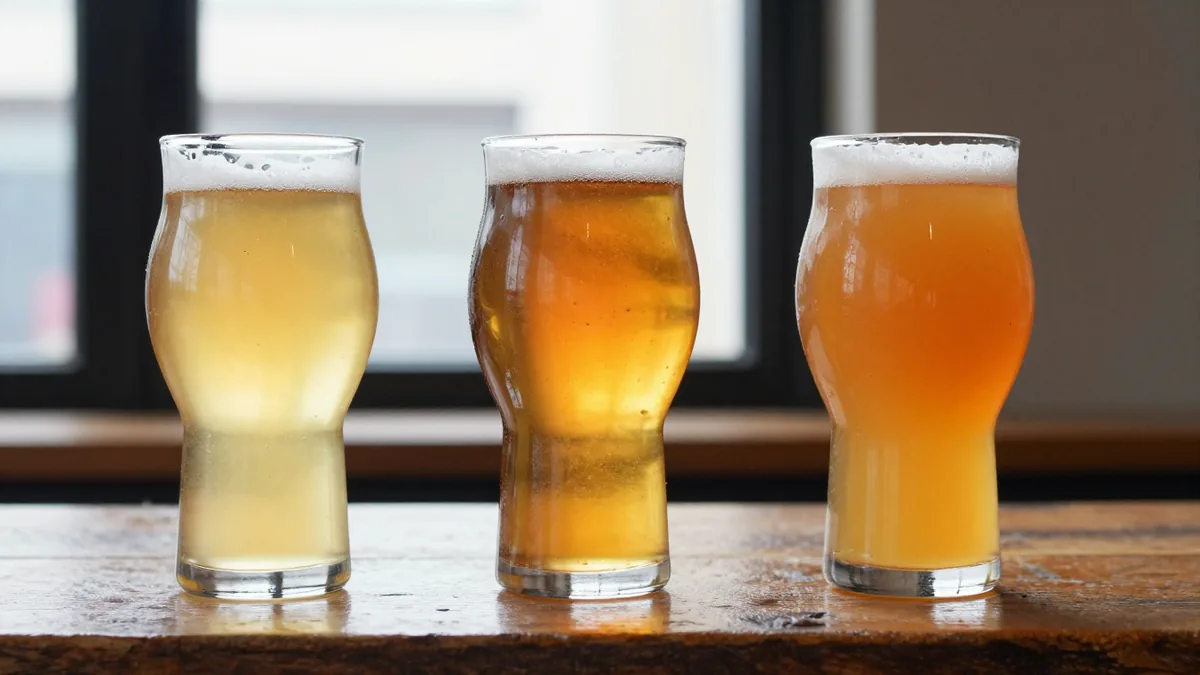
All three are pale, hop-forward ales. The differences:
- Pale ale is the weakest of the three and less bitter than American IPA. The BJCP calls modern American versions "often just lower gravity IPAs."
- American IPA is stronger and more bitter, with a dry finish. "Dry, sharply bitter, clear examples are sometimes known as West Coast IPA," per the BJCP 21A page.
- Hazy IPA (also called New England IPA or NEIPA) trades bitterness for fruit-forward hop aroma, a softer, fuller body and a hazy, often opaque look.
Below are the exact ranges, where they overlap, and a tool that tells you which style your own beer fits.
Get beer science and style notes
How beer gets its bitterness, color and aroma, explained with numbers and sources. Free, unsubscribe from any email.
No fixed schedule. Unsubscribe from any email. 21+ only.
Vital statistics side by side
We pulled the vital statistics from each BJCP 2021 style page and the session IPA numbers from the Brewers Association 2026 Beer Style Guidelines, because the BJCP has no standalone session IPA style. Its 21B Specialty IPA entry only asks entrants to name a strength: "session, standard, double."
| Style | Guide | OG | FG | ABV | IBU | SRM |
|---|---|---|---|---|---|---|
| American Pale Ale (18B) | BJCP 2021 | 1.045–1.060 | 1.010–1.015 | 4.5–6.2% | 30–50 | 5–10 |
| English IPA (12C) | BJCP 2021 | 1.050–1.070 | 1.010–1.015 | 5–7.5% | 40–60 | 6–14 |
| American IPA (21A) | BJCP 2021 | 1.056–1.070 | 1.008–1.014 | 5.5–7.5% | 40–70 | 6–14 |
| Hazy IPA (21C) | BJCP 2021 | 1.060–1.085 | 1.010–1.015 | 6–9% | 25–60 | 3–7 |
| Double IPA (22A) | BJCP 2021 | 1.065–1.085 | 1.008–1.018 | 7.5–10% | 60–100 | 6–14 |
| Session IPA | BA 2026 | 1.008–1.052 | 1.005–1.014 | 0.5–5% | 20–55 | 3–12 |
OG and FG are original and final specific gravity. ABV is alcohol by volume (see ABV explained). IBU is International Bitterness Units, a lab measure of dissolved bitter compounds (see what IBU does and does not predict). SRM is the color scale: lower is paler.
Strength: where the ranges overlap
Each ABV range overlaps the next one up:
- Pale ale and American IPA share 5.5–6.2% ABV. A 6.2% beer fits both.
- Hazy IPA starts 0.5 points higher than American IPA (6% vs 5.5%) and runs to 9%, into double IPA territory.
- Double IPA begins at 7.5%, exactly where American IPA ends.
- Session IPA, by the Brewers Association rule, stops at 5%: "Beers exceeding 5.0% abv are not considered Session India Pale Ales."
So strength alone rarely settles the question. A 6.5% beer fits English IPA, American IPA and hazy IPA ranges at once.
Bitterness: the hazy IPA break
Bitterness is where hazy IPA splits from the rest of the IPA family:
- American IPA requires at least 40 IBU. Hazy IPA can go as low as 25, a floor 15 IBU lower.
- Hazy IPA tops out at 60 IBU, 10 below the American IPA ceiling of 70.
- Pale ale and American IPA overlap from 40 to 50 IBU.
- Double IPA runs 60–100 IBU, the widest range on the chart.
The Brewers Association is stricter on hazy bitterness. Its 2026 Juicy or Hazy India Pale Ale style allows 20–50 IBU, 10 IBU below the BJCP ceiling, and adds that IBU "may differ significantly from perceived bitterness." Its American-Style IPA sits at 50–70 IBU and 6.3–7.5% ABV, a narrower window than the BJCP version.
The BJCP says the same thing in words: hazy IPA has "less perceived bitterness than traditional IPAs but always massively hop-forward." The hop load goes in late, mostly as dry hops, so it adds aroma and flavor without adding much measured bitterness. Hop varieties matter more than hop weight here; our US hop production breakdown shows which varieties American growers harvest most. For named IPA examples, our 13-listing Albuquerque guide includes Boxing Bear's Headlock Hazy IPA and Uppercut IPA. Among the eight listings in our Buffalo guide, Community Beer Works describes a range spanning IPAs, stouts and lagers, rather than a brewery defined by one hop-forward style.
Taste Match on the recommendations page files a request for any of the three under one hoppy flavor family, read from the brewery's own description, and it never asks about the 20–50 versus 50–70 IBU split above, so a reader who wants that difference has to write bitter and crisp rather than just hoppy.
Why hazy IPA looks different
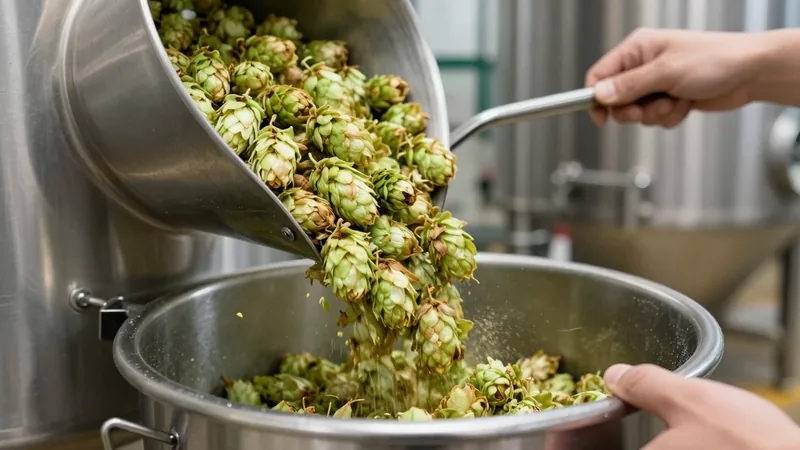
Color and clarity are the fastest tell:
- Hazy IPA: 3–7 SRM, "straw to very light amber." Clarity is "hazy, often opaque," but "should not be cloudy or murky."
- American IPA: 6–14 SRM, "medium gold to light reddish-amber." "Clear, but light haze allowable."
- Pale ale: 5–10 SRM, "pale golden to amber," and "generally quite clear."
The haze has a specific cause. The BJCP 21C page says haziness comes from the interaction between polyphenols from dry-hopping and proteins from starchy grains, "not suspended yeast, starch haze, or other techniques." That is why hazy recipes use "more flaked grains and less caramel or specialty malts" and are "heavily dry-hopped, partly during active fermentation." Visible floating hop matter or yeast clumps count as faults.
Body follows the grist. Hazy IPA is "medium to medium-full body," while American IPA is "medium-light to medium body" with a "dry to medium-dry finish." The BJCP adds a line every hazy brewer should read: examples "suggestive of milkshakes, creamsicles, or fruit smoothies are outside this style."
Which style is my beer?
Enter your beer's ABV and IBU from the label or your brew log. Add SRM if you know it. The tool checks the six ranges above and lists every style that contains your beer. If none does, it names the closest one and says which number is out of range.
Try 6.5% and 45 IBU: it fits English IPA, American IPA and hazy IPA. That overlap is real, and it is why judges look at clarity, body and hop character before the spec sheet. Add an SRM of 3 and English IPA and American IPA drop out, because both start at 6 SRM.
Where each style came from
The order the styles appeared explains a lot of the overlap:
- English IPA. A pale stock ale from London first shipped to India in the late 1700s. The East India Company had Samuel Allsopp reformulate it in 1823 with Burton's sulfate-rich water, and the name India Pale Ale "wasn't used until around 1830," per the BJCP 12C history.
- American IPA. The BJCP credits Anchor Liberty Ale, first brewed in 1975 with whole Cascade hops, as the first modern American craft version.
- American pale ale. Sierra Nevada Pale Ale, first made in 1980, "helped popularize the style," per the BJCP 18B history.
- Double IPA. Developed in the mid-late 1990s; Russian River Pliny the Elder, first brewed in 2000, popularized it. That is 25 years after Liberty Ale.
- Hazy IPA. The BJCP names Alchemist Heady Topper as "the original inspiration," with the style growing through the 2010s in New England.
Each new style pushed one variable: more hops, more alcohol, then less bitterness and more haze. The older styles did not move to make room, which is why the ranges overlap.
How to order or brew the one you want
- Want bitter and crisp? Ask for an American or West Coast IPA. Look for 40+ IBU and a clear, gold glass.
- Want fruit aroma and low bite? Hazy IPA. Expect 6% ABV or more, so it is stronger than it tastes.
- Want hops at a lower strength? Pale ale (4.5–6.2%) or session IPA (up to 5%).
- Brewing at home? Hit the gravity first. A hazy IPA needs an OG of at least 1.060, while a pale ale can start at 1.045. Federal law (27 CFR 25.205) lets an adult brew 100 gallons a year in a one-adult household and 200 in a household of two or more adults, for personal or family use, not for sale.
The yeast is the same family for all three: clean or lightly fruity ale strains. For how ale yeast differs from lager yeast and why temperature matters, see lager vs ale yeast. Browse more styles at /styles.
Frequently Asked Questions
Is a hazy IPA the same as a New England IPA?
Yes. The BJCP 21C entry says hazy IPA is "also known as New England IPA or NEIPA." The style is named for its look; the region is where it started.
Is pale ale less bitter than IPA?
On paper, yes. Pale ale runs 30–50 IBU and American IPA 40–70 IBU, so they overlap only from 40 to 50. A hazy IPA can measure lower than a pale ale, down to 25 IBU. For brewery examples beyond the style ranges, our San Diego brewery guide lists 21 breweries, from Mission Brewery downtown to AleSmith in Miramar.
Why is hazy IPA stronger than regular IPA?
Its BJCP range starts at 6% ABV against 5.5% for American IPA, and its OG floor is 1.060 against 1.056. More flaked grain and a softer finish need more gravity to carry the hop load.
Our NEIPA process guide works inside the BJCP box: OG 1.060–1.085, FG 1.010–1.015, 25–60 IBU, a 2:3 sulfate-to-chloride water profile with each under 200 ppm, and 12 oz (340 g) of flaked oats in a 5 gal (19 L) batch.
What makes a session IPA a session IPA?
Strength. The Brewers Association caps it at 5% ABV and calls it a lower-alcohol version of any IPA style. Its IBU range is 20–55.
Is West Coast IPA a separate BJCP style?
No. The BJCP treats it as a type of American IPA (21A): "dry, sharply bitter, clear examples." The Brewers Association does list a separate West Coast-Style India Pale Ale in its 2026 guidelines.
Sources
- BJCP, 18B. American Pale Ale (2021 Style Guidelines), https://www.bjcp.org/style/2021/18/18B/american-pale-ale/ (checked 2026-10-01)
- BJCP, 21A. American IPA (2021 Style Guidelines), https://www.bjcp.org/style/2021/21/21A/american-ipa/ (checked 2026-10-01)
- BJCP, 21C. Hazy IPA (2021 Style Guidelines), https://www.bjcp.org/style/2021/21/21C/hazy-ipa/ (checked 2026-10-01)
- BJCP, 12C. English IPA (2021 Style Guidelines), https://www.bjcp.org/style/2021/12/12C/english-ipa/ (checked 2026-10-01)
- BJCP, 22A. Double IPA (2021 Style Guidelines), https://www.bjcp.org/style/2021/22/22A/double-ipa/ (checked 2026-10-01)
- BJCP, 21B. Specialty IPA (2021 Style Guidelines), https://www.bjcp.org/style/2021/21/21B/specialty-ipa/ (checked 2026-10-01)
- Brewers Association, 2026 Beer Style Guidelines, https://cdn.brewersassociation.org/wp-content/uploads/2025/12/12085737/2026BABeerStyleGuidelines.pdf (checked 2026-10-01)
- eCFR, 27 CFR 25.205 Production, https://www.ecfr.gov/current/title-27/section-25.205 (checked 2026-10-01)