All-in-One Electric Systems: A Homebrewer's Guide
Fill the unit to the maker's calculated mash volume, let the controller heat it, stir in the grain, and recirculate at 150-155°F (65-68°C) for about 60 minutes. Lift the basket, sparge, boil 60 minutes with the element, and chill through the counterflow or immersion chiller.
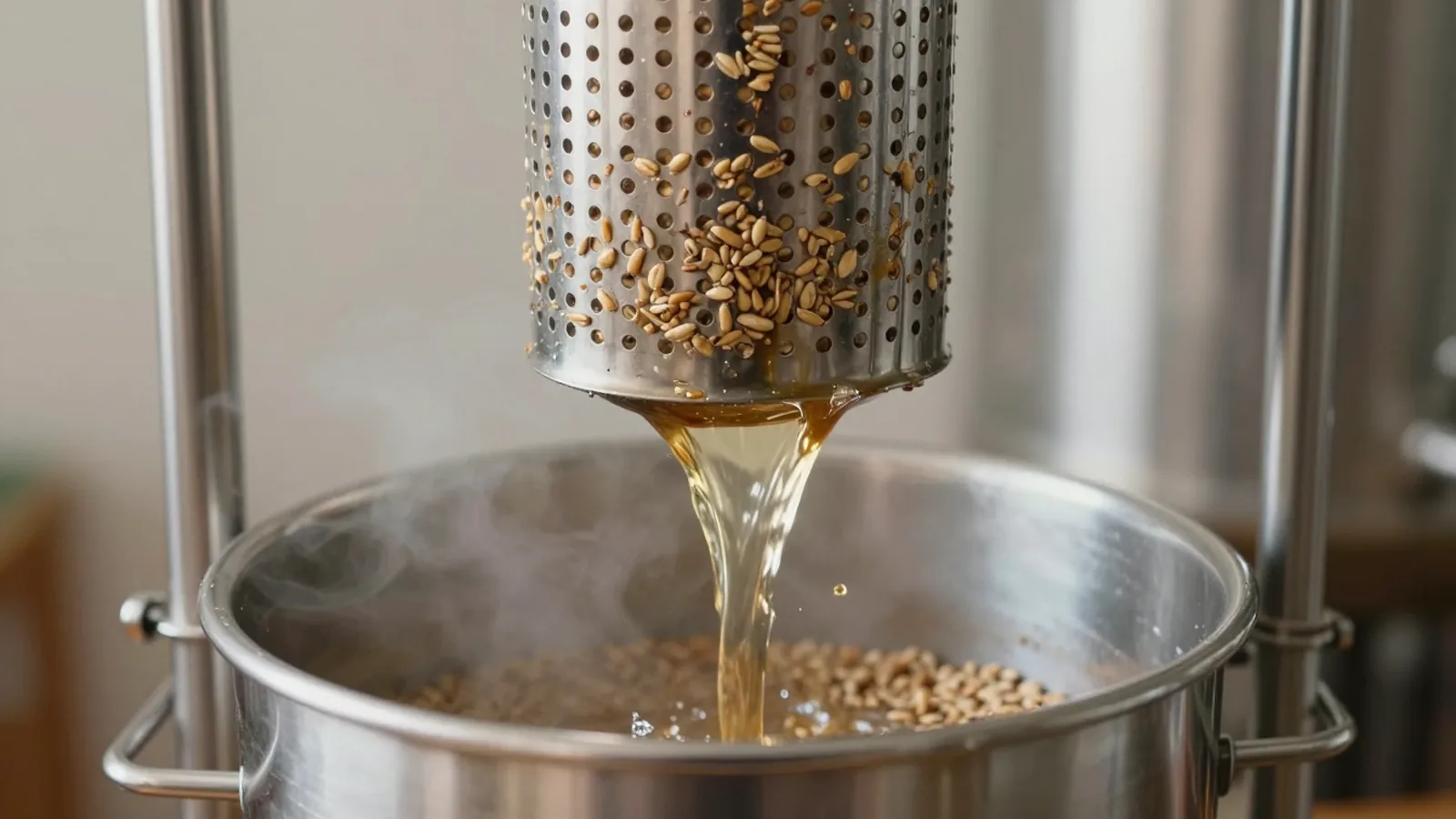
An all-in-one electric system is BIAB with the bag replaced by a perforated stainless basket, plus a built-in heating element, a temperature controller and usually a pump. You mash in the basket, the pump recirculates wort over the grain bed to keep the temperature even, then you lift the basket, sparge, and boil in the same vessel. Grainfather and Anvil Foundry are common examples. The Grainfather G40, as an example, is rated for batches of 10-40 L (2.6-10.6 gal) and 3-12 kg (6.6-26.5 lb) of grain, with a 46 L (12.2 gal) maximum pre-boil volume. Use one when you want all-grain control with less hardware, no propane, and mash temperatures that hold without babysitting. The controller makes step mashes and mash-outs a button press. It suits garages, basements and patios with a suitable outlet, and it cleans up as one vessel instead of three. The trade-offs are cost, power and capacity. Element wattage limits how fast you heat and how hard you boil; the G40's EU spec is 3300 W at 230 V, and smaller 120 V units heat more slowly. Grain capacity caps your strongest beers, and the basket design works more like BIAB than a fly-sparged tun. Electrics also need a GFCI-protected circuit rated for the unit.
At a Glance
Equipment
- All-in-one electric brewing unit with grain basket and pump
- Dedicated GFCI-protected circuit rated for the unit
- Separate pot or kettle for sparge water (unless the unit has one)
- Counterflow or immersion chiller
- Digital scale
- Hydrometer or refractometer
- Long paddle for stirring
- Fermenter, airlock and sanitizer
- Cleaning brush and non-caustic cleaner suitable for the element
Steps
- 1
Plan volumes
Enter grain weight and batch size into the maker's water calculator or app to get mash and sparge volumes.
Calculators assume a dead space and absorption for that unit. They are more accurate than generic BIAB numbers.
- 2
Fill and heat
Fill to the mash volume, seat the basket, and let the controller heat to strike temperature.
Start heating while you weigh and mill grain to save time.
- 3
Mash in
Stir the grain into the basket slowly, breaking up dough balls. Fit the top plate and recirculation arm if your unit uses them.
Add grain gradually. Dumping it all in at once makes dough balls the pump cannot break.
- 4
Recirculate the mash
Start the pump at a moderate flow and hold 150-155°F (65-68°C) for 60 minutes. Throttle the pump if wort pools on top of the grain.
If flow stalls, slow the pump and stir the top of the bed. Do not run it dry.
- 5
Mash out
Raise the setpoint to about 170°F (77°C) before lifting the basket to stop enzyme activity and loosen the wort.
The controller makes step mashes simple; use a mash-out when the grain bill is large.
- 6
Lift and sparge
Raise the basket and lock it on its support. Pour sparge water at 165-175°F (73-80°C) slowly and evenly over the grain until you reach pre-boil volume.
Pour gently over the whole surface. A single stream channels through the bed.
- 7
Boil
Remove the basket and boil 60 minutes with your hop schedule. Use the power setting to hold a steady rolling boil without boiling over.
Leave the lid off so DMS precursors boil away.
- 8
Chill and transfer
Chill through the counterflow chiller straight to the fermenter, or with an immersion chiller in the vessel, to pitching temperature. Aerate and pitch.
Run boiling wort through the counterflow chiller near the end of the boil to sanitize it.
- 9
Clean immediately
Rinse, then run a hot cleaning cycle through the pump and chiller. Do not let wort dry on the element.
Scorched wort on the element is the hardest cleaning job these units have.
Tips
- Measure your actual efficiency on the first three batches and update the recipe software. Basket systems vary by crush and sparge technique.
- Check the outlet before buying. 240 V versions heat and boil much faster than 120 V versions.
- Use a separate pot for heating sparge water, or brew with a full-volume no-sparge mash if your unit can hold it.
- Set a delayed heat timer, if the controller has one, so strike water is ready when you start.
- Keep the grain bill inside the maker's maximum. Overfilling the basket stalls recirculation.
- Use the controller for step mashes on wheat- or oat-heavy recipes.
Common Mistakes to Avoid
- Running the pump at full flow on a fresh mash and compacting the grain bed.
- Running the element on a circuit too small for its wattage, or without GFCI protection.
- Trusting the setpoint without checking the mash with a separate thermometer.
- Pouring sparge water in one stream and channeling through the grain.
- Letting the unit boil over at full power during the hot break.
- Leaving wort to dry on the element and inside the pump.