Brew in a Bag (BIAB): A Homebrewer's Guide
Heat your full water volume (pre-boil volume plus about 0.1 gal per lb of grain) to 8-12°F (4-7°C) above your mash target, stir the grain into a mesh bag in the kettle, hold about 152°F (67°C) for 60 minutes, lift and drain the bag, and boil. A 5 gal (19 L) batch needs at least a 10 gal (38 L) kettle.
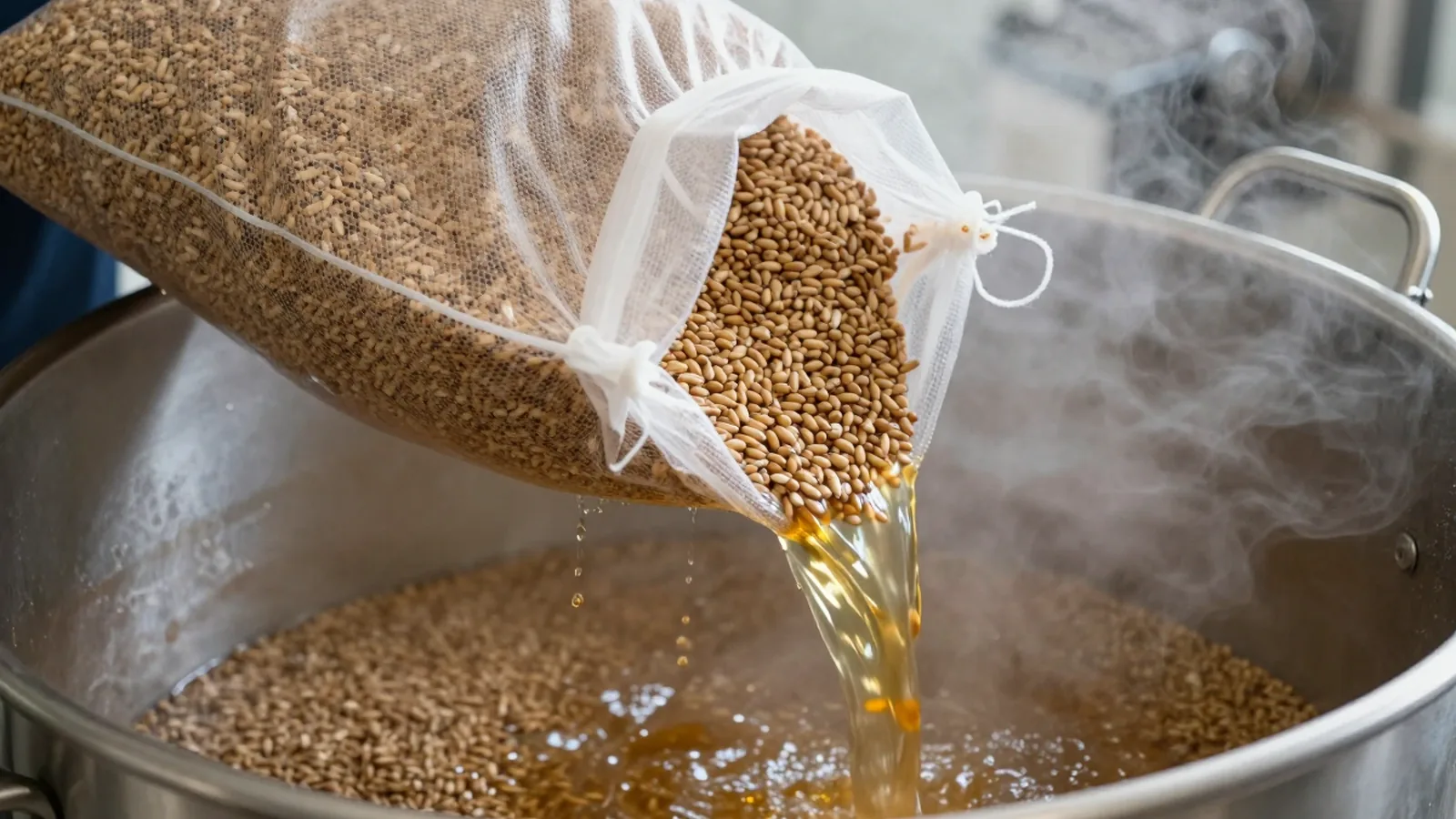
Brew in a bag (BIAB) is all-grain brewing in a single kettle. A fine mesh bag lines the pot, you mash the grain inside it, then lift the bag out like a giant tea bag and boil the wort in the same kettle. The common version is full-volume, no-sparge: all the water for the batch goes into the mash, so there is no separate hot liquor tank and no sparge. Use it when you want all-grain control without buying a mash tun and two extra pots, when you brew in an apartment, or when you brew small batches. It is a common first step past extract and partial mash. Because the bag, not a false bottom, separates grain from wort, you can crush finer than in a cooler tun without risking a stuck sparge, and a finer crush is the main way to recover efficiency. The trade-off is efficiency and lifting. It is not unusual for BIAB to land at 50-60% efficiency, though many brewers reach 70-80% with a double-milled crush, a longer mash, or a quick dunk sparge. A wet bag of 12 lb (5.4 kg) of grain is heavy and hot, so a pulley or a rack over the kettle helps. You also need a kettle big enough to hold all the water and the grain at once.
At a Glance
Equipment
- Kettle, 10 gal (38 L) minimum for 5 gal batches
- BIAB mesh bag sized to the kettle (voile is a common material)
- Heat source
- Digital thermometer
- Pulley, hook, or rack for lifting the bag
- Colander or bucket to hold the drained bag
- Hydrometer or refractometer
- Wort chiller
- Fermenter, airlock and sanitizer
Steps
- 1
Work out pre-boil volume
Multiply your boil-off rate by boil time and add it to the batch volume. With 1 gal (3.8 L) per hour boil-off and a 60-minute boil, 5 gal needs 6 gal (22.7 L) pre-boil.
Measure your own boil-off on one batch. It varies a lot between burners and kettle shapes.
- 2
Work out strike volume
Add grain absorption to pre-boil volume: 0.1-0.125 gal per lb of grain. For 12.4 lb at 0.1 gal/lb that is about 1.24 gal, so 7.24 gal (27.4 L) of strike water.
Grain absorbs less in BIAB if you let the bag drain for a long time.
- 3
Heat the strike water
Fit the bag in the kettle and heat the water 8-12°F (4-7°C) above the target mash temperature. For a 152°F (67°C) mash, heat to 160-164°F (71-73°C).
Some brewers add the bag after heating so it never touches a hot kettle floor.
- 4
Mash in
Turn off the heat and stir all the grain into the bag. Break up dough balls, confirm the mash temperature, cover, and wait 60 minutes.
Avoid opening the lid to check. Insulate the kettle with a sleeping bag or blanket if it loses heat fast.
- 5
Lift and drain
Raise the bag out of the kettle and let it drip until it slows. Do not lose grain into the pot.
Hang it from a pulley or set it in a colander over the kettle to free your hands.
- 6
Adjust volume
Check that you have your pre-boil volume. If short, pour about 170°F (77°C) water through the bag to make it up. If over, extend the boil.
Pouring water through the bag is technically a sparge and can add a few points of efficiency.
- 7
Boil, chill, ferment
Boil with your hop schedule, chill to pitching temperature, transfer, aerate, measure gravity, and pitch.
The rest of the brew day is the same as any other batch.
Tips
- Mill the grain twice, or ask the shop for a fine crush. The bag handles flour that would clog a cooler tun.
- For a dunk sparge, soak the drained bag in a separate pot of water at about 170°F (77°C) for 10 minutes, then add that liquid to the kettle.
- Extend the mash past 60 minutes, or confirm conversion with a gravity reading, if your efficiency keeps coming in low.
- Choose a bag that drains quickly but holds grain. Too coarse lets grain into the boil; too fine traps sugar.
- Plan your first recipes at 70% efficiency and adjust once you have measured your system.
- Keep strike temperature notes; the kettle's mass and the grain's starting temperature change what you need.
Common Mistakes to Avoid
- Using a kettle that cannot hold the full strike volume plus the grain. For 5 gal batches you want 10 gal (38 L) or more.
- Letting the bag rest on the kettle floor while the burner is on, which can scorch or melt it.
- Forgetting grain absorption when calculating strike water and ending up short of pre-boil volume.
- Lifting a hot, heavy bag without a secure hold. Plan the lift before mash-in.
- Expecting cooler-tun efficiency with a coarse homebrew-shop crush.
- Pulling the bag out before conversion is done.