Cold Crashing and Fining: A Homebrewer's Guide
When gravity is stable and any dry hops are done, chill the fermenter to about 32-34°F (0-1°C) and hold it 1-3 days so yeast and haze settle. For faster, brighter results add gelatin at 60-90 mg/L (about 1.1-1.7 g in 5 gal (19 L)) once the beer is cold, and protect against suck-back so the cooling beer does not pull in air.
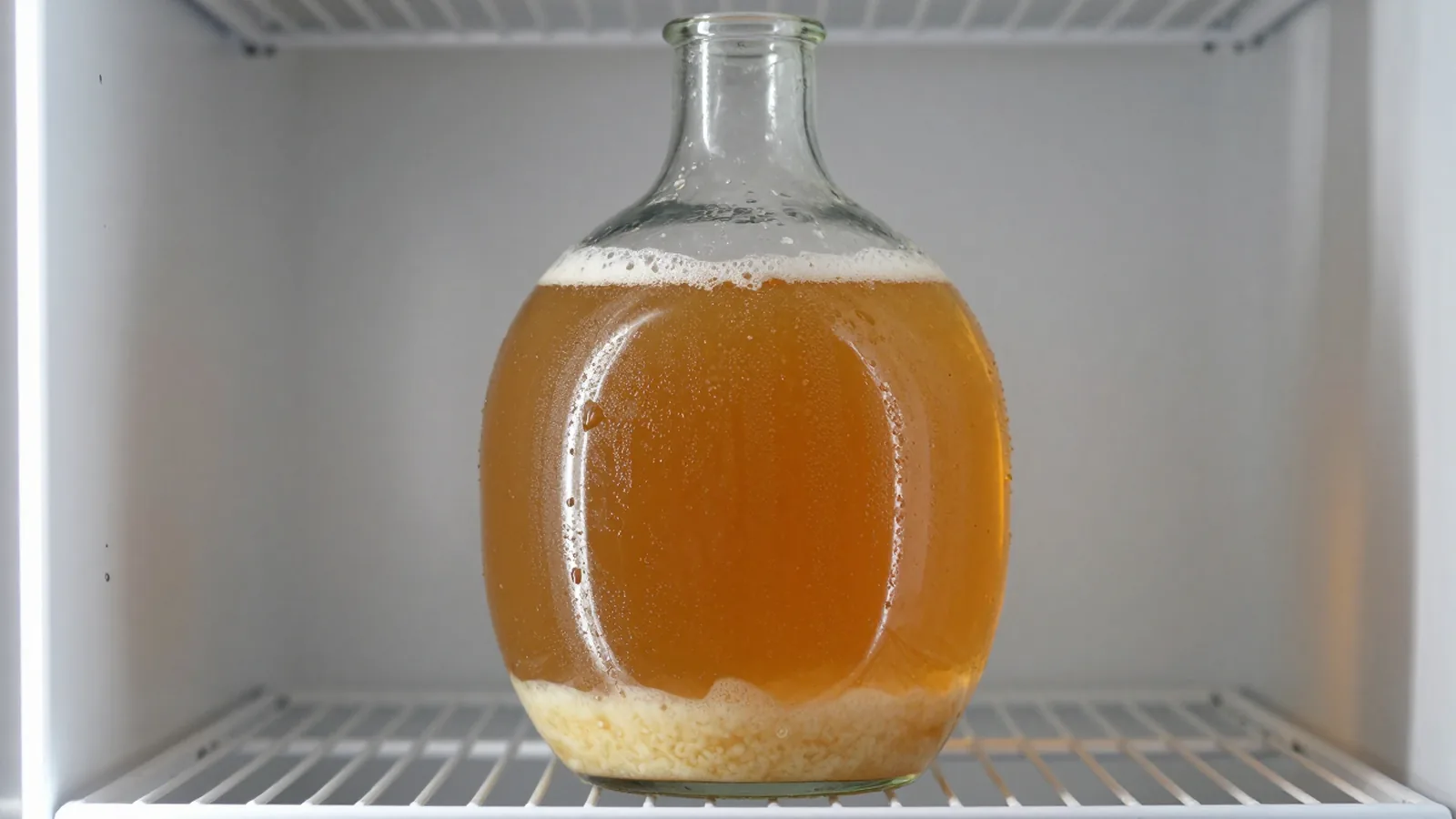
Cold crashing is dropping finished beer to near freezing before packaging. Cold makes yeast flocculate and lets protein-polyphenol haze particles grow large enough to settle. Fining agents speed this up: gelatin and isinglass carry an electrical charge that pulls yeast and haze-formers together so they sink. Use it when clarity matters and the style allows it: lagers, pale ales, bitters, West Coast IPAs. Skip it for hazy IPAs, hefeweizens and witbiers, where haze is part of the style. It also firms up the yeast cake, so less sediment ends up in the keg or bottling bucket. The cost is oxygen risk. As beer cools, the headspace gas contracts and pulls air (and airlock liquid) back into the fermenter. In a Brulosophy test, a German pilsner crashed at 32°F (0°C) for 2 days pulled sanitizer from the airlock, but 26 blind tasters could not reliably tell it from the same beer packaged warm (9 correct where 14 were needed). That result is one beer and one panel; hop-forward beers are far more sensitive to oxygen, so the safe default is to limit suck-back.
At a Glance
Equipment
- Fermentation chamber, fridge or chest freezer with temperature controller
- Hydrometer or refractometer
- Unflavored gelatin powder (or isinglass)
- Gram scale
- Small heat-safe cup or measuring cup
- CO2 tank and regulator for purging or pressurizing (pressure-capable fermenters)
- Solid stopper, spunding valve or CO2 balloon to stop suck-back
- Auto-siphon or closed-transfer setup for packaging
Steps
- 1
Confirm the beer is finished
Take gravity readings on two or three days. Crash only when the reading is stable and any dry-hop additions and diacetyl rest are complete.
Crashing too early stalls the yeast and can leave residual sugar or diacetyl.
- 2
Stop suck-back
Plan for the vacuum. In a pressure-capable fermenter, keep light CO2 pressure on it or close a spunding valve. In a carboy or bucket, swap the liquid airlock for a solid stopper or attach a CO2-filled balloon or bag that can collapse as the gas contracts.
If you must use a standard airlock, fill it with sanitizer, not water or vodka, because some will end up in the beer.
- 3
Drop the temperature
Set the controller to 32-34°F (0-1°C). Keep it above freezing; beer freezes a few degrees below water, but a frozen fermenter is a real risk with a cold freezer.
Tape the probe to the fermenter so it reads beer temperature.
- 4
Dissolve the gelatin
Once the beer is cold, weigh about 1.1-1.7 g of unflavored gelatin for 5 gal (19 L), the 60-90 mg/L range Palmer gives. Sprinkle it on a few ounces of water, let it bloom, then heat it until it dissolves fully. Do not boil it.
Fine after the beer is cold, when yeast and haze are already starting to drop.
- 5
Add the fining
Pour the dissolved gelatin gently into the cold fermenter without splashing. With a closed fermenter, push it in through a port under CO2.
Isinglass works the same way at 30-60 mg/L and is better at dropping yeast than chill haze.
- 6
Hold cold
Hold the beer cold for 1-3 days. Pull a small sample from the valve or with a sanitized thief to check clarity.
Lagers often sit longer: about 10 days at 33°F (1°C) clears most lagers after a warm diacetyl rest.
- 7
Package gently
Transfer to the keg or bottling bucket without disturbing the yeast cake. Use a closed CO2 transfer if your gear allows it.
Racking cold beer from a compact cake leaves noticeably less sediment in the package.
Tips
- Irish moss or Whirlfloc in the boil (about 1 teaspoon of Irish moss flakes or 1 tablet per 5 gal) reduces the protein load before fermentation even starts.
- PVPP (Polyclar) at 6-10 g per 5 gal (19 L) removes haze-forming polyphenols in a few hours of contact.
- Chill haze looks like a fault but is cosmetic: it clears when the beer warms. Fining with gelatin or PVPP reduces it.
- Gelatin is not vegan. Use PVPP or a silica product for a vegan clarifier.
- Do not fine hazy styles. You will strip the haze and some hop character with it.
- If you bottle after a long, cold crash, there is still usually enough yeast to carbonate, but very long cold storage may need a small dose of fresh yeast.
Common Mistakes to Avoid
- Crashing before fermentation is finished.
- Using a water-filled airlock and pulling unsanitized water into the beer.
- Boiling the gelatin solution, which degrades it.
- Adding gelatin to warm beer and seeing little effect.
- Fining a hazy IPA and stripping the style's haze and hop character.
- Splashing during transfer and undoing the clarity gain with oxidation.
- Letting the controller drift below freezing.