All-Grain Brewing (3-Vessel): A Homebrewer's Guide
Mash crushed grain in 1.5-2 qt of water per pound (3-4 L/kg) at 150-155°F (65-68°C) for 60 minutes, recirculate until the runnings clear, then sparge with 165-175°F (73-80°C) water to collect about 6.5 gal (25 L) of wort for a 60-minute boil and a 5 gal (19 L) batch.
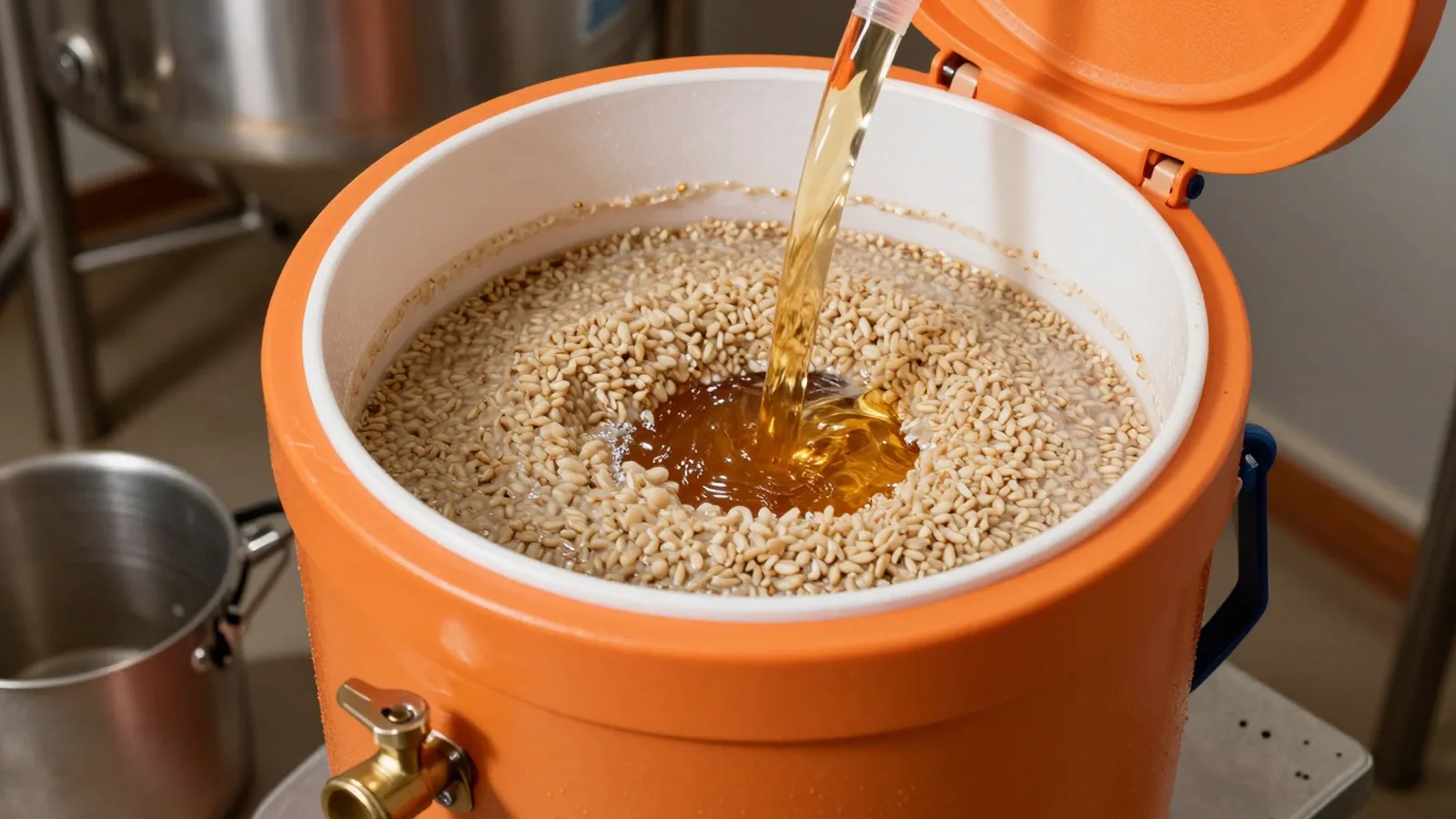
All-grain brewing makes wort from malted grain with no extract. The classic homebrew layout uses three vessels: a hot liquor tank for heating water, a mash tun (often an insulated picnic cooler with a manifold or false bottom), and a boil kettle. You mash the crushed grain so enzymes convert starch to sugar, drain and rinse the sugar out (lautering and sparging), then boil, chill and ferment like any other batch. The reason to do it is control. Mash temperature sets fermentability: around 140-150°F (60-65°C) gives a lighter-bodied, more attenuable wort, and 150-160°F (65-71°C) leaves more dextrins and body. You choose every malt, can run step mashes for difficult grists, and pay less per batch than with extract. You also need a kettle that holds a full boil, at least 8 gal (30 L) for 5 gal batches, and a burner strong enough to boil it. The trade-offs are time, space and cleanup. Three vessels mean more to heat, carry and wash than brew in a bag or an all-in-one electric system, and the sparge adds a step that can go wrong. In exchange you get the highest typical efficiency: Palmer's comparison puts continuous (fly) sparging around 80%, batch sparging around 75% and no-sparge around 65%.
At a Glance
Equipment
- Hot liquor tank or second pot, 5 gal (19 L) minimum
- Mash/lauter tun: 36-48 qt cooler or 10 gal round cooler with manifold or false bottom
- Boil kettle, 8 gal (30 L) minimum
- Outdoor propane burner or high-output heat source
- Grain mill, or grain crushed at the shop
- Digital thermometer
- Hydrometer or refractometer
- Wort chiller
- Pitcher for recirculation
- Fermenter, airlock and sanitizer
Steps
- 1
Heat the strike water
Heat about 5 gal (19 L) for a 2 qt/lb mash. For a 152°F (67°C) target, water at 160°F (71°C) is a typical starting point at that ratio.
Heat more than you need. A spare gallon of hot water fixes a low mash temperature.
- 2
Preheat the tun
Pour about 1 gal of boiling water into the cooler, swirl it, and pour it back to the sparge pot.
A cold cooler absorbs heat and throws off your infusion math.
- 3
Mash in
Add the water to the grain a gallon at a time, stirring between additions. Make sure all the grain is wet with no dough balls, but do not splash.
Water into grain, not grain into water, so you do not thermally shock the enzymes.
- 4
Check and correct the temperature
Read the mash after it settles. Aim for 152°F (67°C), anywhere in 150-155°F (65-68°C) is fine. Add boiling water if low, cold water if high.
156°F (69°C) is about the ceiling for a medium-bodied ale.
- 5
Hold for an hour
Close the lid and rest 60 minutes. Stir every 15-20 minutes and check temperature. A drop of less than 5°F over the hour needs no action.
Enzyme activity is highest in the first 20 minutes, so get the temperature right early.
- 6
Heat the sparge water
During the mash, heat about 3.5 gal (13 L) to 165-175°F (73-80°C). Keep it under a boil.
Sparge water that is too hot extracts tannins from the husks.
- 7
Mash out (optional)
Raise the mash to about 170°F (77°C) with hot water before draining. This stops enzyme activity and makes the wort flow more easily.
Mashout matters most with thin wort runoffs and large grain bills.
- 8
Recirculate (vorlauf)
Open the valve slowly, drain about 2 qt (1.9 L) into a pitcher, and pour it gently back on top of the grain bed. Repeat until the runoff looks like unfiltered apple cider rather than cloudy.
This sets the grain bed as a filter and keeps husk bits out of the kettle.
- 9
Lauter and sparge
Drain the first runnings slowly into the kettle. For a batch sparge, add the sparge water, stir, rest about 15 minutes, recirculate again, and drain. For a fly sparge, add water to the top as fast as you drain, keeping about an inch above the grain.
Open the valve only partway at first. A fast start compacts the bed and sticks the sparge.
- 10
Measure efficiency
Stir the kettle, read the gravity, multiply the gravity points by gallons collected, and divide by pounds of grain. About 28 is normal, 29 is better, over 30 is very good, and 25 or less means poor conversion.
Low numbers usually trace to a coarse crush, a wrong mash temperature, or too little time.
- 11
Boil, chill, ferment
Boil the full volume for 60 minutes with your hop additions. Add Irish moss in the last 15 minutes, then chill, transfer, aerate and pitch.
All-grain wort throws more break material than extract. Leave the trub in the kettle where you can.
Tips
- Calculate grain from your efficiency: 5 gal of 1.049 is 245 gravity points; at 28 points per lb per gal that is 8.75 lb of grain.
- Start with a single-infusion mash. Well-modified modern malts do not need a protein rest.
- With 20% huskless malt such as wheat, add rice hulls equal to at least 1% of the grain bill to prevent a stuck sparge.
- Keep mash pH at 5.2-5.6 (measured at 77°F/25°C). Water chemistry, not temperature, is the main cause of tannin extraction.
- Stir the kettle before reading pre-boil gravity. First and second runnings layer and give false readings.
- Write down strike temperature, grain temperature, and resulting mash temperature every batch so your infusion estimates improve.
Common Mistakes to Avoid
- Dumping all the strike water in at once, which overshoots temperature and shocks the enzymes.
- Mashing too hot and getting a sweet, under-attenuated beer.
- Draining the tun too fast and compacting the grain bed into a stuck sparge.
- Sparging with water near boiling, or sparging so long that runnings get thin, which pulls astringent tannins.
- Buying a kettle that is too small. A 5 gal batch starts the boil with about 6.5 gal (25 L).
- Splashing hot wort during mash-in and transfers, which oxidizes it.