Most ales and lagers are carbonated to 2.3–2.8 volumes of CO2. After fermenting at 68°F, beer already holds 0.86 volumes, so reaching 2.5 volumes in 5 gallons takes 145 g (5.1 oz) of corn sugar or 126 g of table sugar. In a keg at 38°F, 2.5 volumes needs 11.3 psi at sea level, plus 1 psi per 2,000 ft of altitude.
What a "volume" of CO2 means
Carbonation in the US is measured in volumes: liters of CO2 dissolved per liter of beer. Brewer's Friend defines the gas volume at "a pressure of one atmosphere ... and at a temperature of 0° C (32° F)." By weight, UF/IFAS Extension gives "1 vol/vol = 1.96 g/L."
We checked that conversion: CO2 weighs 44.0095 g/mol (NIST WebBook) and an ideal gas takes up 22.414 L/mol at 0°C and 1 atm (NIST CODATA), which gives 1.963 g per liter per volume.
The Brewers Association puts "many lagers and ales" between 2.3 and 2.8 volumes.
Get homebrewing guides by email
New brewing guides, fixes for common off-flavors, and equipment notes. Free, unsubscribe from any email.
No fixed schedule. Unsubscribe from any email. 21+ only.
Target carbonation by style
John Palmer's How to Brew lists typical CO2 volumes by style. British ales sit lowest; German wheat beers highest.
| Style | Volumes of CO2 | Corn sugar for 5 gal at 68°F, midpoint |
|---|---|---|
| British ales | 1.5–2.0 | 79 g |
| Porter, stout | 1.7–2.3 | 101 g |
| Belgian ales | 1.9–2.4 | 114 g |
| American ales | 2.2–2.7 | 141 g |
| European lagers | 2.2–2.7 | 141 g |
| Belgian lambic | 2.4–2.8 | 154 g |
| American wheat | 2.7–3.3 | 190 g |
| German wheat | 3.3–4.5 | 270 g |
Standard bottles limit what you can bottle-condition. Craft a Brew says "Standard pry-off bottles are rated to about 3.0 volumes." American wheat and German wheat beer reach past that, so use heavier bottles rated for the pressure or keg them.
How much CO2 is already in the beer
Fermentation makes CO2, and some of it stays dissolved. The warmer the beer, the less it holds. That residual counts toward your target, so priming math starts from it.
The equation most homebrew calculators use, from Brewer's Friend (Craft a Brew calls it "the Zahm & Nagel equation"), with T in °F:
CO2 in beer = 3.0378 - 0.050062 x T + 0.00026555 x T²
Use the warmest temperature the beer reached after fermentation, not the bottling-day temperature. Brewer's Friend says the temperature to enter "is usually the fermentation temperature of the beer."
We checked the equation against two independent tables:
| Temperature | Equation | UF/IFAS, pure water at 0 psig | BA/ASBC table, extended to 0 psig |
|---|---|---|---|
| 32°F | 1.71 | 1.60 | |
| 33°F | 1.67 | 1.57 | |
| 41°F / 42°F | 1.43 / 1.40 | 1.37 (41°F) | 1.32 (42°F) |
| 50°F | 1.20 | 1.17 | |
| 59°F | 1.01 | 1.01 |
The UF/IFAS values are Henry's-law numbers for water; the BA numbers come from its pressure table (below) with each row extended in a straight line to zero gauge pressure. The equation matches the water value at 59°F and runs up to 0.11 volumes above it at 32°F; against the BA table it runs about 0.1 volume high. That is close enough for priming. At typical ale temperatures it gives 0.91 volumes at 65°F, 0.86 at 68°F and 0.78 at 75°F.
Here is what that does to the sugar bill. Corn sugar for 5 gallons at 2.5 volumes, by the warmest temperature after fermentation:
| Warmest temperature | Residual CO2 | Corn sugar |
|---|---|---|
| 60°F | 0.99 vol | 134 g |
| 65°F | 0.91 vol | 141 g |
| 70°F | 0.83 vol | 148 g |
| 75°F | 0.78 vol | 153 g |
A beer that warmed from 60°F to 75°F before bottling needs 19 g more sugar for the same result. Enter the higher number: using a temperature that is too low under-primes the beer.
Keeping that warmest number known is the job of a controller: an active fermenter runs up to 10°F (6°C) above the room, so the fermentation temperature control guide tapes the probe to the fermenter wall rather than hanging it in the chamber air.
Priming sugar: the math
Three numbers turn a target into grams:
- CO2 to add = target volumes - residual volumes.
- CO2 per gram of sugar. UF/IFAS works from glucose: "For every 1 g sugar, 0.46 g CO2 ... is produced," 94% of the 0.489 g that the chemistry allows, because yeast also grows. At 1.96 g of CO2 per volume, one volume in one liter takes 4.261 g of anhydrous glucose.
- Convert to the sugar in your hand by molecular weight (PubChem: sucrose 342.3, glucose 180.16, glucose monohydrate 198.17 g/mol). Table sugar splits into two glucose-sized sugars and gains water, so it needs less: 4.048 g. Corn sugar is dextrose monohydrate, 90.9% glucose by weight, so it needs more: 4.687 g. That matches Brewer's Friend, which counts "corn sugar is 91% sugar." For malt extract we use Brewer's Friend's "68% attenuation for DME" against table sugar.
| Sugar | Grams per liter per volume | 5 gal, 68°F, to 2.5 volumes |
|---|---|---|
| Anhydrous glucose (UF/IFAS basis) | 4.26 | 132 g (4.7 oz) |
| Table sugar (sucrose) | 4.05 | 126 g (4.4 oz) |
| Corn sugar (dextrose monohydrate) | 4.69 | 145 g (5.1 oz) |
| Dry malt extract | 5.95 | 185 g (6.5 oz) |
The example is 18.93 liters (5 US gallons), adding 1.64 volumes on top of the 0.86 already present; the priming sugar calculator returns those same 1.64 volumes, then uses Brewer's Friend's rounded 4 g of table sugar per liter per volume rather than this article's 4.26 g of glucose and lands at 136 g of corn sugar for the batch, 9 g under the 145 g in the table.
Compare the retail rule of thumb. MoreBeer says "Use 4-5 oz. of dextrose to prime 5 gallons." By the math above that is 2.14 to 2.46 volumes for beer fermented at 68°F. Palmer's How to Brew quotes "~4 oz" for "about 2.5 volumes"; our math puts 4 oz at 2.14. The gap comes from the inputs: we use UF/IFAS's 0.46 g of CO2 per gram of sugar and Brewer's Friend's 91% figure for corn sugar. Palmer also puts malt extract at "about 75%" fermentable, a bit above the 68% we use.
Dry malt extract is the expensive way to hit that target: 185 g (6.5 oz) at the $6.58 a pound median that DME carried across 261 listings from 32 retailers in the October 2026 Homebrew Price Index costs $2.68, against $0.85 at the $2.08 a pound low in the cheapest dry malt extract guide, where the dearest listing runs $9.99 a pound, or $4.07 for the same 185 g.
Dissolve the sugar first. Northern Brewer says to "Boil your priming sugar in 16 oz of water," cool it, and add it to the bottling bucket so every bottle gets the same dose. Then hold the bottles at room temperature for about 2 weeks.
Bottle safety
Two things over-pressurize bottles: too much priming sugar, and bottling before fermentation has finished. Palmer warns: "If the beer is bottled before fermentation is complete, the beer will become over-carbonated and the pressure may exceed the bottle strength."
- Check that fermentation is done before bottling. Palmer says ales "are usually ready to bottle in 2-3 weeks."
- Keep standard 12 oz pry-off bottles at or under about 3.0 volumes (Craft a Brew).
- For higher targets, UF/IFAS says "Appropriately pressure-rated bottles must be used to achieve high carbonation levels."
- Weigh the sugar. Brewer's Friend notes that over-carbonation leads to "swollen caps, exploding bottles."
Kegging: serving pressure by temperature
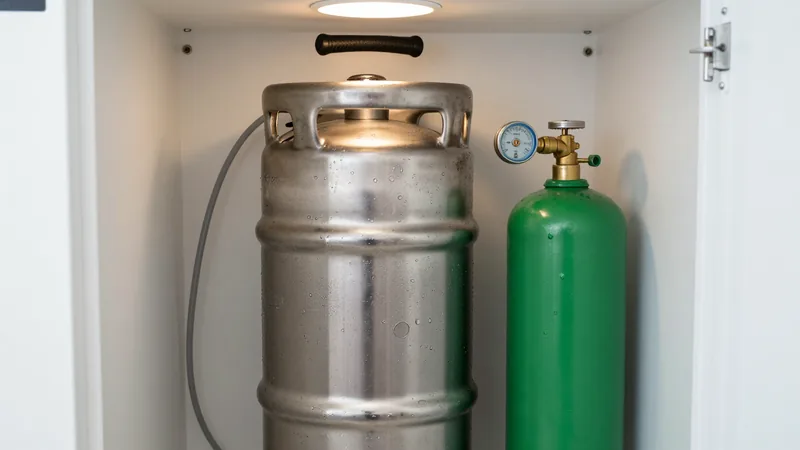
A keg reaches the same carbonation with gas pressure instead of sugar. The Brewers Association publishes the equilibrium table, taken from the American Society of Brewing Chemists' Methods of Analysis (1949). Selected rows, in psi gauge at sea level:
| Beer temperature | 2.2 vol | 2.5 vol | 2.7 vol | 3.0 vol |
|---|---|---|---|---|
| 34°F | 6.2 | 9.1 | 11.1 | 14.0 |
| 36°F | 7.1 | 10.2 | 12.3 | 15.5 |
| 38°F | 8.1 | 11.3 | 13.5 | 16.7 |
| 40°F | 9.1 | 12.4 | 14.6 | 17.9 |
| 42°F | 9.9 | 13.3 | 15.6 | 19.0 |
The BA's own example: "a retailer at sea level would use 11.3 psig to maintain 2.5 volumes CO2 in beer served at 38˚F." Above sea level, "Add 1 psig for every 2,000 ft.," so the same beer needs 13.3 psig at 4,000 ft. The table assumes 1.015 SG, 4.8% ABV, sea level.
Most draught systems assume beer at 36–38°F. Craft a Brew says to "Hold this pressure for 7–10 days for full carbonation." Pick a temperature and target to read the pressure, including values between the table's rows:
For the full bottling routine, see how to start homebrewing. For how fermentation temperature changes by yeast, see lager vs ale yeast.
None of this arithmetic cares what fermented the sugar. Five gallons of cider that finished at 0.995 holds the same 0.86 volumes of CO2 at 68°F, so it takes the same 145 g of corn sugar for 2.5 volumes — how to make hard cider covers the juice, yeast and clearing that come before the bottle.
Bottles or keg?
| Bottle conditioning | Keg, force carbonated | |
|---|---|---|
| CO2 comes from | priming sugar fermented by the remaining yeast | a CO2 cylinder through a regulator |
| Time to carbonate | about 2 weeks at room temperature (Palmer, Northern Brewer) | 7–10 days at the table pressure (Craft a Brew) |
| Practical ceiling | about 3.0 volumes in standard bottles | set by the pressure you hold |
| What sets the level | grams of sugar and the residual CO2 | temperature and gauge pressure |
Bottles need no gas equipment but cannot be adjusted once capped. A keg can be turned up or down at any time.
The keg route is charted in our kegging guide: at 38°F (3°C), 11.3 psi gives 2.5 volumes, and the set-and-forget wait runs about 3 days to a week.
Frequently Asked Questions
How much priming sugar for 5 gallons of beer?
For 2.5 volumes after fermenting at 68°F: 145 g (5.1 oz) of corn sugar, 126 g (4.4 oz) of table sugar, or 185 g (6.5 oz) of dry malt extract. Lower the target for British ales and stouts.
Why does fermentation temperature matter for priming?
Warmer beer holds less CO2, so it needs more sugar. Beer that fermented at 75°F holds 0.78 volumes; at 60°F it holds 0.99.
Is table sugar or corn sugar better for priming?
Either works. By weight, table sugar gives more CO2: you need about 16% more corn sugar for the same carbonation. Corn sugar carries water of hydration (90.9% glucose), and table sugar gains weight when yeast split it.
What PSI should I set my keg to?
At 38°F, 8.1 psi for 2.2 volumes, 11.3 for 2.5 and 13.5 for 2.7, per the Brewers Association table at sea level. Add 1 psi for every 2,000 ft of altitude.
How many volumes can a beer bottle hold?
Craft a Brew rates standard pry-off bottles at about 3.0 volumes. Higher-carbonation styles such as German wheat beer (3.3–4.5 volumes per Palmer) need bottles rated for more pressure.
Sources
- John Palmer, How to Brew, How to Brew, Chapter 11: Priming and Bottling, checked October 1, 2026.
- Brewers Association, Facts About Draught Beer Carbonation, checked October 1, 2026.
- University of Florida IFAS Extension, A Guide to Carbonating Beverages at Small Scale (FS379), checked October 1, 2026.
- Brewer's Friend, Beer Priming Sugar Calculator, checked October 1, 2026.
- Craft a Brew, Priming Sugar Calculator, checked October 1, 2026.
- NIST Chemistry WebBook, Carbon dioxide, checked October 1, 2026.
- NIST CODATA, Molar volume of ideal gas (273.15 K, 101.325 kPa), checked October 1, 2026.
- MoreBeer, Corn Sugar (Premium Dextrose), checked October 1, 2026.
- Northern Brewer, How to Brew Beer: Homebrewing 101, checked October 1, 2026.
- PubChem, Sucrose (CID 5988), checked October 1, 2026.
- PubChem, D-Glucose (CID 5793), checked October 1, 2026.
- PubChem, Glucose Monohydrate (CID 22814120), checked October 1, 2026.
- NIST, NIST Guide to the SI, Appendix B.9: Factors for units listed by kind of quantity, checked October 1, 2026.