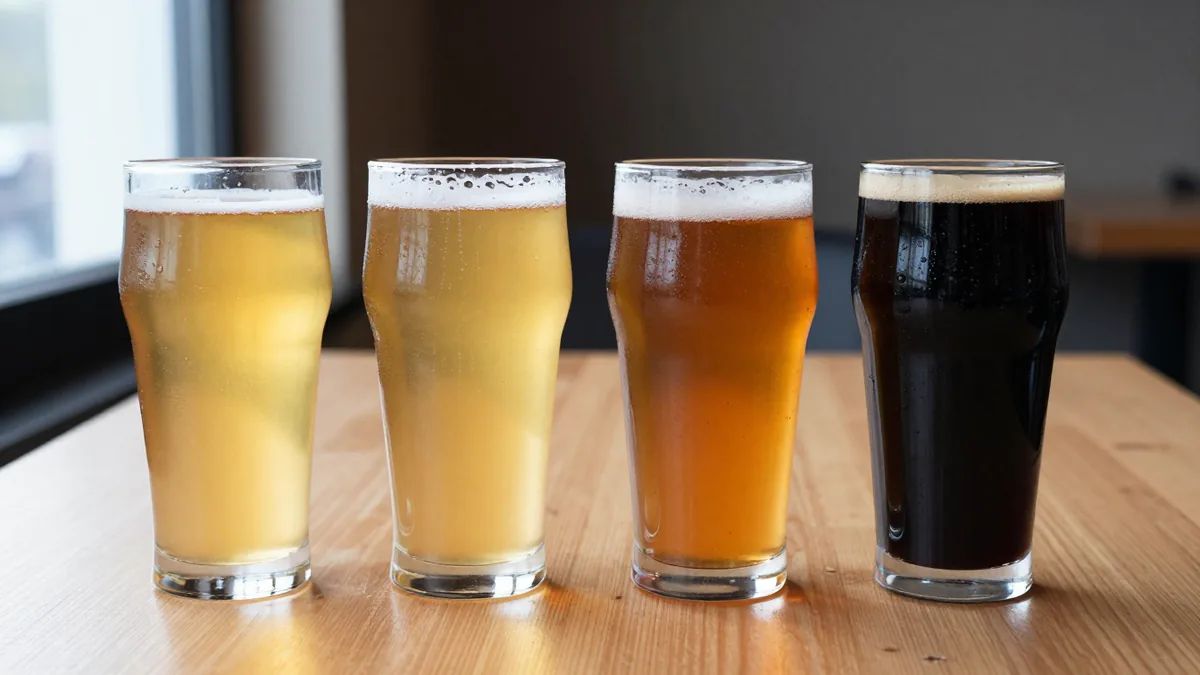
Ale yeast is Saccharomyces cerevisiae; lager yeast is S. pastorianus, a cold-tolerant hybrid of S. cerevisiae and S. eubayanus (Libkind et al., PNAS 2011). Makers rate common ale strains at about 60–73°F and lager strains at about 50–55°F. Lagers then sit cold for weeks: Wyeast calls 1–4 weeks of lagering typical.
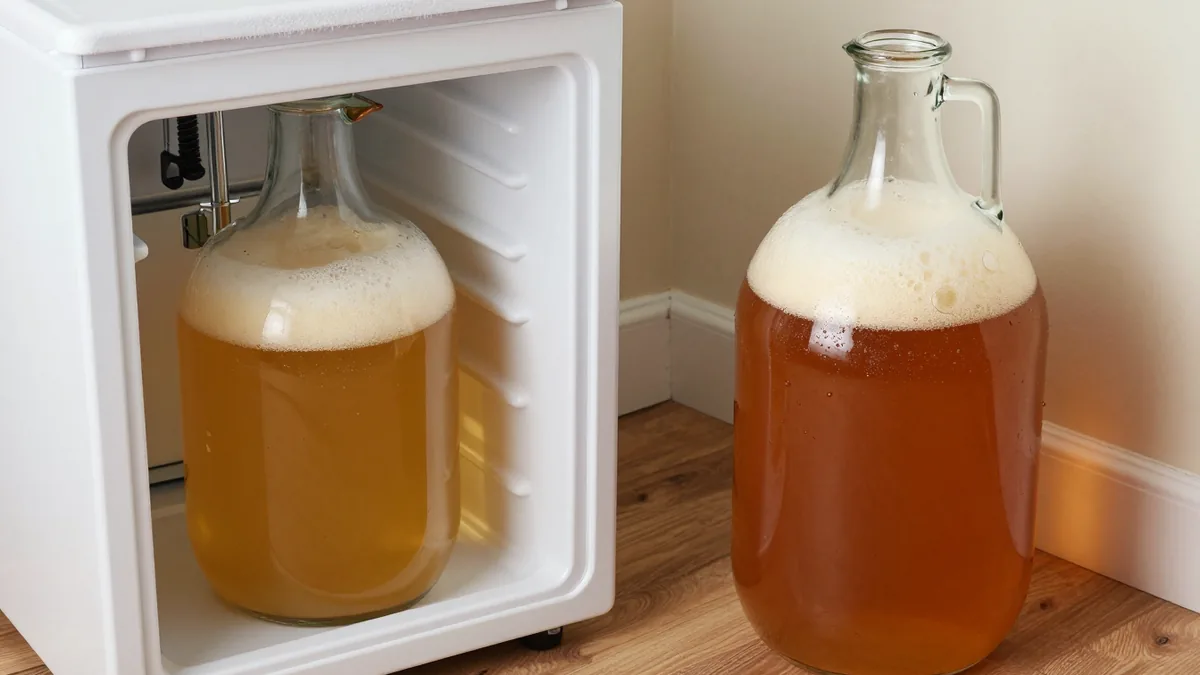
The difference in one table
| Ale | Lager | |
|---|---|---|
| Yeast species | Saccharomyces cerevisiae | Saccharomyces pastorianus (hybrid) |
| Maker temperature range, example strain | Wyeast 1056: 60–72°F (16–22°C) | WLP830: 50–55°F (10–13°C) |
| Cold conditioning | Optional | 1–4 weeks at 33–34°F (Wyeast) |
| BJCP label | "top-fermented" | "bottom-fermented, lagered" |
The old shorthand is top-fermenting versus bottom-fermenting. The species and the temperature are what actually differ.
Get homebrewing guides by email
New brewing guides, fixes for common off-flavors, and equipment notes. Free, unsubscribe from any email.
No fixed schedule. Unsubscribe from any email. 21+ only.
Two yeast species
Ale yeast is the same species used for bread and wine. Lager yeast is a domesticated hybrid. The Libkind et al. 2011 PNAS paper puts it this way: lager beer, "first brewed in the 15th century," uses S. pastorianus, "created by the fusion of a Saccharomyces cerevisiae ale-yeast with an unknown cryotolerant Saccharomyces species."
That paper found the missing parent. The authors isolated S. eubayanus from Nothofagus (Southern beech) forests in Patagonia and reported that its draft genome is 99.5% identical to the non-S. cerevisiae part of the lager yeast genome.
What the hybrid inherited matters in the fermenter. A review by Gibson and Liti in Yeast (2015) lists the key traits as cold tolerance and good maltose- and maltotriose-utilizing ability. Cold tolerance lets it ferment where ale yeast slows down. Maltotriose use lets it ferment more of the wort's sugars at those temperatures.
Spec sheets confirm the split by species. Wyeast 2124 and SafLager W-34/70 list Saccharomyces pastorianus. Wyeast 1056, SafAle US-05 and the kveik strain LalBrew Voss list Saccharomyces cerevisiae.
Fermentation temperature by strain
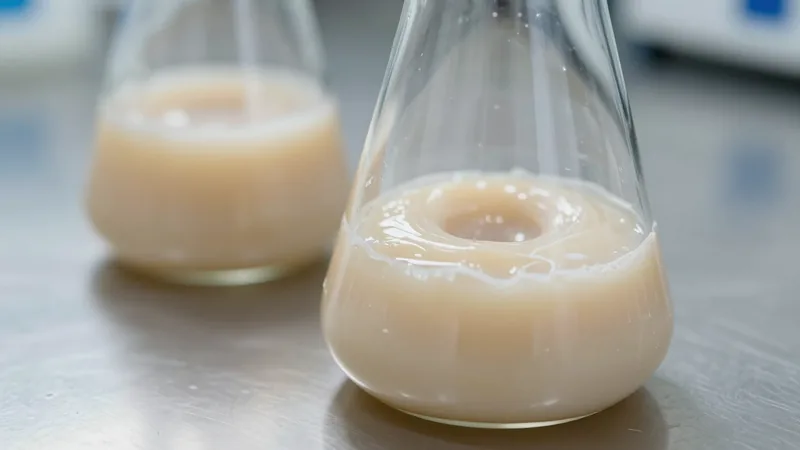
We pulled the stated range for 7 widely sold strains from each maker's product page:
| Strain | Maker | Type | Range °F | Range °C | Apparent attenuation |
|---|---|---|---|---|---|
| Wyeast 1056 American Ale | Wyeast | Ale | 60–72 | 16–22 | 73–77% |
| WLP001 California Ale | White Labs | Ale | 64–73 | 18–23 | 73–85% |
| SafAle US-05 | Fermentis | Ale | 64.4–78.8 | 18–26 | 78–82% |
| LalBrew Voss (kveik) | Lallemand | Ale | 77–104 | 25–40 | 76–82% |
| Wyeast 2124 Bohemian Lager | Wyeast | Lager | 45–68 | 7–20 | 73–77% |
| WLP830 German Lager | White Labs | Lager | 50–55 | 10–13 | 74–79% |
| SafLager W-34/70 | Fermentis | Lager | 53.6–64.4 | 12–18 | 80–84% |
What the ranges show:
- White Labs and Fermentis keep ale and lager apart. White Labs ends WLP830 at 55°F and starts WLP001 at 64°F, a 9°F gap. Fermentis stops W-34/70 at 18°C, exactly where US-05 starts (0°C gap, no overlap).
- Wyeast ranges overlap. 2124 runs to 68°F and 1056 starts at 60°F, so 60–68°F is inside both. Wyeast recommends 2124 for lagers at 45–55°F and can make "Common beer" at 65–68°F.
- Kveik is the outlier. Voss is rated 77–104°F with an optimum from 95°F. The full chart spans 59°F from coldest lager floor to hottest kveik ceiling.
Temperature changes flavor inside a range too. Wyeast notes that 1056 develops "mild citrus notes" at a cooler 60–66°F.
Check your fermentation temperature
Pick a strain and enter the temperature where your fermenter will sit: a basement, a closet, a fridge with a controller. The tool compares it with the maker's stated range and tells you how far outside you are. The range is for the beer, which runs warmer than the room during active fermentation, so leave margin at the top.
A 66°F basement fits Wyeast 1056, WLP001, US-05 and Wyeast 2124. It is 11°F too warm for WLP830.
How long each takes
Lager primary. The Wyeast lager brewing guide recommends pitching into wort at 48–58°F and gives an 8-day example schedule. Gravity falls 6.6°P in the first four days at 54°F, then the temperature is raised to 56°F for the diacetyl rest and gravity falls only 0.4°P more. Wyeast: "The diacetyl rest may take 6 days."
Cell count is the other half of that schedule: our yeast starter guide grows a 2 qt (1.9 L) starter of 1.040 wort from 60 billion cells to roughly 173 billion, and holds a lager starter no more than 5°F (3°C) above the beer's planned fermentation temperature.
White Labs' version. The White Labs lager tips say to start at 48–55°F, free-rise to 65°F at 50–60% attenuation until the diacetyl rest is done (about 2–6 days), then cool 4–5°F per day to 35°F.
Cold time after primary. Wyeast describes a secondary of 1 to 3 weeks falling toward 33°F, and "a lagering period of one to four weeks is typical" at 33–34°F. Stacked, that is 2–7 weeks cold after primary. Wyeast adds that a cold secondary lets you shorten the lagering period, so the top of that range is a ceiling. The cold weeks in that range are what a lager drinker is paying for, and the quiz’s Lager Loyalist result is written for them: German pils, Czech premium pale lager, Munich helles and Vienna lager, served at 38–45°F (3–7°C).
Our lagering guide splits that cold time from the warm finish: raise the beer at least 5°F (to 60–65°F) for a 24–48 hour diacetyl rest as primary slows, then chill no faster than 5°F every 12 hours and hold near 33°F (1°C) for about two weeks.
Crash cooling is the short version of that chill: the cold crashing guide drops finished beer to 32–34°F (0–1°C) and holds it 1–3 days, then fines it with gelatin at 60–90 mg/L, about 1.1–1.7 g (0.04–0.06 oz) for 5 gal (19 L), when clarity is the goal.
Ale. Ale strains run warm and finish faster; most ales skip the long cold stage. The extreme case is kveik: Lallemand says Voss reaches full attenuation "typically" within 2–3 days in its optimal range.
We did not find a maker-published day count for a standard ale primary, so we do not quote one.
Picking a strain for the space you have
Match the strain to the temperature you can hold, not the other way around:
- No temperature control, room near 66°F: an ale strain such as Wyeast 1056 (60–72°F) or US-05 (64.4–78.8°F).
- Hot garage or summer closet: kveik. Voss is rated up to 104°F.
- Cool basement in the 65–68°F band: Wyeast 2124 for a California Common. W-34/70 needs it a little cooler: Fermentis rates it only to 64.4°F.
- A fridge or freezer with a controller: a true lager strain such as WLP830 at 50–55°F, plus room to hold 33–34°F for weeks afterward.
Kettle souring uses that warm end on purpose: our kettle souring guide holds unhopped wort at 86–104°F (30–40°C) for 24–48 hours, then boils with hops once pH reaches 3.2–3.5.
Attenuation is the share of sugar the yeast ferments: the 1.040 to 1.010 example works out to 75% on the (OG - FG) / OG formula. The lager strains here are rated at 73–84% apparent attenuation, the ale strains at 73–85%, so species alone does not decide how dry a beer finishes. Those same two readings, 1.040 OG and 1.010 FG, return 3.94% in the ABV calculator, so the attenuation percentage and the alcohol figure are the same fermentation measured two ways.
Styles that blur the line
Three BJCP styles show that species and temperature are separate choices:
- Kölsch: "top-fermented, lagered." Ale yeast, but the BJCP says current practice is to ferment around 15°C and "cold condition near freezing for up to a month."
- California Common: lager yeast run warm, at 55–60°F. The BJCP notes some strains "work better than others at the warmer fermentation temperatures."
- German Pils: the reference lager. Its BJCP attributes include "bottom-fermented, lagered."
For how strength and bitterness define styles, see IPA vs pale ale vs hazy IPA and the full list at /styles. Terms like attenuation and diacetyl are in the glossary. The 12 listings in our Bellingham guide include lager-focused Larrabee and Otherlands, which makes both unfiltered lagers and farmhouse ales. Our 12-listing Charlotte guide includes German-style brewing at Olde Mecklenburg and Belgian-inspired ales at Sugar Creek, local examples of the two families rather than a temperature rule for every beer.
Frequently Asked Questions
Is lager yeast a different species from ale yeast?
Yes. Ale yeast is S. cerevisiae. Lager yeast is S. pastorianus, a hybrid of S. cerevisiae and S. eubayanus. The wild parent's genome is 99.5% identical to the non-cerevisiae part of lager yeast (Libkind et al.).
Can I ferment a lager at room temperature?
Not with most lager strains. WLP830 is rated only to 55°F. Wyeast 2124 is rated to 68°F and is sold for "Common beer" at 65–68°F, but that makes a California Common, not a Pils.
What is a diacetyl rest?
A short warm-up near the end of lager primary so the yeast cleans up diacetyl, a buttery compound. White Labs free-rises to 65°F for about 2–6 days. Diacetyl turns perceptible around 10–40 µg/L, so the rest has to be warm enough and long enough to clear it: the off-flavor troubleshooting reference carries that threshold beside the 64–68°F, 48–72-hour rest, the cause and the fix.
How long does a lager take compared with an ale?
After primary, Wyeast describes 2–7 weeks of cold secondary and lagering. Ales usually skip that stage, and a kveik ale can finish primary in 2–3 days.
What happens if I ferment an ale too warm?
You leave the maker's range, and the beer's flavor drifts from what the strain is sold for. Check the strain sheet: US-05 tops out at 78.8°F, WLP001 at 73°F.
Sources
- PNAS via PubMed Central, Microbe domestication and the identification of the wild genetic stock of lager-brewing yeast (Libkind et al., PNAS 2011), https://pmc.ncbi.nlm.nih.gov/articles/PMC3167505/ (checked 2026-10-01)
- PubMed, Saccharomyces pastorianus: genomic insights inspiring innovation for industry (Gibson and Liti, Yeast 2015), https://pubmed.ncbi.nlm.nih.gov/25088523/ (checked 2026-10-01)
- White Labs, WLP001 California Ale Yeast, https://www.whitelabs.com/yeast-single?id=101&type=YEAST (checked 2026-10-01)
- White Labs, WLP830 German Lager Yeast, https://www.whitelabs.com/yeast-bank/wlp830-german-lager-yeast (checked 2026-10-01)
- Wyeast, 1056 American Ale, https://wyeastlab.com/product/american-ale/ (checked 2026-10-01)
- Wyeast, 2124 Bohemian Lager, https://wyeastlab.com/product/bohemian-lager/ (checked 2026-10-01)
- Fermentis, SafAle US-05, https://fermentis.com/en/product/safale-us-05/ (checked 2026-10-01)
- Fermentis, SafLager W-34/70, https://fermentis.com/en/product/saflager-w-34-70/ (checked 2026-10-01)
- Lallemand, LalBrew Voss Kveik Ale Yeast, https://www.lallemandbrewing.com/en/united-states/product-details/lalbrew-voss-kveik-ale-yeast/ (checked 2026-10-01)
- Wyeast, Lager Brewing, https://wyeastlab.com/resource/professional-lager-brewing/ (checked 2026-10-01)
- White Labs, Tips From The Pitch: Lagers, https://blog.whitelabs.com/tips-from-the-pitch-lagers (checked 2026-10-01)
- BJCP, 5B. Kölsch (2021 Style Guidelines), https://www.bjcp.org/style/2021/5/5B/kolsch/ (checked 2026-10-01)
- BJCP, 5D. German Pils (2021 Style Guidelines), https://www.bjcp.org/style/2021/5/5D/german-pils/ (checked 2026-10-01)
- BJCP, 19B. California Common (2021 Style Guidelines), https://www.bjcp.org/style/2021/19/19B/california-common/ (checked 2026-10-01)