Partial Mash Brewing: A Homebrewer's Guide
Swap part of the extract for base malt (lb of LME ÷ 0.75, or lb of DME ÷ 0.6), mash it in 1.5-2 qt of water per pound at about 152°F (67°C) for 60 minutes, then strain, top up to your 3 gal (11.4 L) boil volume and finish with the remaining extract.
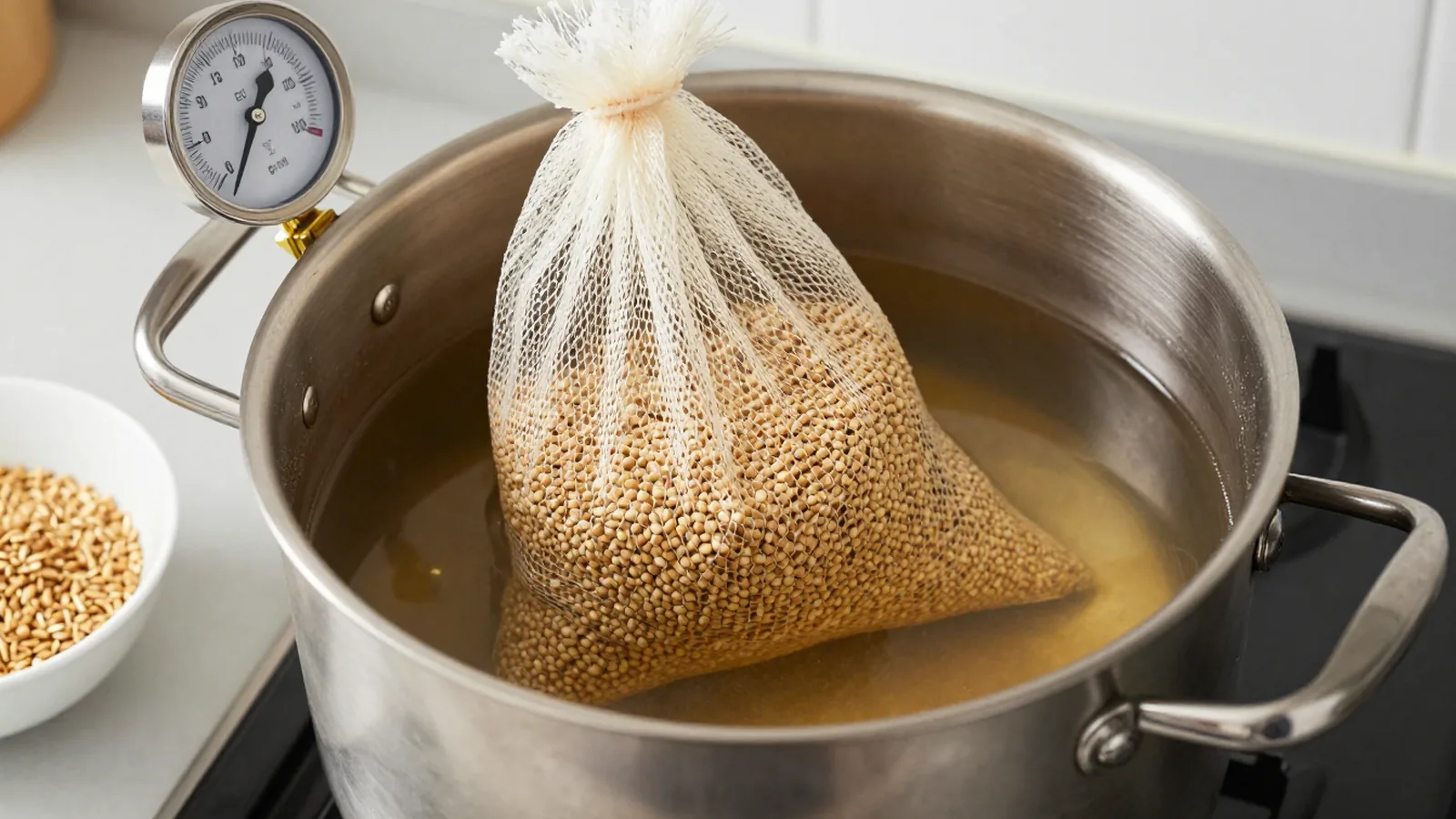
A partial mash, or mini-mash, is a real mash on a small scale. You soak several pounds of crushed base malt plus specialty grain in hot water so the malt's enzymes convert starch to fermentable sugar. That is the difference from steeping: steeped specialty grain adds color and flavor but almost no fermentable sugar, while a partial mash supplies a meaningful share of the gravity. The rest comes from malt extract, so a typical recipe replaces up to half of the extract with grain. Use it when you want to learn mashing without buying a mash tun, a big kettle, or a burner. It fits in a kitchen because you still only boil 3-4 gal (11-15 L). It also lets you use grains that must be mashed to contribute anything, such as Munich, Vienna, or flaked oats, while keeping extract's reliable gravity as a safety net. The cost is a longer brew day than extract and more steps where temperature matters. Compared with all-grain, you still pay for extract and still give up some control of fermentability on the extract portion. Many brewers do a handful of partial mash batches, learn how their pot loses heat, and then move to brew in a bag.
At a Glance
Equipment
- Two stockpots, one 5 gal (19 L) or larger
- Large mesh grain bag or a colander
- Accurate digital thermometer
- Kitchen scale
- Lid and towels or an oven for holding mash heat
- Hydrometer and test jar
- Fermenter, airlock and sanitizer
- Wort chiller or ice bath
Steps
- 1
Convert the recipe
Pick how much extract to replace. Divide pounds of LME by 0.75, or pounds of DME by 0.6, to get pounds of base malt. Replacing one 3.3 lb can of pale LME takes 4.4 lb of pale malt.
Match the malt to the extract: pilsner extract becomes pilsner malt, pale extract becomes pale malt.
- 2
Measure strike water
Multiply pounds of grain by 1.5-2 qt per lb (3-4 L/kg). 4.4 lb at 1.5 qt/lb is 6.6 qt, about 1.65 gal (6.2 L).
A thicker mash holds temperature better in a thin-walled pot.
- 3
Heat strike water
Heat the water 8-12°F (4-7°C) above your target mash temperature. For a 152°F (67°C) mash, aim for 160-162°F (71-72°C).
Write down where you land. After two batches you will know your own pot's heat loss.
- 4
Mash in
Stir all the grain, base and specialty, into the water. Break up every dough ball, check that the mash reads 152-153°F (67°C), cover, and hold for 60 minutes.
Too hot: stir with the lid off until it drops. Too cool: stir in a little boiling water.
- 5
Hold the temperature
Keep the lid on. Wrap the pot in towels or put it in an oven set to its lowest setting and turned off. A drop of a few degrees over the hour is acceptable.
Every lid lift costs heat. Check once at the end, not every ten minutes.
- 6
Separate the wort
Stir the mash, then pour it through a colander or lift the grain bag and let it drain into the boil pot.
Let it drip. You lose more to a torn bag than to a few ounces of wort left in the grain.
- 7
Rinse the grain (optional)
Pour water at about 170°F (77°C) over the drained grain to rinse out remaining sugar, collecting it in the boil pot.
This step is optional in a partial mash because the extract covers any shortfall.
- 8
Top up and add extract
Add water to reach about 3 gal (11.4 L). Stir in half the extract before the boil and the other half at flameout, or all of it at flameout.
Late extract keeps the boil gravity low and the color lighter.
- 9
Boil, chill, and ferment
Boil 60 minutes with your hop schedule, chill to pitching temperature, top up to 5 gal (19 L), aerate, measure gravity, and pitch yeast.
From here it is the same as an extract batch.
Tips
- Mash at the low end, around 150°F (65°C), for a drier beer and toward 155°F (68°C) for more body.
- Mash pH of 5.2-5.6 is the target. Pale-only grists in very soft or very hard water drift outside it.
- Preheat the mash pot with hot water so it does not steal heat from the strike water.
- Use a grain bag even if you have a colander. Lifting a bag is faster and less messy.
- If you want to test whether conversion finished, run an iodine test on a few drops of liquid, or watch for the gravity to stop rising.
- Keep notes on strike temperature, mash temperature, and gravity. Partial mash is practice for all-grain.
Common Mistakes to Avoid
- Treating a partial mash like steeping and pulling the grain after 20 minutes. Conversion needs about an hour.
- Adding strike water at mash temperature instead of 8-12°F above it.
- Mashing too hot, above 160°F (71°C), which leaves a sweet, under-attenuated beer.
- Rinsing with water hotter than 170°F (77°C), which pulls tannins from the husks.
- Forgetting that specialty grain counts toward the total grain weight when measuring strike water.
- Using only specialty malts with no base malt. Crystal and roasted malts have no enzymes to convert starch.