Gluten-free beer styles and brewing alternatives. See beer-versus-malt-beverage
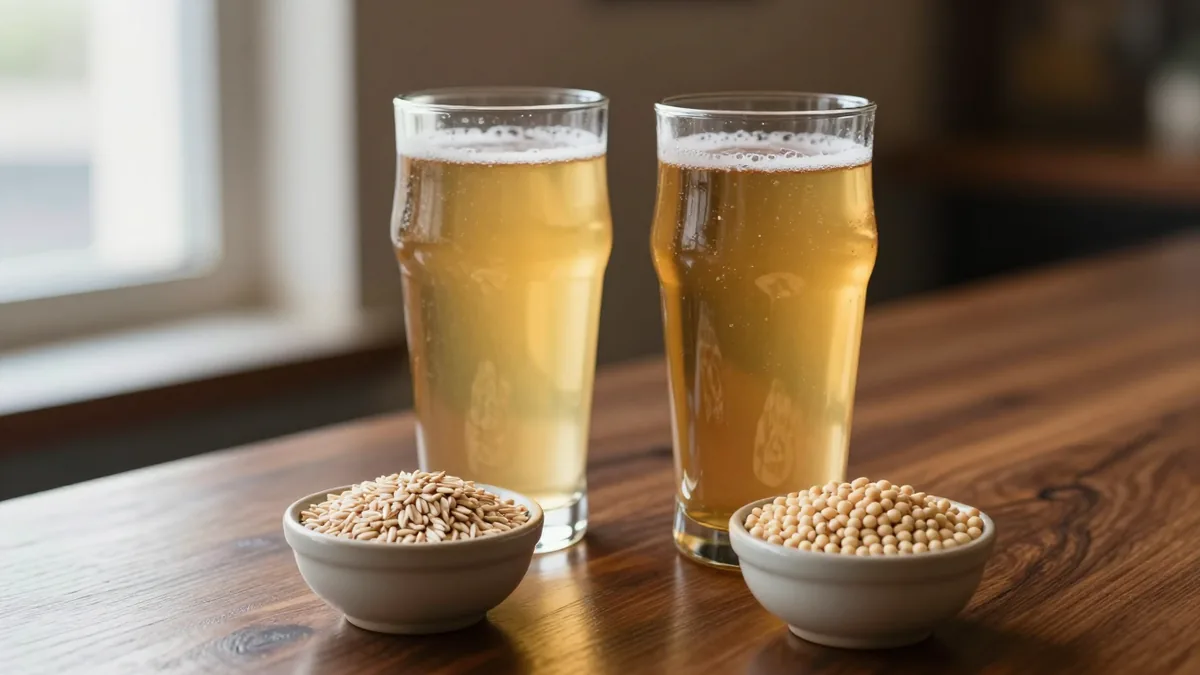
Gluten-free beer is brewed from grains with no gluten, such as sorghum, rice or millet, and has to meet the FDA rule of under 20 ppm gluten. Gluten-reduced beer is barley beer treated with an enzyme, and its label must say "The gluten content of this product cannot be verified, and this product may contain gluten." In one 2021 study, an enzyme-treated barley beer tested under 10 ppm by ELISA yet still held 155 gluten peptides, against 158 in the untreated version.
Two labels, two regulators
Two federal agencies write the gluten rules for beer, and which one applies depends on the recipe.
- TTB (Alcohol and Tobacco Tax and Trade Bureau) labels "malt beverages". The law defines a malt beverage as one made from "malted barley with hops". A beer with barley malt and hops is TTB's.
- FDA labels every other beer. TTB Ruling 2008-3 says a beer brewed "from a substitute for malt (such as rice or corn) but without any malted barley" is not a malt beverage, and neither is a beer made without hops. Those fall under the FDA's food rules. The FDA's own Q&A gives the standard example: "An example of a beer subject to FDA labeling requirements is sorghum beer."
| Label wording | Typical grain bill | Regulator | What it promises |
|---|---|---|---|
| Gluten-free | Sorghum, rice, millet, corn | FDA (no malted barley) | No gluten grain used; under 20 ppm gluten |
| Crafted to remove gluten | Barley malt plus an enzyme | TTB | Gluten was reduced; amount cannot be verified |
| No gluten statement | Barley malt, wheat | TTB | Nothing; assume it contains gluten |
TTB copied the FDA definition. Under TTB Ruling 2020-2, dated October 13, 2020, "gluten-free" may appear on a beer label only "where the product would be entitled to make a 'gluten-free' labeling claim under the standards set forth in the FDA regulations." So the word means the same thing on both sides. The difference is the fallback claim each agency allows for barley beer.
Get beer science and style notes
How beer gets its bitterness, color and aroma, explained with numbers and sources. Free, unsubscribe from any email.
No fixed schedule. Unsubscribe from any email. 21+ only.
What "gluten-free" means for beer
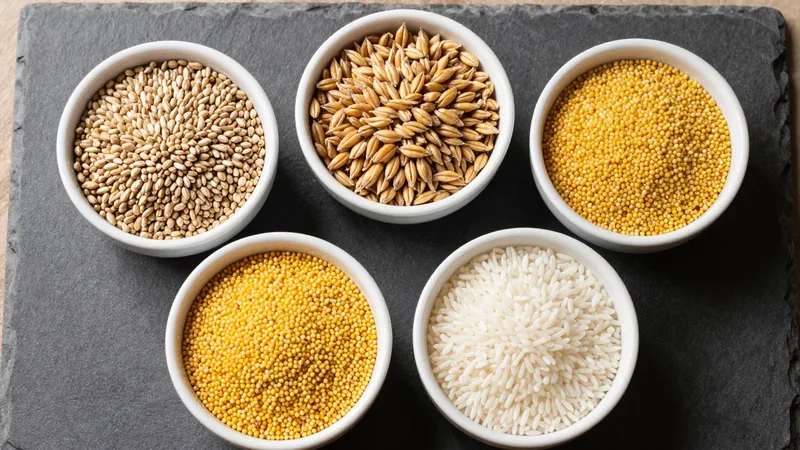
The rule is 21 CFR 101.91. A food labeled "gluten-free", "no gluten", "free of gluten" or "without gluten" must:
- Contain no ingredient that is a gluten-containing grain. The regulation lists three: wheat, rye and barley, plus crossbreeds such as triticale.
- Contain no ingredient derived from those grains unless it was processed to remove gluten and leaves the food under 20 ppm.
- Hold any unavoidable gluten below 20 ppm, which the rule spells out as 20 mg of gluten per kg of food.
Beer adds one more layer. Fermentation breaks proteins into fragments, and the FDA says standard tests do not measure fragments well. Its fermented-foods rule, published August 13, 2020, says the brewer must keep records showing the beer was gluten-free before fermentation, that cross-contact was evaluated, and that controls were put in place. Those records must be kept at least 2 years.
That rule shuts out barley malt directly. The FDA Q&A answers the question "Can ingredients such as barley malt and barley malt extract be used in foods bearing a 'gluten-free' claim?" with one word: "No." A barley beer cannot become gluten-free by being treated after the mash.
Why 20 ppm and not zero? The FDA says validated methods that could reliably detect gluten below 20 ppm "were not available" when it wrote the rule. The same figure is the Codex international threshold: 20 mg of gluten per kg, per the AOAC collaborative study on the R5 competitive ELISA.
What "crafted to remove gluten" means
Gluten-reduced beer starts as normal barley beer. The brewer then removes or breaks down gluten, usually with an enzyme that cuts gluten proteins into smaller pieces. TTB lets these beers say "[Processed or Treated or Crafted] to remove gluten", with three conditions from Ruling 2020-2:
- The label must carry this text, next to or continuing the claim: "Product fermented from grains containing gluten and [processed or treated or crafted] to remove gluten. The gluten content of this product cannot be verified, and this product may contain gluten." A disclaimer elsewhere on the label does not count.
- The brewer must file "a detailed description of the method used to remove gluten" with the label application.
- No claim about a specific gluten level ("contains x ppm") and no claim about the validity of a gluten test for fermented products. TTB treats both as misleading until a valid method exists.
TTB also bans any statement or symbol that links the product to "a disease or health-related condition (such as celiac disease)" unless it meets the health-claim rules. A "celiac safe" badge on a barley beer is not allowed.
The FDA side mirrors this. TTB's ruling notes that the FDA's 2020 rule lets FDA-labeled beers that miss the gluten-free definition use the same "crafted to remove gluten" wording if it is "truthful and not misleading."
The enzyme: proline-specific endoprotease
The enzyme in the studies below is a prolyl endopeptidase (PEP). The best-documented one comes from the mold Aspergillus niger, and it was not developed for gluten. DSM scientists described it in 2005 as a fix for chill haze: haze forms when polyphenols bind "proline-rich proteins", and an enzyme that cuts next to proline breaks those proteins up. Adding "even low levels of this acidic enzyme" during fermentation "effectively prevented chill-haze formation in bottled beer."
Gluten proteins are proline-rich too, which is why the same enzyme reduces the gluten an antibody test can see. The open question is whether it cuts the pieces small enough. Barley gluten is a family of proteins called hordeins, and a 2012 CSIRO study used mass spectrometry to show "that hordeins are indeed present in beer despite speculation to the contrary."
Why the lab test cannot settle it
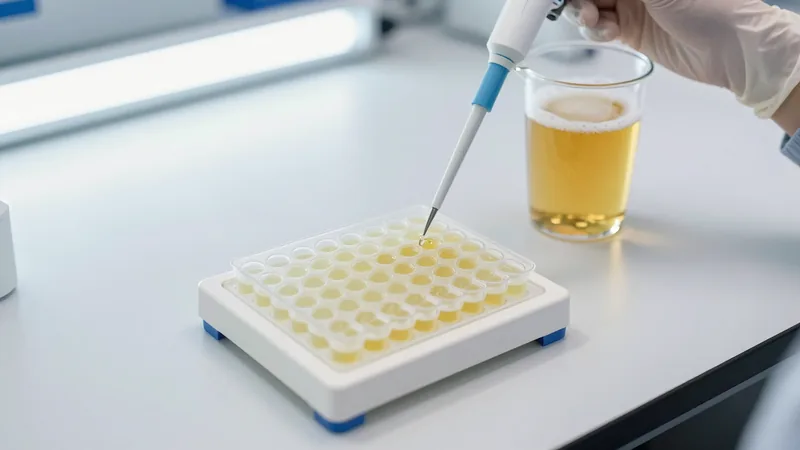
Gluten tests are mostly ELISAs: antibodies that bind a short stretch of the gluten protein. Cut the protein, and the antibody may miss the pieces. Mass spectrometry reads the peptides directly. When labs run both on beer, the results split.
- 60 beers, two methods. Tanner et al. (2013) found ELISA readings from zero up to 47,000 ppm for a wheat beer. About 20% of commercial beers read under 1 ppm by ELISA but had near-average hordein by mass spectrometry. False negatives: 6 beers read zero by ELISA but had near-average hordein.
- Spiked sorghum beer. FDA chemists added 20 µg/ml of wheat gluten to a sorghum beer and tested it with 7 ELISA kits. The most sensitive kit (0.25 ppm) tracked the gluten as it "dropped to 2 μg/ml" through fermentation. The R5 and G12 sandwich ELISAs "were unable to reliably detect gluten" once production started.
- Commercial gluten-reduced beers. Colgrave et al. (2017) found hordein in every beer they analyzed, including "many gluten-reduced beers", with fragments "many >30 kDa in size." They concluded "PEP digestion was incomplete in several commercial beers."
- FDA pilot brew. An FDA pilot-scale study brewed barley beer with PEP and filtration. Gluten proteins or polypeptides were still found by sandwich ELISA, western blot and mass spectrometry, and the gluten profile varied between 3 replicate batches.
The clearest pair of numbers comes from Watson et al. (2021), who compared an industrial PEP-treated barley malt beer with its untreated twin:
| Measure | Untreated beer | PEP-treated beer |
|---|---|---|
| Gluten by ELISA | 58 ppm | under 10 ppm |
| Gluten peptides found by mass spectrometry | 158 | 155 |
| Peptides with complete celiac motifs | 7 | 0 |
| Peptides with partial celiac motifs | 37 | 18 |
The ELISA number fell at least 83%. The peptide count fell 1.9%. The enzyme removed the complete celiac motifs, and the authors still flagged 18 peptides with partial, "potentially unsafe" motifs, many of which carry no R5 antibody site and "would be overlooked" by the standard ELISA.
A 2023 survey by the same CSIRO group found several beers sold as gluten-free with "equivalent or higher hordein content than some of the untreated, control beers." The FDA and TTB both say no scientifically valid method yet measures gluten in fermented foods as intact-gluten equivalents.
What celiac blood samples showed
A test that skips the chemistry: expose celiac patients' serum to the beer and see whether antibodies bind. Allred et al. (2017) used sera from 31 people with active celiac disease and 29 controls.
- No serum bound the gluten-free beer: 0 of 31.
- 11 celiac sera bound a barley extract (IgA or IgG), against 1 control.
- Of the 7 with an IgA response to barley, 4 also responded to traditional beer and 2 responded to the gluten-removed beer.
Small numbers, same direction as the lab data. The Celiac Disease Foundation reads the study the same way: "beers labeled 'gluten-removed' may not be safe for those with celiac disease." It adds that "removing" gluten by breaking it into fragments "has not been validated or accepted by the scientific and medical communities."
What to buy if you avoid gluten
- Celiac disease: pick beers labeled "gluten-free" and made from sorghum, rice, millet or other non-gluten grains. Read the ingredient list; barley malt or wheat on a gluten-free beer is a red flag. Skip "crafted to remove gluten" beers per the Celiac Disease Foundation. The FDA estimates celiac disease affects up to 3 million Americans and tells people sensitive to low gluten levels to "seek the advice of their health care providers." Follow your clinician, not a label.
- Avoiding gluten for other reasons: a gluten-reduced beer is a barley beer with less gluten that an ELISA can detect. How much is left cannot be verified, so decide with your doctor.
- Dedicated gluten-free breweries: ALT Brew at 1808 Wright St in Madison, Wisconsin is a dedicated gluten-free brewery, and it is one of the seven listings in our Madison brewery guide, a visitor’s selection rather than a count of every brewery in the city.
Style terms such as "pale lager" or "IPA" say nothing about gluten; see our style guide and glossary. Gluten status is separate from strength, covered in our ABV guide. Our 13-listing Baltimore guide identifies Checkerspot's beer as gluten-reduced, not gluten-free, a distinction to preserve when choosing a taproom. The 16 listings in our Asheville guide include Archetype, where the guide notes gluten-free taproom options without extending that description to every beer.
This article is informational and is not medical advice.
Frequently Asked Questions
Is gluten-reduced beer the same as gluten-free beer?
No. Gluten-free beer is brewed without wheat, rye or barley and meets the FDA's under-20-ppm rule. Gluten-reduced beer is brewed from barley and treated with an enzyme; its label must say the gluten content "cannot be verified."
Can a barley beer that tests under 20 ppm be called gluten-free?
No. The FDA says barley malt cannot be used in a food labeled gluten-free, and TTB applies the same standard. A test result does not change that, because no validated method measures gluten in fermented beer.
Who regulates gluten-free beer labels?
TTB for beers made from malted barley with hops, the FDA for the rest. A sorghum beer without barley malt is the FDA's standard example of an FDA-labeled beer.
Is "crafted to remove gluten" beer safe for celiac disease?
The Celiac Disease Foundation says it may not be. In one serum study, 2 of 7 celiac patients with an IgA response to barley also reacted to a gluten-removed beer. Ask your clinician.
What enzyme is used to make gluten-reduced beer?
A proline-specific endoprotease from Aspergillus niger, described in a 2005 paper as a chill-haze treatment. It cuts proline-rich proteins, including gluten, into peptides.
Sources
All checked Oct 1, 2026.
- eCFR (FDA regulation), 21 CFR 101.91 Gluten-free labeling of food, checked Oct 1, 2026.
- U.S. Food and Drug Administration, Questions and Answers: Gluten-Free Food Labeling Final Rule, checked Oct 1, 2026.
- Alcohol and Tobacco Tax and Trade Bureau, TTB Ruling 2020-2: Gluten Content Statements in the Labeling and Advertising of Wine, Distilled Spirits, and Malt Beverages, checked Oct 1, 2026.
- Alcohol and Tobacco Tax and Trade Bureau, TTB Ruling 2008-3: Classification of Brewed Products as "Beer" and as "Malt Beverages", checked Oct 1, 2026.
- Lopez and Edens, DSM Food Specialties, Effective prevention of chill-haze in beer using an acid proline-specific endoprotease from Aspergillus niger (J Agric Food Chem, 2005), checked Oct 1, 2026.
- Colgrave et al., CSIRO, What is in a beer? Proteomic characterization and relative quantification of hordein (gluten) in beer (J Proteome Res, 2012), checked Oct 1, 2026.
- Tanner et al., CSIRO, Measuring hordein (gluten) in beer: a comparison of ELISA and mass spectrometry (PLoS One, 2013), checked Oct 1, 2026.
- Panda et al., FDA, Detection and Quantification of Gluten during the Brewing and Fermentation of Beer Using Antibody-Based Technologies (J Food Prot, 2015), checked Oct 1, 2026.
- Lacorn and Weiss, R-Biopharm, Partially Hydrolyzed Gluten in Fermented Cereal-Based Products by R5 Competitive ELISA: Collaborative Study, First Action 2015.05 (J AOAC Int, 2015), checked Oct 1, 2026.
- Colgrave, Byrne and Howitt, CSIRO, Liquid Chromatography-Mass Spectrometry Analysis Reveals Hydrolyzed Gluten in Beers Crafted To Remove Gluten (J Agric Food Chem, 2017), checked Oct 1, 2026.
- Allred et al., Gluten Intolerance Group and University of Chicago, The Celiac Patient Antibody Response to Conventional and Gluten-Removed Beer (J AOAC Int, 2017), checked Oct 1, 2026.
- Fiedler et al., FDA, Detection of gluten in a pilot-scale barley-based beer produced with and without a prolyl endopeptidase enzyme (Food Addit Contam A, 2019), checked Oct 1, 2026.
- Watson et al., Ghent University, Peptidomics of an industrial gluten-free barley malt beer and its non-gluten-free counterpart (Food Chem, 2021), checked Oct 1, 2026.
- Nye-Wood et al., Edith Cowan University and CSIRO, Low Gluten Beers Contain Variable Gluten and Immunogenic Epitope Content (Foods, 2023), checked Oct 1, 2026.
- Celiac Disease Foundation, The Truth About Gluten-Free Beer, checked Oct 1, 2026.