In the US, "non-alcoholic" beer may contain up to, but not including, 0.5% alcohol by volume; only beer labeled "alcohol free" must contain none (27 CFR 7.65). A 12 oz can at 0.5% holds 1.4 g of ethanol, so about 10 cans equal one US standard drink of 14 g. If you avoid alcohol completely, in recovery or pregnancy, treat "non-alcoholic" as containing alcohol.
What the US label terms mean
For a focused look at the wording in the table below, read our guide to low-alcohol and reduced-alcohol label terms.
Federal malt beverage labeling rules are in 27 CFR 7.65. We read the current text on October 1, 2026:
| Label term | Alcohol allowed | Tolerance |
|---|---|---|
| "Alcohol free" | None. A sample must go to TTB for approval. | None |
| "Non-alcoholic" | Less than 0.5% ABV, with "contains less than 0.5% alcohol by volume" printed next to it | None |
| "Low alcohol" / "reduced alcohol" | Less than 2.5% ABV | None |
| Regular beer | Any stated ABV of 0.5% or more | 0.3 points either way |
Three details matter:
- "0.0%" is restricted. A malt beverage may not show 0.0% ABV unless it is also labeled "alcohol free" and contains no alcohol.
- Under 0.5%, the ABV may be printed to the hundredth (for example 0.35%), and no tolerance applies.
- Non-alcoholic and alcohol-free are different claims. FDA says the same for the products it regulates: it does "not consider the terms 'non-alcoholic' and 'alcohol-free' to be synonymous."
For how ABV works on regular beer, see ABV explained.
Get beer science and style notes
How beer gets its bitterness, color and aroma, explained with numbers and sources. Free, unsubscribe from any email.
No fixed schedule. Unsubscribe from any email. 21+ only.
Who regulates NA beer: TTB or FDA
The answer depends on the recipe, not only the alcohol. TTB's 2026 guide, Federal Regulation of Low and No Alcohol Beverages, lays it out:
- Under 0.5% ABV a drink is not an alcohol beverage under federal regulations. It is not taxable, and it does not need the Government Warning.
- Made with malted barley and hops: it is still a "malt beverage" under the Federal Alcohol Administration Act, and TTB's part 7 label rules apply "regardless of alcohol content."
- Made without malted barley and hops (a "cereal beverage"): FDA labeling rules apply.
- Either way, the IRC adds one required label statement: "Nontaxable under section 5051 I.R.C."
The Government Warning is required only at 0.5% ABV or more. Its first line reads: "women should not drink alcoholic beverages during pregnancy because of the risk of birth defects." A non-alcoholic beer does not have to carry it.
How brewers take the alcohol out
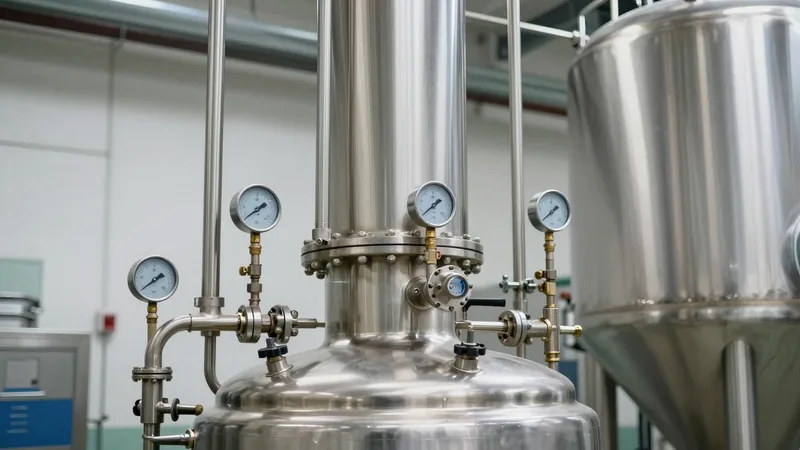
There are two routes. A 2026 review in Foods by D'Andrea and colleagues compares them:
- Remove alcohol after a normal fermentation (physical methods): vacuum distillation, spinning cone columns, reverse osmosis, nanofiltration, osmotic distillation.
- Never make much alcohol (biological methods): stop fermentation early, ferment cold, or use yeasts that cannot ferment maltose, such as Saccharomycodes ludwigii and Zygosaccharomyces rouxii.
| Method | Process conditions | Final ABV reported |
|---|---|---|
| Vacuum distillation | 34–50 °C; 60–200 mbar | 0.05–0.5% |
| Spinning cone column | 35–60 °C | 0.04–0.5% |
| Reverse osmosis | 5–20 °C; 10–40 bar | 0.45–0.5% |
| Nanofiltration | 19 ± 1 °C; 5–8.6 bar | under 0.5% |
| Osmotic distillation | 10–20 °C; atmospheric pressure | 0.4–1.1% |
| Arrested or limited fermentation | Fermentation at 8 °C | 0.3–1.0% |
| Special yeast strains | Fermentation at 10–20 °C | 0.05–2.32% |
Source: the review's Table 3, which compiles values from the studies it cites.
The trade-offs, in the review's words:
- Thermal methods are "costly and energy-intensive". Vacuum distillation lowers the boiling point so ethanol comes off at 34–50 °C under 60–200 mbar, but its main limit is "the unavoidable co-evaporation of flavour-active volatile compounds alongside ethanol".
- Membranes like reverse osmosis run cold (5–20 °C at 10–40 bar) and keep more aroma, but the reported end point is 0.45–0.5%, close to the legal line.
- Biological methods leave sugar behind: "high levels of residual sugars, an excessively sweet flavour". Cold-contact fermentation holds yeast at 0–8 °C for 24 to 100 h.
Brands describe their own processes on their pages. Guinness says it removes the alcohol from Guinness 0 "through a cold filtration method." For taproom options, our eight-listing Boulder guide notes Upslope's non-alcoholic lineup and Asher's hop water, which are different product categories. The ten listings in our Anchorage guide include King Street, whose draft list covers non-alcoholic ale and IPA alongside regular beers; check the specific label rather than inferring ABV from the venue.
How much alcohol is in a non-alcoholic beer
The label tells you a ceiling, not the exact number. One US standard drink is 14 g of pure alcohol (NIAAA). Using 29.57353 mL per fl oz (NIST) and ethanol's density of 0.7893 g/mL (PubChem):
| 12 oz can at | Ethanol | Cans to reach one standard drink |
|---|---|---|
| 0.5% ABV (label ceiling) | 1.4 g | 10.0 |
| 0.3% ABV | 0.84 g | 16.7 |
| 0.05% ABV | 0.14 g | 100 |
| 5% ABV (regular beer) | 14.0 g | 1 |
USDA's malt beverage entry, which includes non-alcoholic beer, lists 0.3 g of ethanol per 100 g, about 0.38% ABV. Try your own pour:
Everyday foods also contain traces of alcohol
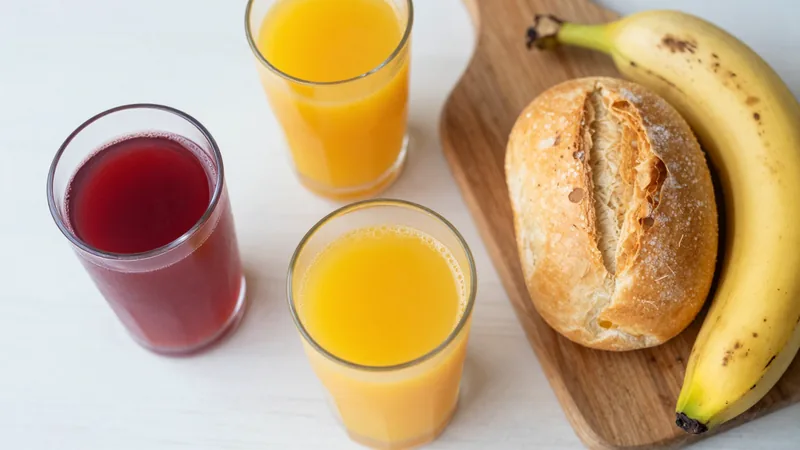
Fermentation does not only happen in breweries. Gorgus, Hittinger and Schrenk (2016) measured ethanol in foods sold in Germany:
- Red grape juice: up to 0.86 g per liter (about 0.109% ABV). An 8 oz glass holds 0.2 g.
- Orange juice: up to 0.73 g/L. Apple juice: up to 0.66 g/L, mean 0.26 g/L across 5 brands.
- American-style burger rolls: 1.28 g per 100 g.
- Very ripe bananas: 0.04 g per 100 g.
- German malt beer (Malzbier): up to 2.15 g/L, about 0.27% ABV.
FDA's guidance says the same: soft drinks and fruit juices "could actually contain traces of alcohol (less than 0.5 percent alcohol by volume)".
Read this chart carefully. A beer right at the 0.5% ceiling has about 3.95 g/L, 4.6 times the strongest grape juice measured. A beer near 0.05% has less than the strongest grape, orange and apple juices in the study. The label alone does not tell you which one you are holding; the printed ABV, when given to the hundredth, does.
Calories and carbs in NA beer
Taking out alcohol takes out calories, but carbs often go up, especially with biological methods. Per 12 fl oz:
| Beer | Calories | Carbs (g) |
|---|---|---|
| USDA regular beer | 153 | 12.6 |
| Heineken Original | 142 | 11 |
| Heineken 0.0 | 69 | 16 |
| Guinness 0 (from per-100 mL label) | 60 | 13.5 |
| USDA malt beverage incl. NA beer | 131 | 28.6 |
Samuel Adams lists its Non-Alcoholic Hazy IPA at <0.5% ABV and 98 calories. More on where beer calories come from in our beer calories and carbs guide.
The market is still small in the US
Global non-alcoholic beer consumption passed 2.5 billion liters in 2024, up more than 40% on 2018, per the Foods review. Share of total beer sales volume in 2024 (review's Table 1, from industry data):
| Country | NA and low-alcohol share of beer sales |
|---|---|
| Germany | 14.3% |
| Czech Republic | 8.5% |
| Spain | 7.3% |
| Japan | 6.5% |
| France | 5.6% |
| Poland | 5.0% |
| UK | 1.7% |
| Brazil | 1.1% |
| USA | 1.0% |
The review forecasts the US share at 1.2% by 2029. Germany's share is 14 times the US share.
Who should skip NA beer
The label rule is the plain answer: "non-alcoholic" means under 0.5% alcohol, not zero. Only "alcohol free" means none.
- Pregnancy: the Government Warning is about alcohol in pregnancy, and NA beer is exempt from carrying it. If you are avoiding alcohol entirely, choose a product labeled "alcohol free" or 0.0%.
- Recovery from alcohol use disorder: a systematic review of 10 studies found that "Craving and desire to drink have been found to increase after the consumption of NoLo drinks in patients with AUD". The taste and ritual can act as a cue, apart from the alcohol. Talk to your clinician or program first.
- Under 21: NA beer is built to taste like beer. Treat it as an adult drink.
Unfamiliar terms are in the glossary.
Frequently Asked Questions
Does non-alcoholic beer have alcohol?
It can. US "non-alcoholic" beer must be under 0.5% ABV. Only beer labeled "alcohol free" (0.0%) must contain no alcohol.
Can you get drunk on non-alcoholic beer?
At the 0.5% ceiling, it takes about 10 cans of 12 oz to equal one standard drink of 14 g; at 0.05% it takes about 100.
Is 0.0 beer really alcohol free?
In the US a malt beverage may show 0.0% only if it is labeled "alcohol free" and contains no alcohol. Some other markets use "alcohol-free" for beer under 0.05%.
How is alcohol removed from beer?
By vacuum distillation, spinning cone columns, or membranes such as reverse osmosis after normal fermentation, or by limiting fermentation with cold, early stopping, or yeasts that cannot ferment maltose.
Does non-alcoholic beer have fewer calories?
Usually. Heineken 0.0 has 69 calories against 142 for Heineken Original, but 16 g of carbs against 11 g. The 73-calorie gap is the alcohol term: at 0.0% there is no ethanol to count, and the beer calorie calculator shows the same trade-off once a full-strength pour's ABV and carbs go in.
Is non-alcoholic beer safe during pregnancy?
The Government Warning covers alcohol in pregnancy and NA beer under 0.5% is not required to carry it. If you are avoiding all alcohol, choose a product labeled "alcohol free" and ask your doctor.
Sources
- eCFR / TTB, 27 CFR 7.65 Alcohol content (malt beverage labeling), checked October 1, 2026.
- Alcohol and Tobacco Tax and Trade Bureau, Federal Regulation of Low and No Alcohol Beverages (2026), checked October 1, 2026.
- U.S. Food and Drug Administration, CPG Sec 510.400 Dealcoholized Wine and Malt Beverages: Labeling, checked October 1, 2026.
- Foods (MDPI), via PubMed Central, D'Andrea et al. (2026), Non-Alcoholic and Low-Alcohol Beer: Regulatory Complexity, Market Expansion and Technical Bottlenecks in Biological and Physical Dealcoholisation, Foods 15:2822, checked October 1, 2026.
- Journal of Analytical Toxicology, via PubMed Central, Gorgus, Hittinger and Schrenk (2016), Estimates of Ethanol Exposure in Children from Food not Labeled as Alcohol-Containing, Journal of Analytical Toxicology 40(7), checked October 1, 2026.
- Nutrients (MDPI), via PubMed Central, Caballeria et al. (2022), "Doctor, Can I Drink an Alcohol-Free Beer?" Low-Alcohol and Alcohol-Free Drinks in People with Heavy Drinking or Alcohol Use Disorders: Systematic Review, Nutrients 14:3925, checked October 1, 2026.
- National Institute on Alcohol Abuse and Alcoholism, What Is A Standard Drink?, checked October 1, 2026.
- PubChem, NIH, Ethanol (CID 702): Density, checked October 1, 2026.
- NIST, NIST Guide to the SI, Appendix B.9: Factors for units listed by kind of quantity, checked October 1, 2026.
- USDA FoodData Central, Malt beverage, includes non-alcoholic beer (FDC ID 174863, SR Legacy), checked October 1, 2026.
- USDA FoodData Central, Alcoholic beverage, beer, regular, all (FDC ID 168746, SR Legacy), checked October 1, 2026.
- Heineken USA, Heineken range: nutritional values, checked October 1, 2026.
- Guinness (US), Guinness 0 non-alcoholic beer, checked October 1, 2026.
- Samuel Adams, Non-Alcoholic Hazy IPA, checked October 1, 2026.