ABV is the share of a beer's volume that is ethanol. A US label may be off by up to 0.3 percentage points, so a beer labeled 5% can test 4.7% to 5.3%. One US standard drink is 14 g of pure alcohol: a 12 oz beer at 5%. That 14 g is also the biggest calorie term in the glass — ethanol runs 7 kcal a gram, so the alcohol alone is near 100 calories — and the beer calorie calculator adds the carbohydrate side of the pour. BJCP style ranges run from 2.8% (Berliner Weisse, American Light Lager) to 12.0% (Imperial Stout, American Barleywine).
What ABV means on a US label
For the legal terminology behind these labeling rules, see our explanation of beer versus malt beverage definitions.
ABV (alcohol by volume) is milliliters of ethanol per 100 mL of beer. A 12 oz beer at 5% holds about 14.0 g of ethanol.
The federal rules for malt beverage labels are in 27 CFR 7.65, which TTB enforces. We read the current text on October 1, 2026:
| Rule | What the regulation says |
|---|---|
| Unit | Alcohol content must be stated as a percentage by volume. Alcohol by weight is allowed only next to the ABV statement. |
| Precision | At 0.5% ABV or more, round to the nearest 0.1 percentage point. |
| Tolerance | 0.3 percentage points above or below the stated figure. |
| "Non-alcoholic" | Less than 0.5% ABV, with that statement printed next to the term. |
| "Low alcohol" / "reduced alcohol" | Less than 2.5% ABV, with no tolerance. |
| "Alcohol free" | No alcohol at all, no tolerance. |
Two things surprise people:
- The ABV statement is not federally required on most beer. 27 CFR 7.63 makes alcohol content mandatory only for malt beverages with alcohol from added nonbeverage flavors or ingredients. Section 7.65 itself defers to State law where a state requires or bars the statement.
- The tolerance is wide in relative terms. 0.3 points on a 5% beer is 6% of the stated alcohol. A 12 oz can labeled 5% can hold 0.94 to 1.06 standard drinks and still comply.
Get beer science and style notes
How beer gets its bitterness, color and aroma, explained with numbers and sources. Free, unsubscribe from any email.
No fixed schedule. Unsubscribe from any email. 21+ only.
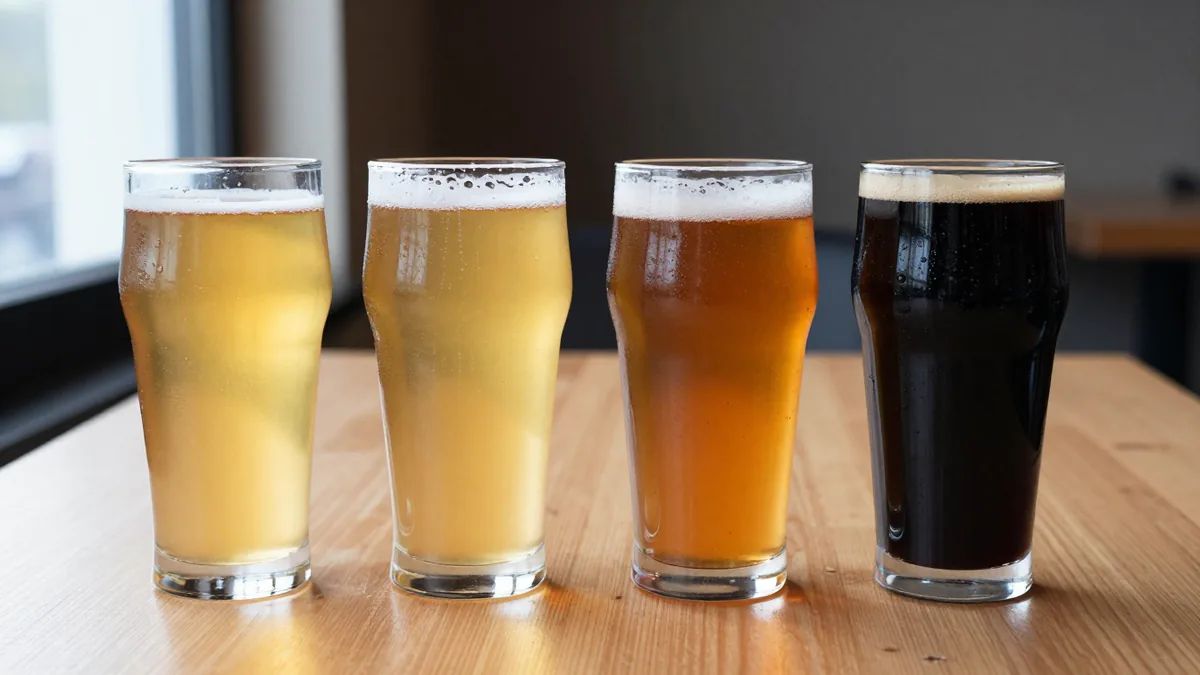
Typical ABV by beer style
The Beer Judge Certification Program (BJCP) 2021 guidelines give a vital-statistics ABV range for every style. We pulled 13 common ones, from the weakest to the strongest:
| Style (BJCP code) | ABV range |
|---|---|
| Berliner Weisse (23A) | 2.8–3.8% |
| American Light Lager (1A) | 2.8–4.2% |
| Irish Stout (15B) | 3.8–5.0% |
| American Lager (1B) | 4.2–5.3% |
| Weissbier (10A) | 4.3–5.6% |
| German Pils (5D) | 4.4–5.2% |
| American Pale Ale (18B) | 4.5–6.2% |
| American IPA (21A) | 5.5–7.5% |
| Hazy IPA (21C) | 6.0–9.0% |
| Belgian Tripel (26C) | 7.5–9.5% |
| Double IPA (22A) | 7.5–10.0% |
| Imperial Stout (20C) | 8.0–12.0% |
| American Barleywine (22C) | 8.0–12.0% |
What the table shows:
- Most everyday beer sits at 4.2–6.2%. American Lager, German Pils, Weissbier, Irish Stout and American Pale Ale all fall in or near that band.
- Dark does not mean strong. Irish Stout tops out at 5.0%, below many pale ales. Imperial Stout starts at 8.0%.
- IPAs climb fast. American IPA runs 5.5–7.5%, Hazy IPA 6.0–9.0%, Double IPA up to 10.0%. Our IPA vs pale ale vs hazy IPA breakdown covers those three in detail.
- Belgian Tripel sits at 7.5–9.5%. That is the strength range behind the quiz’s Belgian Explorer result, which names tripel, dubbel, saison and Belgian golden strong ale for a drinker who takes their time with a 9% pour.
Light beer is closer to regular beer than its name suggests. NIAAA puts typical light beer at 4.2% against 5% for regular beer, "about 85% as much" alcohol. More style data is on our styles page.
Standard drinks: what a pour actually holds
NIAAA defines one US standard drink as 14 g, or about 0.6 fl oz, of pure alcohol. NIAAA says knowing the count "can help you understand how much alcohol you are consuming." For beer, the count depends on two numbers: pour size and ABV.
The math:
standard drinks = fl oz x 29.57353 mL x ABV x 0.7893 g/mL / 14 g
The 29.57353 mL per US fluid ounce is from NIST SP 811; 0.7893 g/mL is the density of ethanol at 20 °C from PubChem. Run it for a 12 oz beer at 5% and you get 1.0, which is why that beer is the reference drink.
| Pour | Standard drinks |
|---|---|
| 12 oz at 4.2% (light beer) | 0.84 |
| 12 oz at 5% (regular beer) | 1.0 |
| 16 oz pint at 5% | 1⅓ (NIAAA) |
| 16 oz at 7% (IPA) | 1.87 |
| 16 oz at 9% (strong hazy IPA) | 2.4 |
| 12 oz at 12% (imperial stout) | 2.4 |
| 22 oz bomber at 5% | 2 (NIAAA) |
| 40 oz at 5% | 3⅓ (NIAAA) |
NIAAA's Rethinking Drinking table gives the 1⅓, 2 and 3⅓ figures for regular beer, and 2 drinks in 16 oz of 7% malt liquor. Its main page says the same thing as our rows above: a 12 oz beer at 10% "contains two standard drinks."
The practical point: a 16 oz can of a 9% hazy IPA is about 2.4 standard drinks. Counting it as "one beer" undercounts by more than half.
How brewers measure ABV
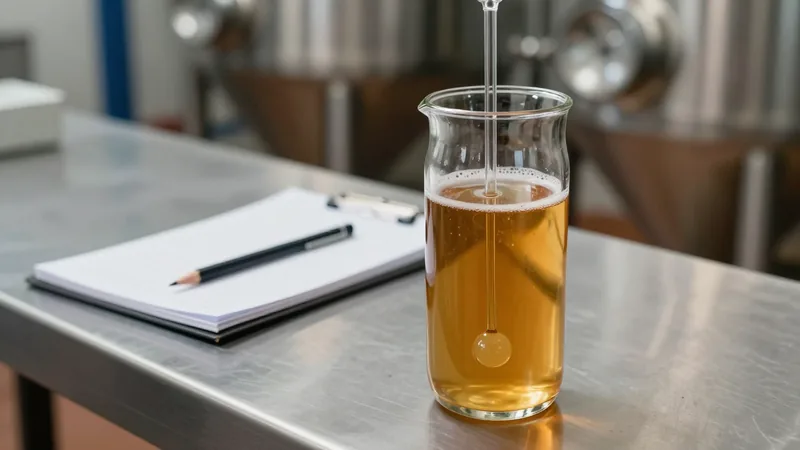
Brewers do not measure alcohol directly during fermentation. They measure specific gravity (density relative to water) with a hydrometer or refractometer twice:
- Original gravity (OG) before the yeast goes in. Sugar makes wort denser than water.
- Final gravity (FG) after fermentation. Yeast has turned sugar into ethanol and CO2, and ethanol is lighter than water.
The drop from OG to FG tracks how much sugar became alcohol. Brewer's Friend lists the two formulas homebrew software uses:
- Standard:
ABV = (OG - FG) x 131.25 - Alternate:
ABV = (76.08 * (OG - FG) / (1.775 - OG)) * (FG / 0.794)
The standard formula is a straight line. The alternate one bends upward as OG rises, so it gives higher numbers for strong beers. Worked examples:
| OG | FG | Standard | Alternate | Gap |
|---|---|---|---|---|
| 1.050 | 1.010 | 5.25% | 5.34% | 0.09 pts |
| 1.065 | 1.012 | 6.96% | 7.24% | 0.28 pts |
| 1.085 | 1.015 | 9.19% | 9.87% | 0.68 pts |
| 1.100 | 1.020 | 10.50% | 11.58% | 1.08 pts |
At OG 1.050 the two agree within 0.09 points. At OG 1.100 they differ by 1.08 points, more than three times the TTB label tolerance. Both formulas estimate alcohol from density; neither measures ethanol directly.
The same formula sizes a mead. Fifteen pounds of honey in a 5-gallon must is about 1.108 OG, so the standard (OG − FG) × 131.25 puts it at 14.2% if it finishes at 1.000 — and how to make mead covers the staggered nutrients a must that strong needs to reach that number instead of stalling.
The partial mash guide applies that arithmetic to a split grain bill: 4.4 lb (2 kg) of pale malt mashed at 152–153°F (67°C) plus 3.3 lb (1.5 kg) of liquid malt extract make 5 gal (19 L).
The worked examples above are the standard formula's own output, so they are also the calculator's: the ABV calculator opens on OG 1.050 and FG 1.010 and returns the table's 5.25%, with 5.34% from the alternate formula and 80% apparent attenuation, the same (OG - FG) / OG arithmetic that puts 1.040 to 1.010 at a 75% apparent attenuation. Enter your own two readings to check a batch you have already brewed against both formulas.
Why the same style can vary so much
Two beers with the same OG can finish at different ABVs. FG depends on the yeast strain, mash temperature and how much unfermentable sugar the recipe carries. The BJCP ranges reflect that: Imperial Stout lists an FG of 1.018–1.030 because those beers keep residual sweetness, while American Light Lager can finish as low as 0.998, lighter than water.
If you brew, our homebrewing cost breakdown shows what a 5-gallon batch costs per bottle. For how style choices affect bitterness, see what IBU measures. Unfamiliar terms are in the glossary.
Frequently Asked Questions
What does ABV stand for?
Alcohol by volume: milliliters of ethanol per 100 mL of beer. US federal rules in 27 CFR 7.65 require any alcohol statement on a malt beverage label to use ABV, rounded to 0.1 point.
How accurate is the ABV on a beer label?
Within 0.3 percentage points either way for beer at 0.5% ABV or more. A beer labeled 5% can legally be 4.7–5.3%. Beer labeled "low alcohol" must stay under 2.5% with no tolerance.
Is non-alcoholic beer alcohol free?
No. "Non-alcoholic" means less than 0.5% ABV, and the label must say so next to the term. Only beer labeled "alcohol free" must contain no alcohol.
How many standard drinks are in a pint of IPA?
A 16 oz pour at 7% is 1.87 standard drinks; at 9% it is 2.4. One standard drink is 14 g of alcohol, the amount in 12 oz of 5% beer.
Is light beer much weaker than regular beer?
Not much. NIAAA lists light beer at about 4.2% and regular beer at 5%, so light beer has about 85% as much alcohol.
Which ABV formula should homebrewers use?
The standard (OG - FG) x 131.25 is within 0.09 points of the alternate at OG 1.050. For strong beers the alternate formula reads higher; at OG 1.100 and FG 1.020 the gap is 1.08 points.
Sources
- eCFR / TTB, 27 CFR 7.65 Alcohol content (malt beverage labeling), checked October 1, 2026.
- eCFR / TTB, 27 CFR 7.63 Mandatory label information, checked October 1, 2026.
- National Institute on Alcohol Abuse and Alcoholism, What Is A Standard Drink?, checked October 1, 2026.
- NIAAA Rethinking Drinking, How Many Drinks are in Common Containers?, checked October 1, 2026.
- PubChem, NIH, Ethanol (CID 702): Density, checked October 1, 2026.
- NIST, NIST Guide to the SI, Appendix B.9: Factors for units listed by kind of quantity, checked October 1, 2026.
- Brewer's Friend, ABV Calculator: standard and alternate formulas, checked October 1, 2026.
- Beer Judge Certification Program, BJCP 2021 Style Guidelines: 23A Berliner Weisse, checked October 1, 2026.
- Beer Judge Certification Program, BJCP 2021 Style Guidelines: 1A American Light Lager, checked October 1, 2026.
- Beer Judge Certification Program, BJCP 2021 Style Guidelines: 15B Irish Stout, checked October 1, 2026.
- Beer Judge Certification Program, BJCP 2021 Style Guidelines: 1B American Lager, checked October 1, 2026.
- Beer Judge Certification Program, BJCP 2021 Style Guidelines: 10A Weissbier, checked October 1, 2026.
- Beer Judge Certification Program, BJCP 2021 Style Guidelines: 5D German Pils, checked October 1, 2026.
- Beer Judge Certification Program, BJCP 2021 Style Guidelines: 18B American Pale Ale, checked October 1, 2026.
- Beer Judge Certification Program, BJCP 2021 Style Guidelines: 21A American IPA, checked October 1, 2026.
- Beer Judge Certification Program, BJCP 2021 Style Guidelines: 21C Hazy IPA, checked October 1, 2026.
- Beer Judge Certification Program, BJCP 2021 Style Guidelines: 26C Belgian Tripel, checked October 1, 2026.
- Beer Judge Certification Program, BJCP 2021 Style Guidelines: 22A Double IPA, checked October 1, 2026.
- Beer Judge Certification Program, BJCP 2021 Style Guidelines: 20C Imperial Stout, checked October 1, 2026.
- Beer Judge Certification Program, BJCP 2021 Style Guidelines: 22C American Barleywine, checked October 1, 2026.