Mash pH: A Homebrewer's Guide
Aim for a mash pH of 5.2-5.6 measured on a sample cooled to room temperature (a hot reading runs about 0.3 lower). Pale all-base-malt mashes in soft water land near 5.7-5.8 and need calcium salts or a little lactic or phosphoric acid; dark roasted grists drop pH on their own and may need alkalinity added.
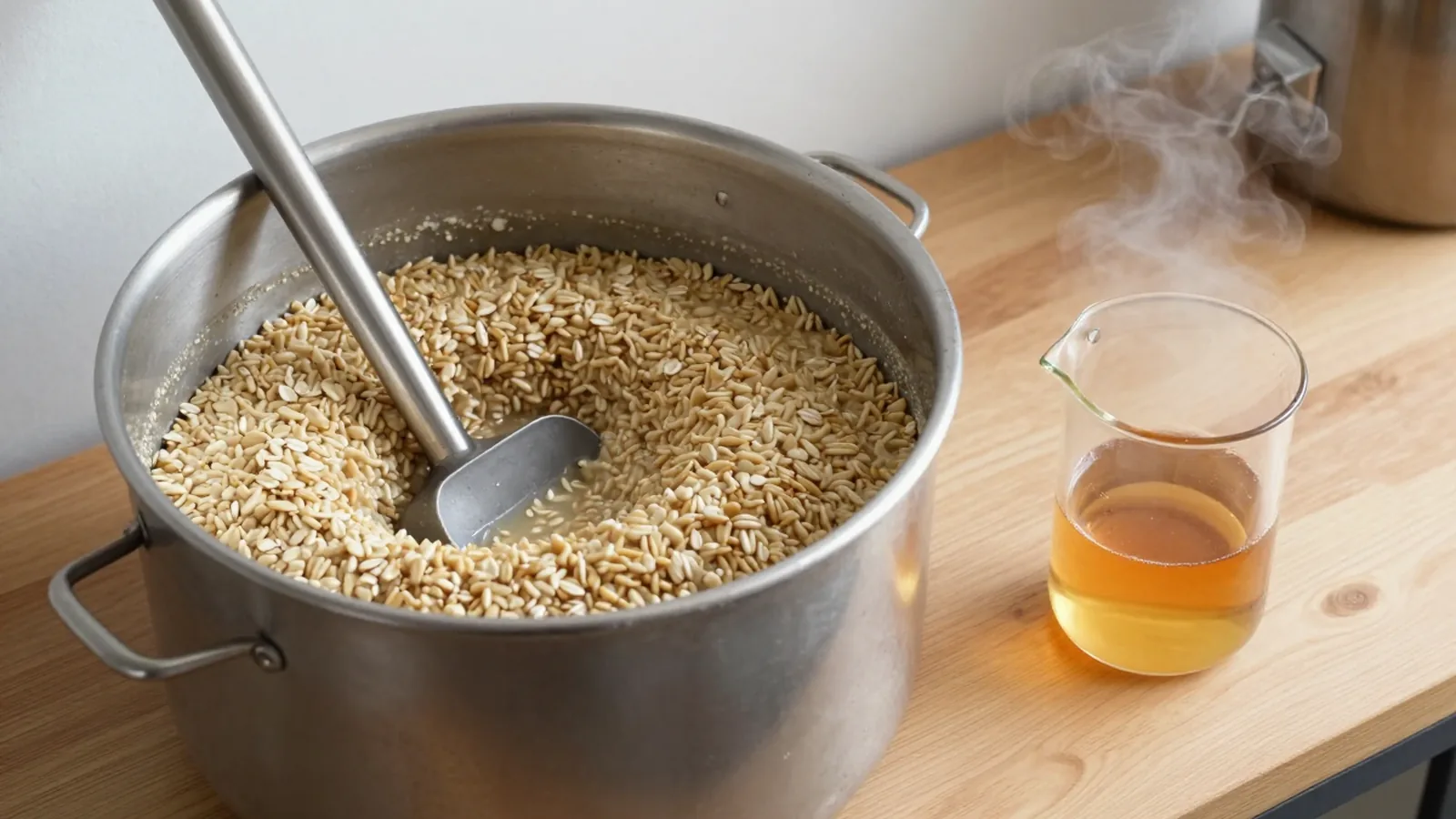
Mash pH is the acidity of the mash once water and crushed malt are mixed. It is set by the grist and the water together: malt, especially crystal and roasted malt, is acidic; water alkalinity (bicarbonate) pushes the other way; and calcium and magnesium react with malt to release acid. Measuring water pH alone tells you almost nothing. Getting the mash into range matters most for all-grain and BIAB brewers. Above about 6.0, the mash pulls harsh tannins and phenolics from husks. In range, enzymes convert well, the beer clarifies better and hop and malt flavors read cleaner. John Palmer stresses the point of perspective: enzyme activity depends more on temperature than pH, so the goal is to be in the right range, not to chase hundredths. You can predict pH with brewing software before brew day or measure it on the day and correct it. Prediction is good enough for many beers once your water and recipes are dialed in. Measurement with a calibrated meter is the only way to know, and it is what you need for very pale or very dark beers, where water and grist are most likely to fight each other.
At a Glance
Equipment
- Digital pH meter with automatic temperature compensation
- pH 4.0 and 7.0 calibration buffer solutions
- Electrode storage solution
- Small sample cups and a ladle or syringe
- Ice bath or small metal cup for cooling samples
- Lactic acid (88%) or phosphoric acid (10%)
- Baking soda or pickling lime for raising pH
- Gram scale and graduated syringe
Steps
- 1
Predict before brew day
Enter your water report and grain bill into brewing water software to estimate pH. In distilled water, 100% base malt gives about 5.7-5.8; 100% caramel malt about 4.5-4.8; chocolate malt 4.3-4.5; black malt 4.0-4.2. A dark crystal or roasted malt at 20% of the grist often drops pH by about 0.5.
Treat the prediction as a starting point. Measure to confirm.
- 2
Calibrate the meter
Calibrate with fresh pH 4.0 and 7.0 buffers at room temperature on brew day. Rinse the probe with distilled water between solutions.
Store the probe in storage solution, never in distilled water, or it drifts and dies early.
- 3
Mash in and stir
Mash in, stir thoroughly so there are no dry clumps, and let the mash settle for several minutes so the reading reflects the whole mash.
Measure early so a correction still has time to matter during conversion.
- 4
Pull and cool a sample
Draw a small sample of liquid and cool it to room temperature before reading. Hot samples read about 0.3 lower and shorten probe life.
Swirl the sample cup in an ice bath to cool it quickly.
- 5
Read and compare to target
The target is 5.2-5.6 at room temperature. Readings above about 6.0 mean tannin extraction is likely.
Write down the reading even if it is in range. It calibrates your predictions.
- 6
Lower pH if high
Add lactic acid (88%, about 11.8 mEq per mL) or phosphoric acid (10%, about 1.1 mEq per mL) in small, measured doses, stir, wait a few minutes and read again. Calcium salts lower pH too, more slowly.
Lactic acid is potent and adds a tang if overused in pale beers. Phosphoric is more flavor-neutral.
- 7
Raise pH if low
Dark, roast-heavy grists in very soft water can fall below range. Add alkalinity with baking soda (sodium bicarbonate) or pickling lime in small doses, or hold back part of the dark malt and add it at vorlauf.
Baking soda adds sodium. Keep the total under about 100 ppm.
- 8
Record and adjust the recipe
Log the starting pH, every addition and the final reading. Move next batch's correction into the water treatment plan so the mash starts in range.
Once a recipe hits range twice in a row, you can trust the prediction for that recipe and water.
Tips
- Compare readings at the same temperature every time; room temperature is the standard.
- Calibrate every brew day. Probe drift is the most common source of wrong pH decisions.
- Calcium at 50-150 ppm helps the mash reach range and supports clarity and yeast health.
- High-alkalinity water (alkalinity above 100 ppm as CaCO3) makes pale beers hard to get right; dilute with RO water.
- Sparge water with high alkalinity can raise pH late in the lauter and extract tannins. Treat sparge water too.
- Do not chase a perfect number. Within 5.2-5.6, temperature and time matter more for conversion.
Common Mistakes to Avoid
- Measuring the water's pH and assuming that is the mash pH.
- Reading a hot sample and comparing it to a room-temperature target.
- Skipping calibration or using old, contaminated buffers.
- Dumping in a large acid dose at once instead of small measured steps.
- Letting a pale mash sit near 6.0, which extracts harsh tannins.
- Over-correcting a dark beer and making it thin and acrid.