Hazy IPA (NEIPA) Process: A Homebrewer's Guide
Build a grist like an American IPA but with more flaked oats and wheat, treat water toward chloride (BYO suggests about 2:3 sulfate to chloride, each under 200 ppm), put most hops in the whirlpool and dry hop, and add the first dry hop during active fermentation. Target OG 1.060-1.085, FG 1.010-1.015 and 25-60 IBU (BJCP 21C), and keep oxygen out from the moment fermentation slows.
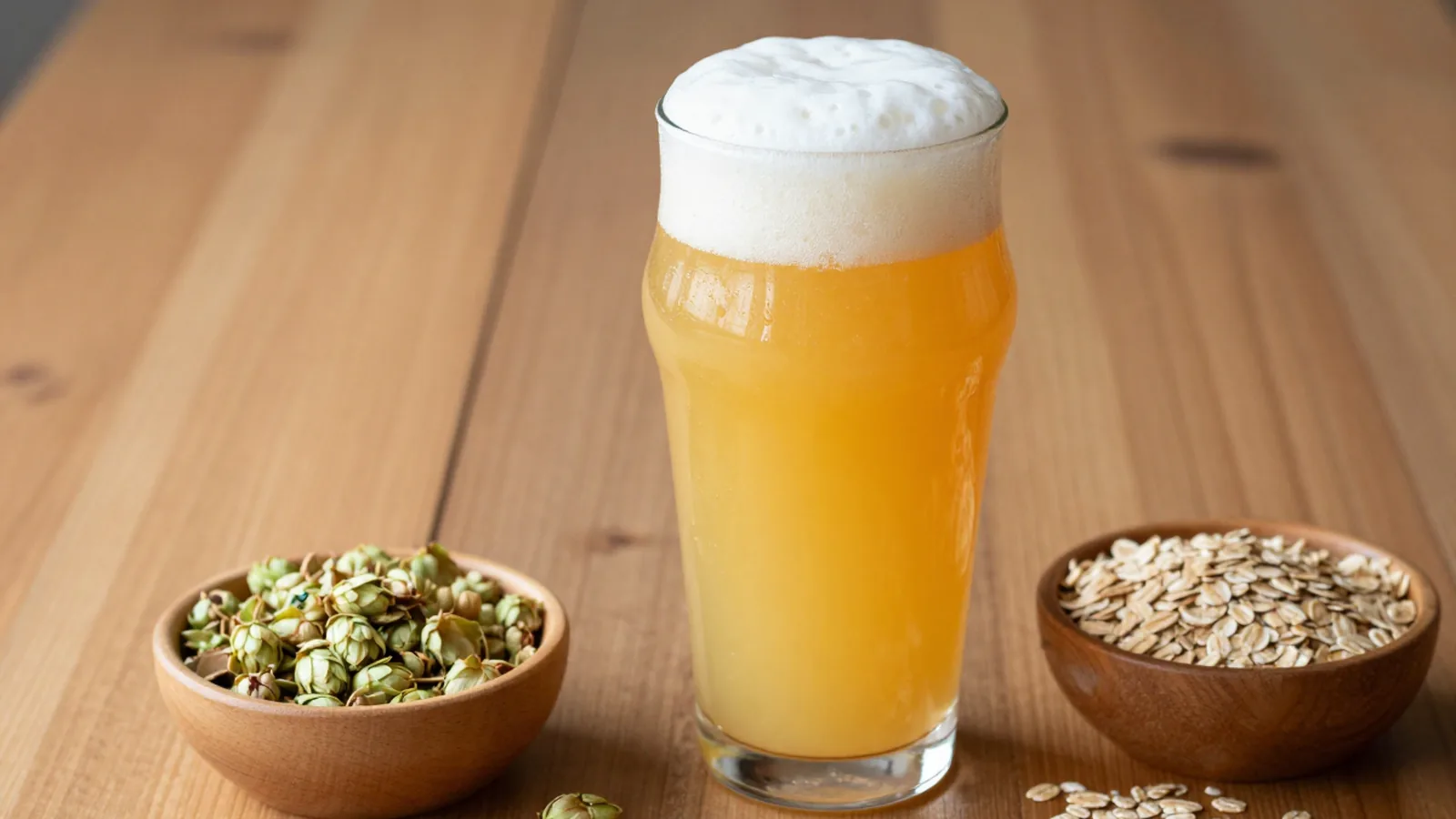
A hazy IPA, also called New England IPA, puts intense fruity hop aroma and flavor in front of bitterness. The BJCP 2021 guidelines (style 21C) describe high to very high fruity hop flavor, low to medium-high perceived bitterness, a soft, fuller body and a hazy appearance, at 6-9% ABV. The grist leans on flaked grains, the water leans on chloride, and most of the hops go in after the boil. This is an advanced all-grain process because small details show up in the glass. Heavy dry hopping during fermentation is part of the style; the BJCP calls out biotransformation of hop oils by yeast as a source of fruit complexity. Oxygen is the main enemy. Hazy IPAs carry so many hop compounds that a little oxygen at packaging turns them dull and dark within weeks. Compared with a West Coast IPA, you trade crisp bitterness and clarity for softness and aroma, and you accept a shorter shelf life. Compared with a pale ale, hop rates and cost per batch are much higher. If you do not have a way to transfer and package without oxygen pickup, brew a West Coast IPA until you do.
At a Glance
Equipment
- All-grain or BIAB brewing system
- Wort chiller capable of holding a whirlpool temperature
- Gram scale
- pH meter
- Fermenter with a dry-hop port or a sealed lid you can open under CO2
- Temperature-controlled fermentation chamber
- Oxygen wand and regulator
- CO2 tank and regulator
- Keg with a closed-transfer setup (jumper line or spunding valve)
- Hop bags or a dry-hop canister (optional)
Steps
- 1
Build the grist
Start like an American IPA and swap caramel malts for flaked grains. BYO's example for 5 gal (19 L) uses 9 lb 2-row, 2 lb Golden Promise, 1 lb flaked wheat and 12 oz flaked oats for an OG of 1.061. Malted oats, chit malt and white wheat malt are common alternatives.
Keep crystal malt out. The BJCP style calls for no caramel or toast flavor.
- 2
Treat the water
Start from RO water and add calcium chloride and gypsum. BYO's Scott Janish suggests a 2:3 sulfate-to-chloride ratio as a starting point and keeping each under 200 ppm; his brewery runs about 150 ppm chloride to 100 ppm sulfate.
Flaked grains carry fewer minerals than malt. Raise chloride slightly as the flaked share grows.
- 3
Mash simply
A single infusion works. The BYO profile mashes at 152°F (67°C) for 60 minutes, then mashes out at 168°F (76°C). Avoid intensive step mashes; the body-building starches from adjuncts are wanted.
Check mash pH and correct it into the 5.2-5.6 range.
- 4
Boil with minimal early hops
Keep early bittering small. Most of the bitterness should come from late additions. Boil 60-75 minutes.
A clean, high-alpha bittering hop in small amounts keeps the base neutral.
- 5
Whirlpool most of the kettle hops
Cool to the stand temperature, add the whirlpool hops and steep. BYO's profile adds them at 180°F (82°C) for 20 minutes. Janish's research summary found late hopping at 185°F (85°C) retained slightly more linalool than at 203°F (95°C) or 167°F (75°C).
Splitting the whirlpool into two additions at different temperatures builds more layered flavor.
- 6
Chill, oxygenate and pitch
Chill to about 64°F (18°C), oxygenate, and pitch a generous dose of an IPA strain such as LalBrew Verdant IPA (64-77°F (18-25°C), 75-82% attenuation, medium flocculation). Let the temperature rise naturally as fermentation proceeds.
Leave extra headspace. A large krausen plus dry hops can blow off.
- 7
Dry hop during active fermentation
Add the first dry hop about two days into active fermentation. The BJCP notes that dry hopping partly during active fermentation, and the biotransformation of hop oils by yeast, add depth and fruit complexity. Yeast activity also scrubs oxygen introduced with the hops.
Hops rich in bound aroma precursors suit this early addition.
- 8
Dry hop again at the end
Add the next dry hop at the end of fermentation and, if planned, a final one a few days later. Keep each charge in contact for two to three days. Research summarized by Janish found most oil extraction (about 80% of day-14 linalool) happens by day two.
Smaller, staged doses of 1.6-3.2 oz (45-90 g) extract more efficiently than one huge charge.
- 9
Transfer without oxygen
Purge the keg with CO2 and do a closed transfer from fermenter to keg. Do not cold crash with an open airlock; suck-back adds oxygen to a beer that has no tolerance for it.
Oxygen exposure on the cold side can visibly darken a hoppy beer quickly.
- 10
Carbonate and drink fresh
Force carbonate and serve cold. Hop aroma is the point of this style and it fades with time, so plan to drink it fresh.
Store kegs cold at all times. Warm storage speeds aroma loss.
Tips
- Chloride-forward water gives the soft, rounded mouthfeel; too much of either ion tastes minerally.
- Multiple smaller dry-hop doses beat one big dose for extraction efficiency.
- Short dry-hop contact (2-3 days per addition) limits grassy, vegetal character.
- Per the BJCP, the style should not taste sweet, and a creamy, buttery or acidic aroma is a fault. Give the yeast time to finish before packaging.
- Pick hops with fruity, tropical or stone-fruit character; grassy or herbal hops do not fit the style.
- Brew this beer when you can serve it soon. It does not age.
Common Mistakes to Avoid
- Opening the fermenter repeatedly for dry hops without purging, which adds oxygen.
- Cold crashing with an airlock and pulling air back in.
- Using crystal malt for color or body, which clashes with the hop fruit.
- Overloading early bittering hops and ending up with a harsh, bitter IPA.
- Leaving dry hops in contact for a week or more and picking up grassy flavors.
- Packaging warm, or storing kegs warm, and losing aroma in days.
- Packaging before gravity is confirmed stable after the last dry hop.