Yeast Starters: A Homebrewer's Guide
Boil 3.5 oz (100 g) of dry malt extract in 1 qt (1 L) of water for 10 minutes to make about 1.040 wort, cool it to room temperature, pitch the liquid yeast, and grow it at 70°F (21°C) for 24-36 hours, on a stir plate if you have one. Pitch it right away or refrigerate it for up to a week.
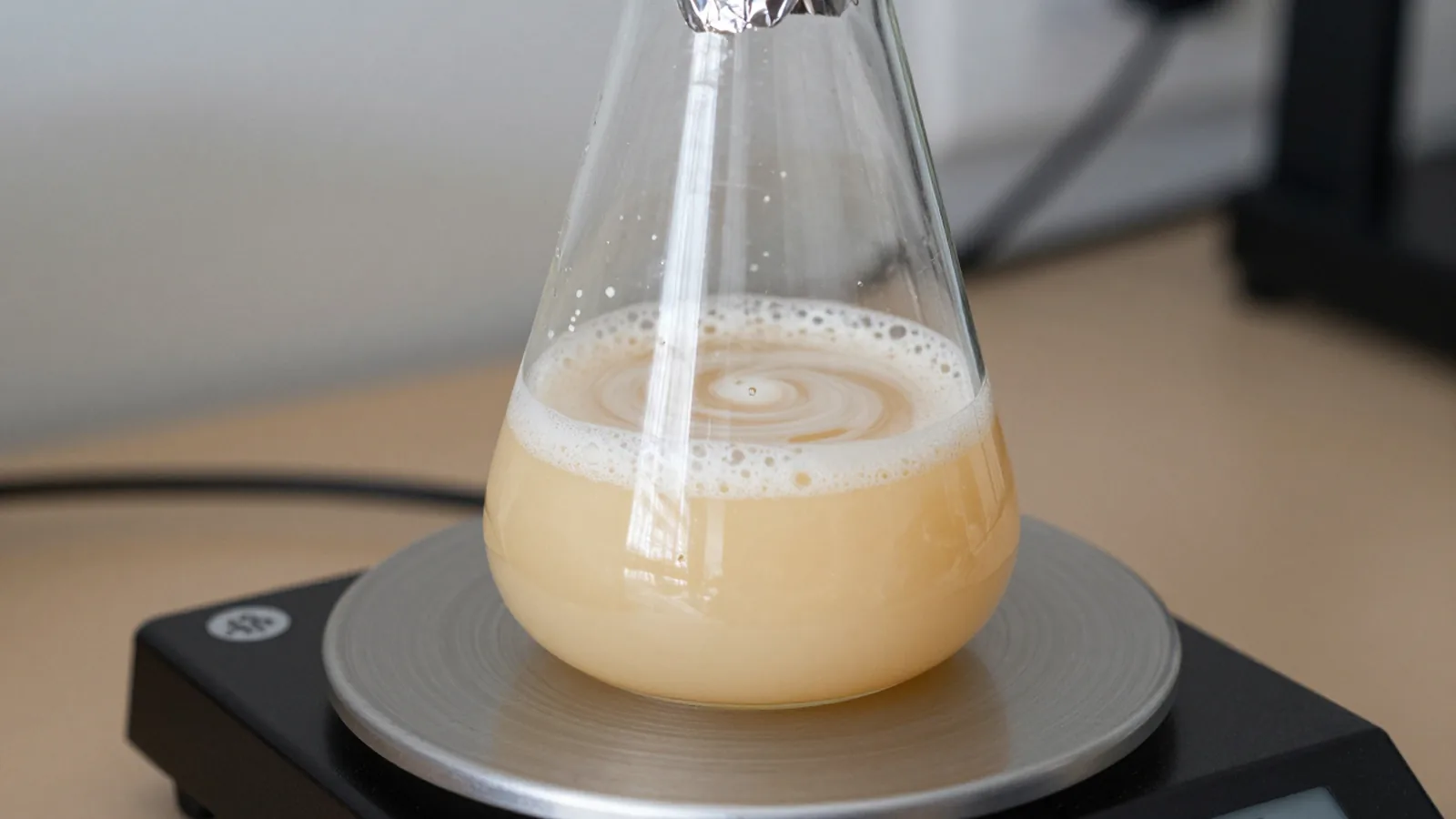
A yeast starter is a small fermentation you run a day or two before brew day to raise the number of healthy yeast cells. The usual pitching rule is about 1 billion cells per liter per degree Plato for repitched yeast, roughly 0.75 billion for fresh ale yeast and about 1.5 billion for lagers. One degree Plato is about 4 gravity points, so a 20 L (5.3 gal) batch at 1.044 (11°P) wants about 220 billion cells at the 1 billion rate. A fresh liquid pouch or vial holds roughly 100 billion. You need a starter when the math comes up short: ales above about 1.055, any lager, a liquid package that is weeks old, or yeast harvested from a bottle. A dry yeast packet, at roughly 6 billion cells per gram, gives 50-70 billion cells and covers 5 gal of most common ale styles without a starter. A single fresh liquid package needs no starter for lower-gravity beers around 4% ABV. The alternative is to buy more packages. That costs more per batch, but it skips a day of prep and a sanitation risk. A starter also lets you check that the yeast is alive before you commit a whole batch of wort to it. Stirring the starter on a stir plate increases cell growth by 25-50% over a still starter.
At a Glance
Equipment
- Erlenmeyer flask, 2 L or larger (or a sanitized glass jug)
- Magnetic stir plate and stir bar (optional)
- Dry malt extract (light)
- Yeast nutrient
- Small saucepan
- Aluminum foil or a foam stopper
- No-rinse sanitizer
- Kitchen scale
- Hydrometer
Steps
- 1
Size the starter
Find your target cell count from batch volume and gravity. For ales under 1.055, about 50-110 billion cells covers 5 gal; 1.055-1.065 needs about 110-170 billion; 1.065-1.075 about 170-225 billion.
A starter calculator that accounts for yeast age and stir plate use gives a closer number.
- 2
Boil the starter wort
Stir 3.5 oz (100 g) of DME into 1 qt (1 L) of water and boil for 10 minutes. Add 1/2 tsp of yeast nutrient. Cover for the last couple of minutes.
DME foams over quickly. Start with a pan bigger than you think you need.
- 3
Cool it
Set the covered pan in an ice bath until the wort reaches room temperature.
Pitching into hot wort kills the yeast you are trying to grow.
- 4
Transfer and pitch
Pour the cooled wort into the sanitized flask, add the stir bar, and pitch the yeast. Cover the neck loosely with sanitized foil.
Foil lets CO2 out and oxygen in while keeping dust off.
- 5
Grow the yeast
Keep the starter at about 70°F (21°C). Stir it on a stir plate or shake it whenever you pass by. Growth is usually maximized in 24-36 hours.
A stir plate keeps yeast in suspension and drives off CO2, which is where the extra growth comes from.
- 6
Step up if needed
If one starter is not enough, let it finish, then add a larger volume of fresh 1.040 wort and repeat.
Stepping up beats one huge starter from a single small package.
- 7
Decide how to pitch
Pitch the whole starter at high krausen if it is small and similar to your beer's wort. For a large starter, chill it, pour off most of the spent liquid, and pitch the slurry.
Decanting keeps a liter of oxidized starter beer out of a delicate lager.
- 8
Pitch or store
Use the starter immediately, or refrigerate it and use within one week. Let a chilled starter warm toward pitching temperature first.
Check starter gravity before pitching to confirm it fermented.
Tips
- Pitch rate rule of thumb: 1 billion cells per liter per °P, with about 0.75 billion for fresh ale yeast and about 1.5 billion for lagers.
- Ferment a lager starter no more than 5°F (3°C) above the planned fermentation temperature.
- A 2 qt (1.9 L) starter of 1.040 wort grown from 60 billion cells yields roughly 173 billion cells.
- Keep starter gravity near 1.040. Stronger starter wort stresses yeast instead of growing it.
- Make the starter one to two days before brew day so the yeast has time to finish and build reserves.
- Sniff and taste the spent starter. It should smell like plain beer, not sour or solvent.
Common Mistakes to Avoid
- Using sugar or a high-gravity wort for the starter. Yeast grown on simple sugar adapts to the wrong food.
- Sealing the flask with an airlock and never shaking it, which starves the yeast of oxygen.
- Pouring a large, oxidized starter beer into a light lager.
- Skipping sanitation because the starter is small. A contaminated starter infects the whole batch.
- Pitching a starter straight from the fridge into warm wort, which shocks the yeast.
- Pitching a starter without checking that its gravity dropped, which hides dead yeast until brew day.