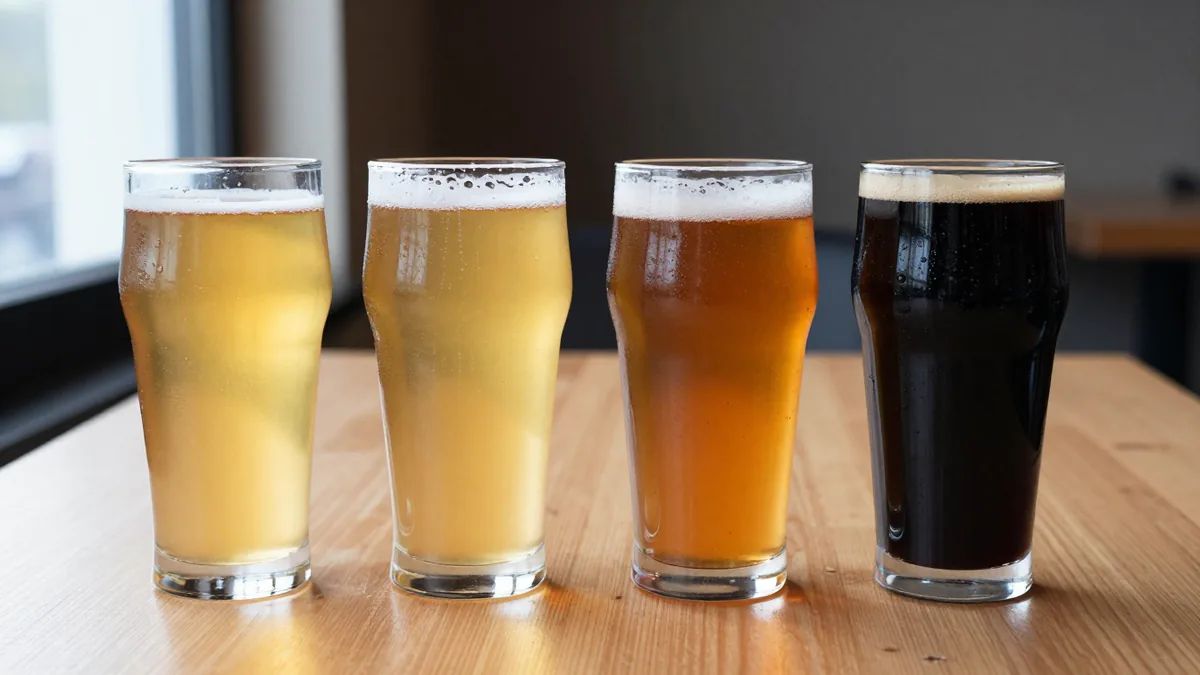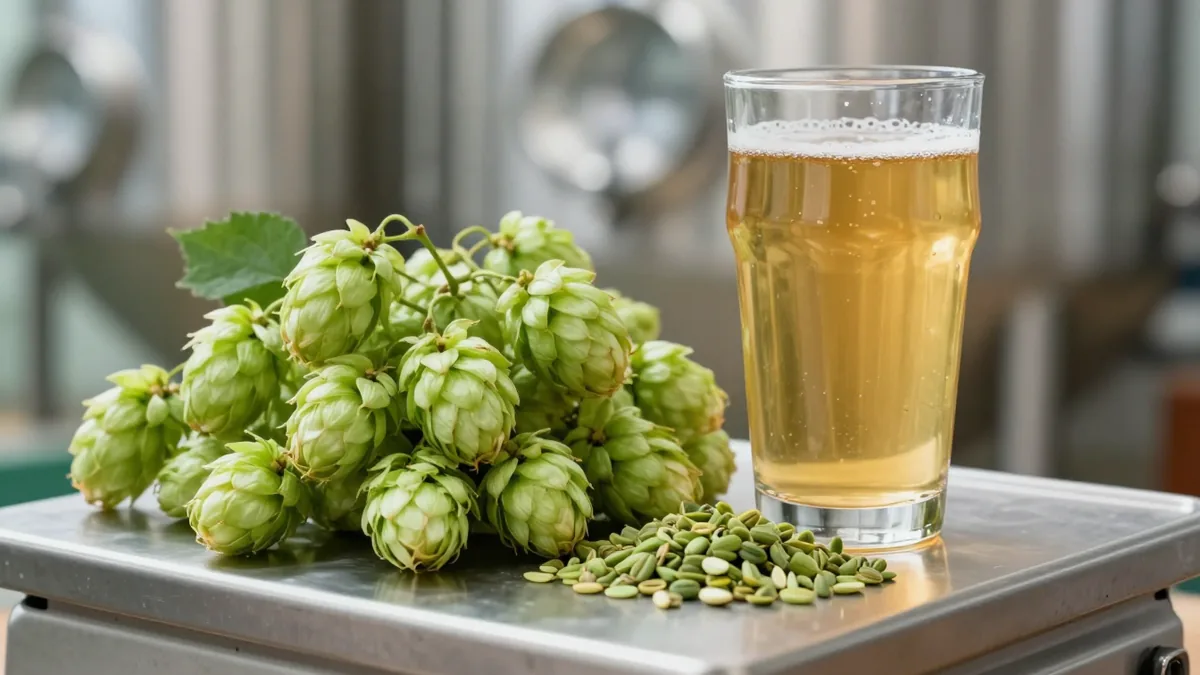
IBU (International Bitterness Units) is a lab number: beer is extracted with iso-octane and the absorbance at 275 nm is multiplied by 50. It tracks hop compounds such as iso-alpha acids and humulinones, not taste. The BJCP lists Hazy IPA at 25–60 IBU yet notes "less perceived bitterness than traditional IPAs", because malt sweetness and body mask bitterness. Use IBU with gravity (the BU:GU ratio), not alone.
What IBU actually measures
The lab does not weigh hop compounds directly. It measures ultraviolet light absorbance. The method described in two Foods papers on hop freshness, following the Analytica-EBC procedure, is:
- Take 10 mL of degassed beer.
- Add 0.5 mL of hydrochloric acid and 20 mL of iso-octane.
- Shake for 15 minutes so hop compounds move into the iso-octane layer.
- Measure that layer's absorbance at 275 nm (ultraviolet).
- BU = 50 × absorbance.
The weakness is in step 4. The method "measures all iso-octane-soluble compounds that absorb at 275 nm". In the kettle-hopping study by the same group, alpha acids, iso-alpha acids and humulinones all absorbed at 275 nm. They are not equally bitter. Humulinones, which form when hops oxidize, are about 66% as bitter as iso-alpha acids, per the dry-hop paper.
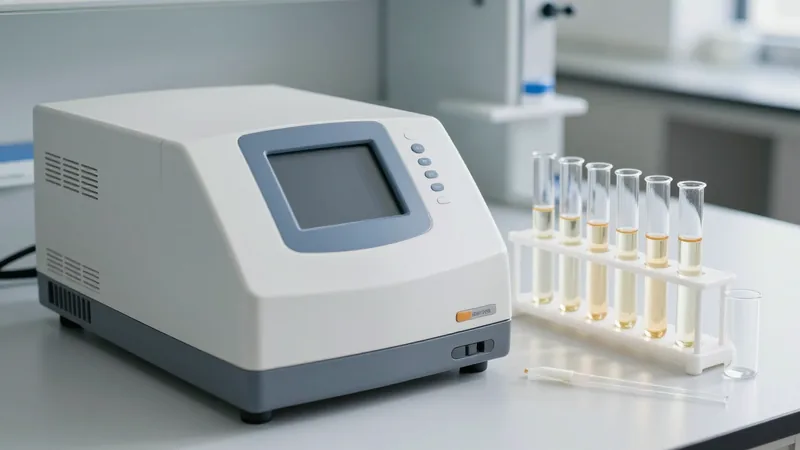
"BU" and "IBU" are used for the same lab number. Brewers also use "IBU" for the calculated estimate from a recipe, which is what the Tinseth formula below gives you. A calculated IBU and a lab IBU for the same beer can differ.
Get beer science and style notes
How beer gets its bitterness, color and aroma, explained with numbers and sources. Free, unsubscribe from any email.
No fixed schedule. Unsubscribe from any email. 21+ only.
IBU ranges by style
The BJCP 2021 guidelines give an IBU range for every style. A sample:
| Style | IBU | Original gravity |
|---|---|---|
| American Light Lager | 8–12 | 1.028–1.040 |
| Weissbier | 8–15 | 1.044–1.053 |
| Irish Stout | 25–45 | 1.036–1.044 |
| German Pils | 22–40 | 1.044–1.050 |
| Czech Premium Pale Lager | 30–45 | 1.044–1.060 |
| American Pale Ale | 30–50 | 1.045–1.060 |
| Hazy IPA | 25–60 | 1.060–1.085 |
| American IPA | 40–70 | 1.056–1.070 |
| Double IPA | 60–100 | 1.065–1.085 |
| Imperial Stout | 50–90 | 1.075–1.115 |
| American Barleywine | 50–100 | 1.080–1.120 |
The ranges overlap a lot. Irish Stout (25–45) and American Pale Ale (30–50) cover nearly the same band, and Hazy IPA's range (25–60) starts below German Pils's top end (40). Our 19-listing Austin guide records Independence's Stash IPA at 94 IBU and 7.5% ABV, a named beer's figures rather than a style-wide limit. The 13 listings in our Baltimore guide include Key Brewing's Positive Mental Attitude Pilsner and Dundalk Calling Double IPA; the style names do not provide a shared bitterness number. A drinker who wants the top of those ranges rather than the bottom is the profile the quiz’s Hop Chaser result describes, naming American IPA, hazy IPA, double IPA and American pale ale.
For how IPA, pale ale and hazy IPA differ beyond bitterness, see our IPA vs pale ale vs hazy IPA comparison.
Why IBU does not predict taste
The dry-hop paper puts it directly: "BU values do not always correlate with the actual perceived bitterness". Four things break the link:
- Malt sweetness and body. The BJCP Hazy IPA entry says bitterness is "often masked by the fuller body and soft, off-dry to medium finish". American Barleywine runs 50–100 IBU, but its bitterness is "tempered by a rich, malty palate".
- Which compounds are in the extract. Iso-alpha acids, humulinones and other hop compounds all read at 275 nm but taste different. Polyphenols have a 10-fold lower influence on BU and on perceived bitterness than humulinones, per the same paper.
- Dry hopping. Hops added after the boil add little iso-alpha acid but do add humulinones. In dry-hopped beers, the paper reports, humulinones are the main source of bitterness.
- Age. Bittering compounds break down in storage, so an old IPA tastes less bitter than its label. Our beer freshness guide has the storage numbers.
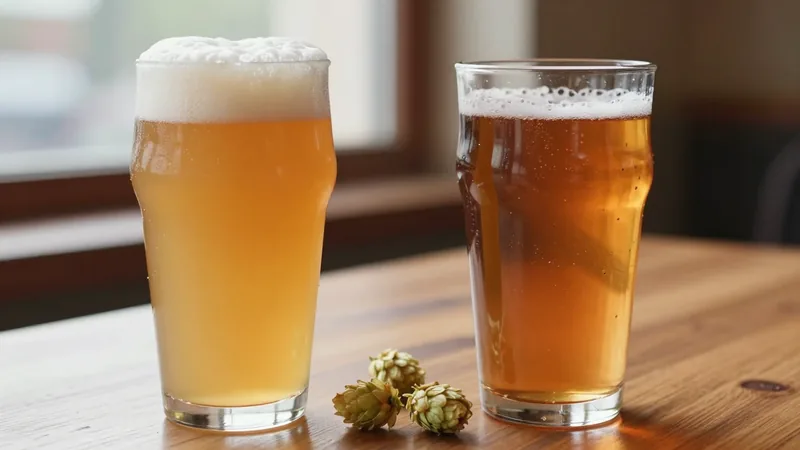
The practical fix is to read IBU next to gravity.
How brewers estimate IBU: the Tinseth formula
A widely used recipe model is the one Glenn Tinseth published on his hop utilization page. It has two parts.
Alpha acids added (mg/L):
- US units: AA as a decimal × ounces of hops × 7490 ÷ gallons of finished beer
- Metric: AA as a decimal × grams of hops × 1000 ÷ liters of finished beer
Utilization (the share of those alpha acids that ends up as bitterness):
- Bigness factor = 1.65 × 0.000125^(wort gravity − 1)
- Boil time factor = (1 − e^(−0.04 × minutes)) ÷ 4.15
- IBU = alpha acids added × bigness factor × boil time factor
Tinseth says to "Use an average gravity value for the entire boil", and that 4.15 is the number to adjust if your kettle gets higher utilization than his.
Worked example: 1 oz of 6% alpha acid hops in 5 gallons at 1.050, boiled 60 minutes. Alpha acids added = 89.9 mg/L. Utilization = 0.231, the same value (0.231) Tinseth's table lists for 60 minutes at 1.050. Estimate: 21 IBU. The same hops boiled 15 minutes give about 10 IBU; boiled 60 minutes in a 1.080 wort, about 16 IBU.
Hop form moves that ounce's price more than the Tinseth math does: cryo and lupulin pellets carried a median of $5.95 an ounce across 152 listings from 21 retailers in the October 2026 Homebrew Price Index, so the 1 ounce charge above costs $5.95 at that median, and the cheapest cryo hops guide records a $1.25 an ounce low and an $8.99 high.
Two things the curve shows:
- Boil time. At OG 1.060, a 60-minute addition reaches 21.1% utilization against 10.5% at 15 minutes, 2.0x more.
- Gravity. Moving from 1.040 to 1.080 cuts 60-minute utilization by 30%. Big beers need more hops for the same IBU.
The highest value in Tinseth's table is 30.1% (120 minutes at 1.030). Most of the alpha acid you add never becomes measured bitterness.
Hop timing: bittering, flavor and aroma additions
Brewers split hops by when they go in, and Tinseth's table shows why the split matters for IBU:
| Boil time | Utilization at OG 1.060 | What the addition is for |
|---|---|---|
| 60 min | 21.1% | Bittering |
| 30 min | 16.2% | Bitterness plus some flavor |
| 15 min | 10.5% | Flavor |
| 0 min (flameout) | 0.0% | Aroma |
The model assigns zero utilization at zero minutes, so flameout and dry-hop additions add nothing to a calculated IBU. That is a known gap. The dry-hop paper found that humulinones, which dry hops carry into the beer, are the main source of bitterness in dry-hopped beers. A heavily dry-hopped IPA can therefore taste and test more bitter than its recipe IBU.
A flameout addition keeps isomerizing until the wort cools, and the whirlpool hopping guide puts that line at 175–180°F (79–82°C), which is why a 160–170°F (71–77°C) stand held 10–90 minutes adds flavor with little new bitterness.
The reverse also happens. A 60-minute addition in a strong wort loses utilization to gravity, so a big beer brewed to a target IBU uses more hops per gallon than a session beer at the same number.
How to read IBU on a label
- Compare within a style, not across styles. 55 IBU is mid-range for an American IPA and would be off the chart for a Weissbier (8–15).
- Check the strength. Higher alcohol usually means higher gravity and more residual malt, which pulls perceived bitterness down.
- Discount hazy and very fresh dry-hopped beers. Their IBU number and their bitterness often disagree, in either direction.
- Discount old beer. A label IBU describes the beer when it was packaged.
Calculate your IBU and BU:GU
Enter each hop addition. The calculator applies Tinseth's formula and divides the result by gravity points (OG minus 1, times 1000) to give a BU:GU ratio you can compare with the style midpoints below.
If you brew at home, the homebrew cost breakdown covers what a batch costs.
BU:GU: bitterness relative to malt
BU:GU divides IBU by gravity points. A 1.050 beer has 50 gravity points; the worked example's 20.7 IBU gives a BU:GU of 0.41. Higher means more bitter-tasting balance. Using the BJCP midpoints:
- Weissbier: 0.24, the sweetest balance in this set.
- American IPA: 0.87.
- Hazy IPA: 0.59, below American Pale Ale's 0.76.
- Double IPA: 1.07, the most bitter balance here.
Irish Stout's 0.87 matches American IPA's 0.87: a dry stout at 35 IBU has the same bitter balance as an IPA at 55 IBU, because the stout has far less malt to offset it. These are our calculations from BJCP ranges, not BJCP figures. Our glossary defines the terms, and the style index has full profiles.
Frequently Asked Questions
What is a high IBU?
Among BJCP styles, Double IPA (60–100) and American Barleywine (50–100) reach 100. American Light Lager sits at 8–12.
Is IBU the same as BU?
They name the same lab measurement: 50 times the absorbance at 275 nm of an iso-octane extract. "IBU" is also used for calculated recipe estimates.
Why does my hazy IPA taste less bitter than its IBU?
Fuller body, residual sweetness and dry-hop compounds. The BJCP guideline says Hazy IPA has less perceived bitterness than traditional IPAs.
Does IBU drop as beer ages?
Yes. Bittering compounds degrade in storage, faster when warm. See our freshness guide.
How accurate is a calculated IBU?
It is an estimate tuned to one brewer's system. Tinseth tells brewers to adjust the 4.15 factor to match their own kettle, and a lab test of the finished beer can differ from the recipe number.
Sources
- Glenn Tinseth, Glenn's Hop Utilization Numbers, Internet Archive copy of realbeer.com/hops/research.html, checked 2026-10-01.
- Rutnik et al., Impact of Hop Freshness on Dry Hopped Beer Quality (Foods, 2022), checked 2026-10-01.
- Rutnik et al., The Impact of Hop Freshness on Kettle-Hopped Beers (Foods, 2023), checked 2026-10-01.
- BJCP, BJCP 2021 Style Guidelines: American Light Lager, checked 2026-10-01.
- BJCP, BJCP 2021 Style Guidelines: Weissbier, checked 2026-10-01.
- BJCP, BJCP 2021 Style Guidelines: Irish Stout, checked 2026-10-01.
- BJCP, BJCP 2021 Style Guidelines: German Pils, checked 2026-10-01.
- BJCP, BJCP 2021 Style Guidelines: Czech Premium Pale Lager, checked 2026-10-01.
- BJCP, BJCP 2021 Style Guidelines: American Pale Ale, checked 2026-10-01.
- BJCP, BJCP 2021 Style Guidelines: Hazy IPA, checked 2026-10-01.
- BJCP, BJCP 2021 Style Guidelines: American IPA, checked 2026-10-01.
- BJCP, BJCP 2021 Style Guidelines: Double IPA, checked 2026-10-01.
- BJCP, BJCP 2021 Style Guidelines: Imperial Stout, checked 2026-10-01.
- BJCP, BJCP 2021 Style Guidelines: American Barleywine, checked 2026-10-01.