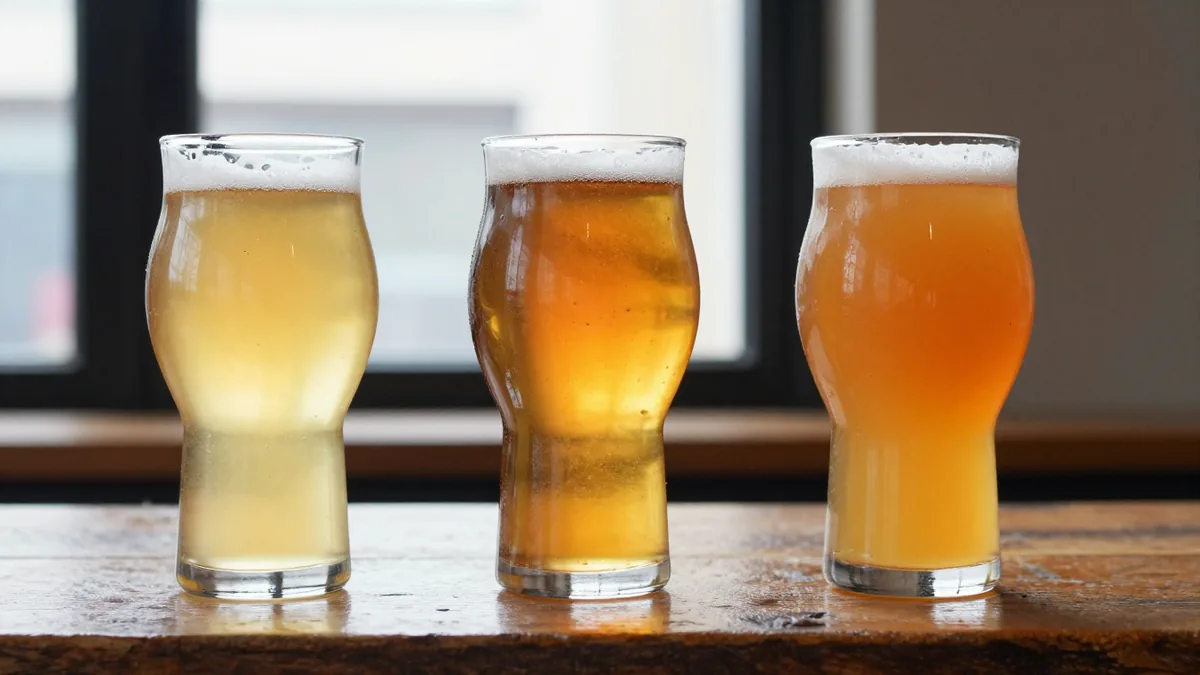
Sour beer is beer with enough organic acid, mostly lactic, to drop its pH to 3–3.9, against 4–4.5 for most regular beers, per a 2020 review in Applied and Environmental Microbiology. The acid comes from Lactobacillus and Pediococcus bacteria, often with Brettanomyces yeast. The BJCP lists seven European sour styles, from 2.8% Berliner Weisse to 8% gueuze.
What makes a beer sour
A regular ale or lager is fermented by one yeast, Saccharomyces. A sour beer adds microbes that make acid:
- Lactobacillus (Lacto): lactic acid bacteria. The culture used in kettle sours, and the BJCP souring organism for gose.
- Pediococcus (Pedio): also lactic acid bacteria. In lambic it dominates late, in the maturation phase.
- Brettanomyces (Brett): a wild yeast, not a bacterium. The review describes "Brett character" as fruity, floral, and tropical taints, as well as medical, leathery, smoky, and horsey aromas.
- Acetic acid bacteria: make vinegar acid. A little is allowed in Flanders red ale; a lot is a fault.
Hops normally stop lactic acid bacteria. Beer-spoiling strains survive because they carry resistance genes such as horA, which "encodes an ABC transporter capable of expelling hops bitter acids from cells," per Dysvik et al.. Pure cultures are less tolerant: White Labs says to keep IBUs below 5–7 "to ensure the bacteria is not inhibited" with its kveik and Lacto blend. That is why sour recipes keep bitterness very low.
Get beer science and style notes
How beer gets its bitterness, color and aroma, explained with numbers and sources. Free, unsubscribe from any email.
No fixed schedule. Unsubscribe from any email. 21+ only.
The seven BJCP sour styles
Vital statistics from each BJCP 2021 style page (category 23, European Sour Ale):
| Style | OG | FG | ABV | IBU | SRM | Souring microbes (BJCP) |
|---|---|---|---|---|---|---|
| Berliner Weisse (23A) | 1.028–1.032 | 1.003–1.006 | 2.8–3.8% | 3–8 | 2–3 | yeast plus lactic acid bacteria |
| Gose (23G) | 1.036–1.056 | 1.006–1.010 | 4.2–4.8% | 5–12 | 3–4 | Lacto, with salt and coriander |
| Flanders Red Ale (23B) | 1.048–1.057 | 1.002–1.012 | 4.6–6.5% | 10–25 | 10–17 | Sacch, Lacto, and Brett |
| Oud Bruin (23C) | 1.040–1.074 | 1.008–1.012 | 4–8% | 20–25 | 17–22 | Sacch and Lacto |
| Lambic (23D) | 1.040–1.054 | 1.001–1.010 | 5–6.5% | 0–10 | 3–6 | spontaneous |
| Gueuze (23E) | 1.040–1.054 | 1.000–1.006 | 5–8% | 0–10 | 5–6 | spontaneous, blended |
| Fruit Lambic (23F) | 1.040–1.060 | 1.000–1.010 | 5–7% | 0–10 | 3–7 | spontaneous, plus fruit |
What the table shows:
- Berliner Weisse is the weakest, 2.8–3.8% ABV. In Germany it is a Schankbier with a starting gravity of 7–8 °P.
- Lambic, gueuze and fruit lambic allow 0 IBU. Lambic uses "aged hops (3+ years) used more as a preservative than for bitterness."
- Oud bruin has the widest strength range, 4–8%, and the darkest color, up to 22 SRM.
- Gueuze and fruit lambic finish driest, with FG as low as 1.000.
For ABV basics see ABV explained; for the bitterness scale see what IBU measures. All styles are on our style pages.
Sour beer pH vs regular beer
pH is the number that defines sour. The scale is logarithmic: each full point down is ten times more hydrogen ions.
- Regular beer: 3.4–4.7 across styles, 4–4.5 for most beers (Dysvik et al. 2020).
- Sour beer: 3–3.9 in the same review. Imperial Yeast gives a terminal range of 3.3–3.9 with 3–6 g/L of lactic acid.
- Size of the gap: a kettle sour at 3.4 has about 10 times the hydrogen-ion concentration of a regular beer at 4.4. Across the two bands the multiple runs from about 1.26 times (4 vs 3.9) to 32 times (4.5 vs 3).
pH is not the whole story. Lallemand reports titratable acidity alongside pH: its Philly Sour yeast reaches pH 3.2–3.5 and 0.1–0.4% titratable acidity as lactic acid. Two beers at the same pH can taste differently sour because titratable acidity counts total acid, not just free hydrogen ions. The BJCP makes the same point about Flanders red: "vinegar is over six times greater in total acidity than this style." Taste Match on the recommendations page has a sour flavor family, but it matches the brewery's own description rather than a pH reading, so the 3–3.9 band above is the number that tells you whether the beer it offers is sour in the sense this page means.
How lambic ferments
Lambic is the slow end of sour beer. Brewers cool hot wort in open, shallow vessels called coolships, "completely open to the air, typically overnight," and let the local microbes in. The review describes four phases:
- Enterobacteria phase: lasts a week to a month.
- Main fermentation: Saccharomyces dominates for 3–4 months.
- Acidification: lactic and acetic acid bacteria take over.
- Maturation: Brettanomyces, Lactobacillus, Pediococcus and acetic acid bacteria dominate from about 8 months on.
The BJCP lambic page says lambic is generally served young, at 6 months, but "a complex Brett character takes a year or more to develop." Gueuze blends one-, two-, and three-year old Lambics, then cellars them. Fruit lambic adds fruit during aging; traditional choices are tart cherries, raspberries. The quiz’s Sour Seeker result is the profile that follows that slow, blended end of sour, listing gueuze with Berliner weisse, gose and Flanders red in a tulip at 45–50°F (7–10°C).
The serving temperature chart splits that tulip row by style: a Berliner-style weisse and a Belgian-style Flanders red are listed at 45–50°F (7–10°C), while a gueuze and a contemporary gose get the wider 40–50°F (4–10°C) band.
Flanders red ale ages "up to two years" in large oak vats called foeders, per the BJCP 23B page. Oud bruin is "not spontaneously fermented, and don’t contain wheat," which separates it from lambic. Among the ten listings in our Anchorage guide, Anchorage Brewing Company provides American examples of mixed-culture sours, coolship saison and barrel-aged blends. The seven listings in our Brooklyn guide include Keg & Lantern's foeder-fermented sours and Grimm's spontaneous ales, so the guide is also a way to find examples of different sour-beer methods.
Kettle souring: the fast method
Kettle souring does the bacterial step first, in unhopped wort, before any yeast. The review puts it at 24–48 hours. Wyeast notes the method was "patented in 1906 by Otto Francke to brew Berliner Weisse beers."
Our kettle souring guide runs that step in detail: no hops in the wort, a 2–5 minute sanitizing boil, a hold at 86–104°F (30–40°C) for 24–48 hours until pH 3.2–3.5, then a hopped boil to kill the bacteria.
The steps the three culture makers publish:
| Step | Imperial Yeast | White Labs | Wyeast |
|---|---|---|---|
| Pre-acidify wort to | pH 4.6 or lower | not stated | about pH 4.5 |
| Hold temperature | 85–95°F | 90–110°F | 100–120°F |
| Pitch rate | 1 L per barrel | 0.35 L per hL | 100 mL package into a 1.5 L starter, then 20–40 L wort |
| Time | 24–48 hours minimum | big drop in 24 h, maximum by 48 h | under 72 hours |
| Stop at | around pH 3.4 | "desired pH" | pH 3.5 |
Then boil the soured wort to kill the bacteria, add hops, cool and ferment with a normal yeast. Two warnings from White Labs: above 100°F "the potential for food pathogens arises," and contamination shows up as butyric acid. Pre-acidifying and a fast pH drop are the defense.
A one-step option skips the bacteria. Lallemand's WildBrew Philly Sour is Lachancea thermotolerans, a yeast that makes lactic acid and alcohol together. It ferments best at 77–86°F, pitches at 50–100 g per hL (product page), and "can be completed in 10 days" per the technical data sheet.
Kettle sour planner
Pick a culture maker, enter your batch size and your current pH reading. The planner scales that maker's pitch rate to your batch, shows its hold temperature and time, and tells you whether to acidify, keep holding, or boil.
Example: a 5 gallon batch at Imperial's 1 L per barrel needs about 161 mL of culture. At White Labs' rate it is about 66 mL. Philly Sour at 50–100 g per hL works out to 9.5–18.9 g of dry yeast.
Brewing a sour at home is legal under federal law. 27 CFR 25.205 allows 100 gallons a year for a one-adult household and 200 gallons for two or more adults, for personal use, not for sale. New to brewing? Start with how to start homebrewing.
Gose and Berliner Weisse: the German sours
Both are pale wheat beers soured with lactic acid bacteria. The BJCP calls Berliner Weisse "increasingly rare in Germany"; gose died out completely:
- Berliner Weisse: Napoleon's troops called it "the Champagne of the North" in 1809, per the BJCP 23A page. Its sourness comes from "a symbiotic co-fermentation with top-fermenting yeast and LAB."
- Gose: the BJCP ingredient list is pilsner and wheat malt, salt and coriander seed, Lacto. It was in Leipzig by 1740, the city had 80 Gose houses in 1900, and production "ceased entirely in 1966" before a revival in the 1980s, per the BJCP 23G page.
Gose should taste lightly of salt, "up to the threshold of taste," not overtly salty. Fruited versions of either style are entered in other BJCP categories.
Frequently Asked Questions
What pH is a sour beer?
Usually 3–3.9, per the Dysvik et al. review. Most regular beers sit at 4–4.5.
Is sour beer the same as wild beer?
No. A kettle sour uses one pure Lactobacillus culture for 24–48 hours. Lambic is spontaneously fermented by whatever microbes reach the coolship, and its maturation phase starts around 8 months.
Does sour beer have more alcohol?
Not as a rule. BJCP ranges run from 2.8% (Berliner Weisse) to 8% (oud bruin and gueuze).
Why do sour beers have so little hop bitterness?
Hop bitter acids slow lactic acid bacteria; White Labs keeps souring worts under 7 IBU. The BJCP lambic, gueuze and fruit lambic styles allow 0–10 IBU, and Berliner Weisse 3–8.
How long does a kettle sour take?
The souring step takes 24–48 hours per Imperial Yeast. Add a normal fermentation after that. Philly Sour does both in about 10 days.
Sources
- BJCP, 23A. Berliner Weisse (2021 Style Guidelines), https://www.bjcp.org/style/2021/23/23A/berliner-weisse/ (checked 2026-10-01)
- BJCP, 23B. Flanders Red Ale (2021 Style Guidelines), https://www.bjcp.org/style/2021/23/23B/flanders-red-ale/ (checked 2026-10-01)
- BJCP, 23C. Oud Bruin (2021 Style Guidelines), https://www.bjcp.org/style/2021/23/23C/oud-bruin/ (checked 2026-10-01)
- BJCP, 23D. Lambic (2021 Style Guidelines), https://www.bjcp.org/style/2021/23/23D/lambic/ (checked 2026-10-01)
- BJCP, 23E. Gueuze (2021 Style Guidelines), https://www.bjcp.org/style/2021/23/23E/gueuze/ (checked 2026-10-01)
- BJCP, 23F. Fruit Lambic (2021 Style Guidelines), https://www.bjcp.org/style/2021/23/23F/fruit-lambic/ (checked 2026-10-01)
- BJCP, 23G. Gose (2021 Style Guidelines), https://www.bjcp.org/style/2021/23/23G/gose/ (checked 2026-10-01)
- Applied and Environmental Microbiology (PMC), Dysvik et al. 2020, Microbial Dynamics in Traditional and Modern Sour Beer Production, Applied and Environmental Microbiology 86(14), https://pmc.ncbi.nlm.nih.gov/articles/PMC7357471/ (checked 2026-10-01)
- Imperial Yeast, Souring with Lactic Acid Bacteria, https://www.imperialyeast.com/resources/document-library/souring-with-lactic-acid-bacteria (checked 2026-10-01)
- White Labs, Making a Kettle Sour with Lactobacillus Cultures, https://blog.whitelabs.com/making-a-kettle-sour-with-lactobacillus-cultures (checked 2026-10-01)
- Wyeast Laboratories, Kettle Souring (home enthusiast), https://wyeastlab.com/resource/home-enthusiast-kettle-souring/ (checked 2026-10-01)
- Lallemand Brewing, WildBrew Philly Sour Technical Data Sheet, https://admin.lallemandbrewing.com/wp-content/uploads/2023/05/Philly-Sour-TDS-ENG-A4-Print-WildBrew-3.pdf (checked 2026-10-01)
- Lallemand Brewing, WildBrew Philly Sour product page, https://www.lallemandbrewing.com/en/united-states/product-details/wildbrew-philly-sour/ (checked 2026-10-01)
- eCFR, 27 CFR 25.205 Production, https://www.ecfr.gov/current/title-27/section-25.205 (checked 2026-10-01)
- eCFR, 27 CFR 25.11 Meaning of terms, https://www.ecfr.gov/current/title-27/chapter-I/subchapter-A/part-25/subpart-B/section-25.11 (checked 2026-10-01)
- NIST, NIST Guide to the SI, Appendix B.9: Factors for units listed by kind of quantity, https://www.nist.gov/pml/special-publication-811/nist-guide-si-appendix-b-conversion-factors/nist-guide-si-appendix-b9 (checked 2026-10-01)