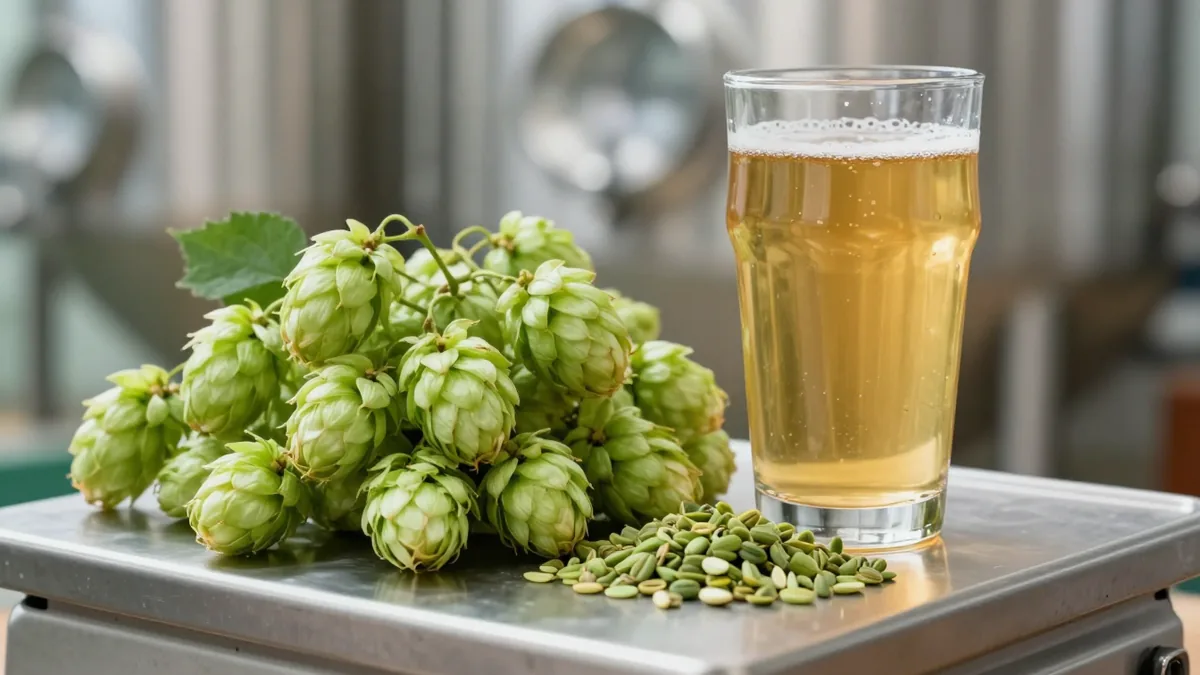
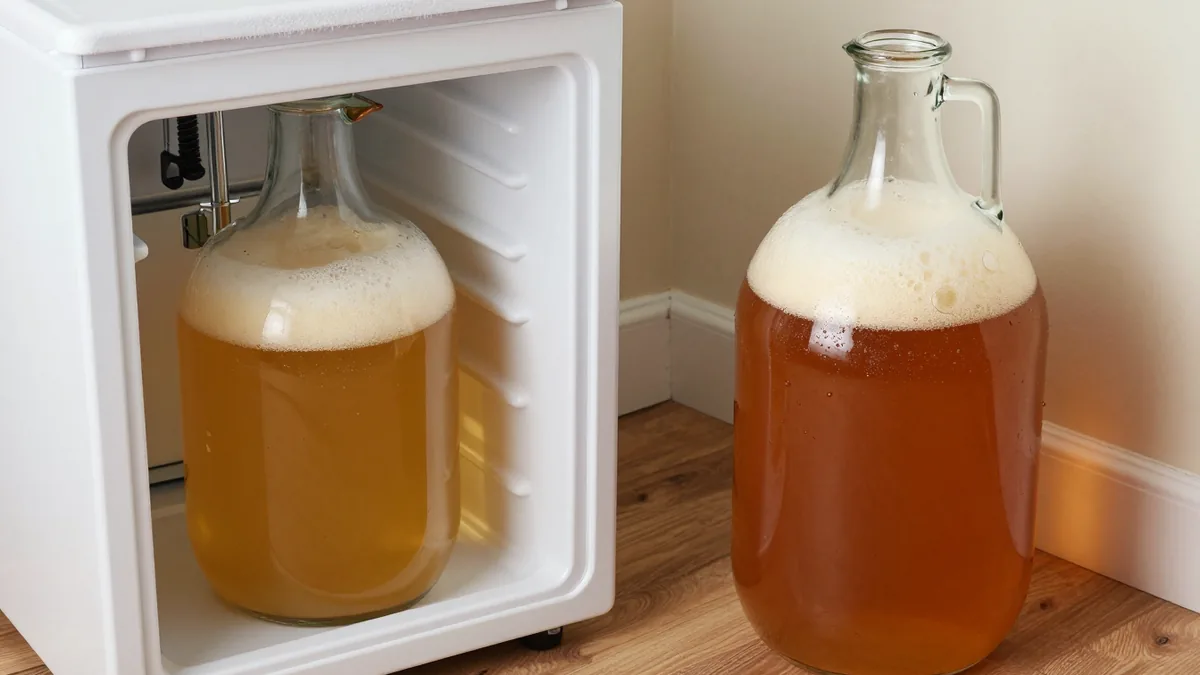
Hop usage and late hopping in brewing. See hop-water-explained See what-is-ibu-does-it-predict-bitterness
Dry hopping extracts most hop aroma within a day: in one study a fitted model reached 90% of peak β-myrcene by 12 hours, and a sensory test found no difference between 6 hours and 12 days of contact. The catch is hop creep. Hop enzymes turn leftover dextrins into sugar, and in a 2018 Oregon State study 10 g/L of Cascade cut real extract by 2 °P and added 1.3% ABV with live yeast present.
Dry-hop rates and units
Brewers quote dry-hop rates in three units. The conversions:
| Unit | Grams per liter | Source |
|---|---|---|
| 1 g/L | 1 | |
| 1 oz/gal (US) | 7.489 | NIST SP 811 |
| 1 lb/bbl (31-gal barrel) | 3.865 | 386.54 g/hL, per the 2023 Molecules review |
A beer barrel is 31 US gallons under 27 CFR 25.11. Tinseth's IBU formula uses the same oz/gal factor, rounded to 7,490 mg/L. Studies use a wide range: Lafontaine and Shellhammer tested 0 to 1,600 g/hL (16 g/L), and the hop creep studies below used 10–12 g/L (2.6–3.1 lb/bbl).
Worked example: 2 lb/bbl in a 5-gallon batch is 7.73 g/L (1.03 oz/gal), or 146 g (5.2 oz) of hops.
Priced per ounce, that charge is where dry hopping gets expensive: Citra carried a median of $3.25 an ounce across 29 listings from 28 retailers in the October 2026 Homebrew Price Index, so the 5.2 ounces above cost $16.90 at that median, and the cheapest Citra hops guide records the $1.06 an ounce low that a patient shopper can reach.
The same charge in cryo or lupulin pellets costs nearly twice as much: at the $5.95 an ounce median those pellets carried across 152 listings from 21 retailers in the October 2026 Homebrew Price Index, the 5.2 ounces above would run $30.94, and the cheapest cryo hops guide shows how far shopping moves that, from $1.25 an ounce at the low to $8.99 at the high.
Get beer science and style notes
How beer gets its bitterness, color and aroma, explained with numbers and sources. Free, unsubscribe from any email.
No fixed schedule. Unsubscribe from any email. 21+ only.
How fast hops give up their aroma
Extraction is fast. The evidence, mostly collected in the 2023 review:
- Hours, not days. In a 2022 pilot study, β-myrcene peaked at 301 µg/L at 34 hours and leveled at 215 µg/L from 42 hours. The authors' fitted model (rate constant 0.1946 per hour) reaches 69% of peak at 6 hours, 90% at 12 and 99% at 24.
- Sensory. Wolfe found no significant aroma difference between 6 hours and 12 days of static dry hopping.
- Oils. Hops pulled after 24 hours still held 33–51% of their essential oil (Hauser), but only 10% of their terpene alcohols. The polar aroma compounds leave first; hydrocarbons such as myrcene mostly stay in the hop.
- Thiols. Most 4MMP extraction happened between the first and second day (Reglitz).
- Bitter acids. 24 hours extracted an average 75% of humulinones (Lafontaine and Shellhammer). α-acids reached 2 mg/L after day one and gained only 1–2 mg/L more by day 18 (Mitter and Cocuzza).
Longer is not better. The review notes that contact of more than a week may give vegetal, grassy aromas. Loose pellets beat a hop bag: nearly 50% more linalool in one study. And yeast competes for some compounds: with evaporation blocked, 98–99% of myrcene ended up stuck to yeast cells (Haslbeck).
More hops, lower efficiency
Doubling the dose does not double the aroma. Lafontaine and Shellhammer dry hopped for 24 hours at doses up to 1,600 g/hL:
- Linalool extraction fell from about 23% at 200 g/hL to 7% at 1,600 g/hL; geraniol from 13% to 3%.
- Humulinone extraction fell from 113% to 47%. Values above 100% mean humulinones also formed in the beer.
- Above 800 g/hL (8 g/L, about 2.1 lb/bbl) the aroma shifted mainly to herbal and tea notes.
Plan your own dose and batch here:
The hazy IPA side of this, including biotransformation and haze, is in our hazy IPA chemistry article.
Dry hops change bitterness and pH
Dry hops add almost no iso-α-acids. Tinseth's utilization table gives 0 at zero boil minutes, so recipe software counts dry hops as zero IBU. The beer still changes:
- Maye and Smith dry hopped at 1 lb/bbl of Cascade for 3 days at 16 °C. Iso-α-acids fell from 51 to 32 mg/L, while α-acids and humulinones each rose from undetectable to 13 mg/L.
- Humulinones are about 66% as bitter as iso-α-acids, per a 2022 Foods paper.
- In the Salamon study, measured bitterness rose from 54.5 to 64.3 IBU.
- pH rose about 0.1 units per lb/bbl in Maye's work, and 0.1 pH reads like 2–3 IBU more bitterness.
A shift like that is measured on finished beer; the mash target is a different number: our mash pH guide aims for 5.2–5.6 on a cooled sample, because a hot reading runs about 0.3 lower.
Our IBU explainer covers why the lab number and the taste diverge.
Hop creep: when dry hops restart fermentation
Hop creep was first reported in 1893. Hops carry starch-degrading enzymes: amyloglucosidase, alpha-amylase, beta-amylase, and limit dextrinase. They break unfermentable dextrins into sugars, and any live yeast ferments them.
The Kirkpatrick and Shellhammer study dry hopped finished, packaged lager at 10 g/L with fresh ale yeast at 20 °C:
- Real extract fell 1 °P in 5 days and about 2 °P by day 40.
- Fully fermented, that is 1.3% more alcohol and 4.75% (v/v) more CO2.
- The effect was "time, temperature, and dose-dependent".
In a 2026 Oregon State fermentation study, 12 g/L added about 48 hours after pitching left dry-hopped beers about 0.5 °P drier than controls that finished at 2.7 (lager) and 2.4 °P (ale). Using Kirkpatrick's ratio of 0.65% ABV per °P, that is roughly 0.33% extra ABV; our estimate, not the authors'. Kirkendall measured 0.77 g/100 mL of new fermentable sugar from a 2-day dry hop, worth 0.39% ABV.
Why it matters:
- Over-carbonation. Packaged beer with live yeast keeps making CO2. That is a gushing and bottle-bomb risk; our carbonation guide has safe CO2 levels.
- Diacetyl. Extended fermentation can produce vicinal diketones (diacetyl and pentanedione), so the beer needs more conditioning time.
- Thinner body and higher ABV than the recipe. See ABV explained.
What controls hop creep
- Variety and lot. Across 30 varieties, α-amylase ranged 0.04–0.25 U/g, a 6.2x spread.
- Kilning. Kilning hops at 82 °C instead of 52 °C cut enzyme activity about 2.6-fold (Rubottom).
- Temperature. The review lists "lower fermentation temperatures, resulting in lower enzyme activity" as a control.
- Dose, with a caveat. With yeast present, Werrie found the same substrate loss at 500 g/hL as at 2,500 g/hL. Cutting the dose may not cut creep.
- Yeast choice does not fix it. Bruner and colleagues tested 30 yeasts with 10 g/L of Centennial; attenuation rose from 2 days after dry hopping, and "No yeasts in this study indicated their use for mitigation of dry-hop creep".
The review's bottom line: "there is no known method to completely avert hop creep". Plan for it: give the beer time to finish after dry hopping, check gravity is stable for several days before packaging, and keep packaged beer cold.
Our dry hopping guide turns that into a schedule: 3–4 oz (85–113 g) of pellets per 5 gal (19 L), 1–2 days for the pellets to extract at 55–65°F (13–18°C), and gravity readings before packaging to catch the creep.
Once that gravity holds, the cold crashing guide chills the fermenter to 32–34°F (0–1°C) for 1–3 days so the yeast drops out before packaging, and no yeast means no extra fermentation from the hop enzymes.
Oxygen pickup
Opening a fermenter to add hops lets air in. In the Salamon study dissolved oxygen went from 0.06 to 0.22 mg/L, about 3.7x, though the authors did not find the rise statistically significant. They still name oxygen as one of the main problems with the technique because "oxygen may be one of the enemies of retaining the bright, fresh and vibrant hop character". Purge with CO2 where you can. Homebrewers starting out can find the equipment basics in how to start homebrewing.
Frequently Asked Questions
How long should I dry hop?
One to three days covers most extraction. Wolfe found no aroma difference between 6 hours and 12 days, and the review warns that more than a week can turn grassy.
What is a normal dry-hop rate?
Lafontaine and Shellhammer tested up to 16 g/L, and the hop creep studies used 10–12 g/L. Above 8 g/L, Lafontaine and Shellhammer found herbal and tea notes took over.
How much extra alcohol can hop creep add?
In the published studies, 0.5 to 2 °P of extra attenuation, up to 1.3% ABV in Kirkpatrick's 40-day test.
Does dry hopping add IBU?
Recipe formulas say no. Lab tests often show a rise: 54.5 to 64.3 IBU in the Salamon study, from humulinones and other compounds.
Should I dry hop during fermentation or after?
It depends on the goal. During active fermentation, yeast can free bound thiols and convert hop compounds; see our hazy IPA chemistry article. After fermentation, fewer yeast cells are in suspension to soak up hydrocarbons such as myrcene, which Haslbeck found bind to yeast at 98–99%. Hops added while yeast is active will also cause creep, so leave time for the gravity to settle.
Do I need to take the hops out?
Not within the first few days. Most extraction is done within 24 hours, and the review links contact of more than a week to grassy, vegetal aromas. Cold crash and rack off the hops before that point.
Can I stop hop creep by crashing the yeast?
It helps, because no yeast means no extra fermentation. The hop enzymes still make sugar, so any yeast that gets back into the beer later can ferment it.
Sources
- Kirkpatrick and Shellhammer, Evidence of Dextrin Hydrolyzing Enzymes in Cascade Hops (Humulus lupulus) (J Agric Food Chem, 2018), abstract, checked 2026-10-01.
- Klimczak, Cioch-Skoneczny and Duda-Chodak, Effects of Dry-Hopping on Beer Chemistry and Sensory Properties: A Review (Molecules, 2023), checked 2026-10-01. Source of the Lafontaine and Shellhammer, Maye and Smith, Hauser, Wolfe, Reglitz, Mitter and Cocuzza, Haslbeck, Kirkendall, Werrie and Rubottom findings.
- Salamon et al., The Effect of Dry Hopping Efficiency on beta-Myrcene Dissolution into Beer (Plants, 2022), checked 2026-10-01.
- Samia et al., A time-course assessment of polyfunctional thiol release and yeast gene expression in dry-hopped beers (Food Chemistry: Molecular Sciences, 2026), checked 2026-10-01.
- Bruner et al., Dry-Hop Creep Potential of Various Saccharomyces Yeast Species and Strains (Fermentation, 2021), abstract, checked 2026-10-01.
- Rutnik et al., Impact of Hop Freshness on Dry Hopped Beer Quality (Foods, 2022), checked 2026-10-01.
- Glenn Tinseth, Glenn's Hop Utilization Numbers, checked 2026-10-01.
- NIST, NIST Guide to the SI, Appendix B.9: Factors for units listed by kind of quantity, checked 2026-10-01.
- eCFR, 27 CFR 25.11 Meaning of terms, checked 2026-10-01.