Cellar a beer only if it is at least 8% ABV, or sour, wild or smoked, per Firestone Walker. Store it dark, upright and no warmer than 55°F; the brewery keeps its own cellar at 40°F. Do not cellar IPAs or pale ales: up to 80% of key hop aroma compounds are gone within 3 months.
The short rules
| Rule | Value | Source |
|---|---|---|
| Minimum strength to cellar | 8% ABV, unless sour, smoked or strongly spiced | Firestone Walker Brewing Company |
| Warmest storage | 55°F | Firestone Walker Brewing Company, Sierra Nevada Brewing Co. |
| Brewery's own cellar | 40°F | Firestone Walker Brewing Company |
| Bottle position | Upright | Firestone Walker Brewing Company, Sierra Nevada Brewing Co. |
| Light | None | Firestone Walker Brewing Company, Sierra Nevada Brewing Co. |
| Do not cellar | IPAs, pale ales, most lagers and session beers | Firestone Walker Brewing Company |
Firestone Walker explains the 8% line: alcohol acts as a preservative and slows the effects of time. Sour and smoked beers get the same protection from lactic acid and smoke phenols, so they can age below 8%.
Get beer science and style notes
How beer gets its bitterness, color and aroma, explained with numbers and sources. Free, unsubscribe from any email.
No fixed schedule. Unsubscribe from any email. 21+ only.
Which beers age and which do not
The BJCP 2021 style guidelines say outright which styles are built to age. Their notes:
- Belgian Dark Strong Ale (8–12% ABV): flavors "often benefit from age".
- English Barleywine (8–12%): aroma "subsides with age, and can develop a quality like sherry, wine, or port".
- American Barleywine (8–12%): "Age will often dry out the beer, and smooth out the flavors." The style is traditionally vintage-dated.
- Imperial Stout (8–12%): age can add "a vinous or port-like impression, but not sourness".
- Old Ale (5.5–9%): the defining quality "is the impression of age".
- Lambic (5–6.5%): "a complex Brett character takes a year or more to develop."
The hop-forward styles carry no aging notes. Firestone Walker names them directly: "Any beers with hop-forward characteristics, such as IPAs and Pale Ales" should not be cellared.
Strength alone does not decide it. A double IPA reaches 10% and a hazy IPA 9%, both above the 8% line, and both still lose what makes them good. A Flanders red tops out at 6.5% and is aged up to 2 years before it is sold.
Our ABV guide lists strength for more styles, and the style index has full profiles.
What happens inside an aging bottle
Three things change, in roughly this order:
- Hops fade. A 2023 Molecules review reports losses of up to 80% for myrcene, humulene and caryophyllene within 3 months, and a 91% loss of humulones (bitter acids) over two years. Strong beers lose this too; Firestone Walker notes that "Hoppiness and bitterness fades over time".
- Oxygen makes aldehydes. The 2022 IJMS aldehyde review names the Maillard reaction, Strecker degradation and hop-compound breakdown as the routes to aged flavors, and calls Strecker reactions "a preferred pathway" during aging. It notes that oxidative reactions stall below 0.1 mg/L of oxygen in fresh beer, which is why the oxygen sealed in the package sets the pace.
- Heat speeds all of it. In a forced-aging study cited by the same review, beer held at 37°C (99°F) reached 200 µg/L of furfural in 14 days and about 800 µg/L in 90 days.
In a pale lager these reactions read as stale and papery. In a 8%-plus dark beer, Firestone Walker describes them as positive: booziness mellows into fruit, caramel and toffee; amber malts turn toward sherry; roasted malts toward chocolate and port. The brewery adds that roasted malts have antioxidant properties that slow aging. The IJMS review reports one pathway that runs the other way: darker beers showed a 3-fold increase of two Strecker aldehydes in wort.
Our shelf-life guide covers the same chemistry for beers you should drink fresh.
Should you cellar this beer?
Enter the beer's strength and type. The tool applies Firestone Walker's rules (8% ABV, or sour or smoked; never hop-forward) and gives check-in dates:
- Now: open one bottle fresh. Firestone Walker's advice is to buy two or more and open one soon, so you know what changed.
- 12 months: BJCP notes that Brett character takes a year or more.
- 24 months: the length of the gueuze bottle study below; Flanders red is aged up to 2 years.
For beers it tells you not to cellar, it gives a drink-by date: 90 days for hop-forward beers (the 3-month hop-loss point above) and 150 days for other beers kept cold, per Sierra Nevada Brewing Co..
The check-in dates are our schedule built from those sources, not a brewery rule. Taste at each one and drink the rest when the beer stops improving.
How to store it
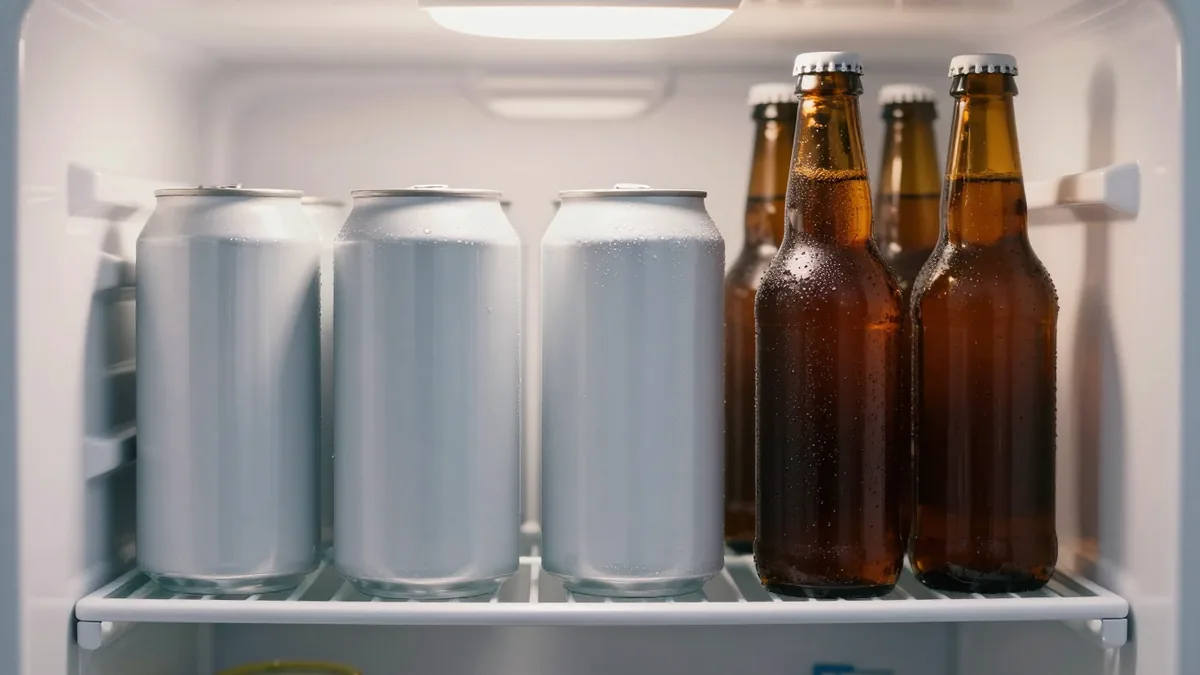
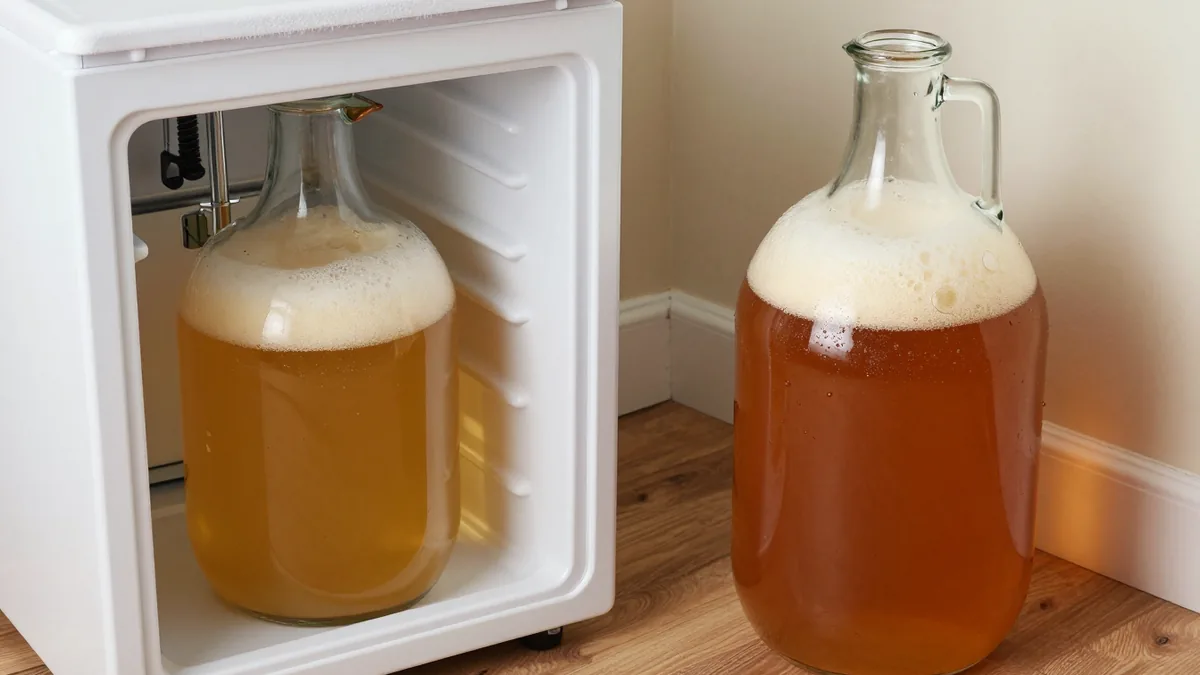
Temperature. Keep it at or below 55°F. Firestone Walker states that higher temperatures speed oxidation and make the result "less enjoyable"; Sierra Nevada gives the same 55°F ceiling for "burlier beers". A basement, an interior closet or a spare fridge works. Firestone Walker's own cellar runs at 40°F, so a regular fridge is not too cold. The oxidation entry sets out the packaging half of the same rule: purge kegs and bottling lines with CO2, fill from the bottom and keep headspace small, then store the beer cold and dark, because warm storage multiplies staling. That 55°F ceiling is a storage number, not a serving one: the serving temperature chart maps every style to a range whose warm end is 55°F or lower, from 40–45°F (4–7°C) for a German-style hefeweizen to 50–55°F (10–13°C) for an American imperial stout.
Position. Stand bottles upright. Firestone Walker's reasons: less beer surface touches the oxygen in the neck, and caps and corks stay sound. Sierra Nevada says the same: upright "to slow the rate of oxidation".
Light. Keep it dark. Firestone Walker: "Light also damages beer, best to keep the lights off." The shelf-life guide explains the skunky reaction. The lightstruck entry sets out the chemistry and the remedy: riboflavin absorbs the light and passes its energy to the iso-alpha acids, which break down into 3-methyl-2-butene-1-thiol, so store bottles in the dark, serve them in shade and buy them from closed boxes rather than lit shelves.
Inventory. Write the purchase date on each bottle or keep a list. Firestone Walker warns that comparing a 5-year-old beer with your memory of it fresh "is nearly impossible", which is why the fresh baseline bottle matters.
Sediment. Firestone Walker notes that a beer's body slowly thins as malt proteins drop out to the bottom of the bottle, so pour aged bottles slowly into the glass.
Sour and Brett beers keep changing in the bottle
Sours age differently because they are still alive. Firestone Walker says its barrel-aged sours "age gracefully for 20+ years", acidity slowly mellows, and Brettanomyces keeps fermenting in the bottle, drying the beer and adding spicy, fruity and funky aromas. Our ten-listing Bend guide includes The Ale Apothecary's oak-aged wild and sour beers; their presence on the list is not a promise that every release benefits from more cellar time. For another producer of sour and barrel-aged beer, the eight listings in our Boise guide include Barbarian's downtown taproom, separate from its Garden City production site.
A 2024 study in Applied and Environmental Microbiology measured this directly. Researchers bottled a blend of lambics, as for gueuze, and sampled it for 24 months:
- Density dropped from 2.7°P to 1.6°P: the yeast kept eating residual sugar.
- B. bruxellensis made up 98.9% of the fungal reads after 24 months.
- Ethyl lactate rose from 257.8 to 542.0 mg/L (2.1x) and ethyl acetate from 65.1 to 121.7 mg/L (1.9x).
- Diacetyl, the buttery compound, fell from 4.8 to 2.1 mg/L.
- 4-ethylguaiacol, a main Brett aroma, peaked at 3.0 mg/L.
One exception to the upright rule: in that study the gueuze bottles matured "placed horizontally in a cellar". The BJCP gueuze entry describes the same process: one-, two- and three-year-old lambics "are blended, then cellared". Sierra Nevada says "the jury is still out" on side storage for corked bottles. For capped bottles and cans, stand them up. Our sour beer guide covers how these beers are made. Gueuze is the beer the quiz’s Sour Seeker result treats as the patient end of sour, set beside Berliner weisse, gose and Flanders red.
Frequently Asked Questions
Can you cellar beer in cans?
Yes. Firestone Walker's upright advice covers "the bottle/can". The same rules apply: 8% ABV or sour, 55°F or colder.
Does an IPA get better with age?
No. Firestone Walker lists hop-forward beers as ones that "shouldn't be cellared", and the Molecules review measured up to 80% hop aroma loss within 3 months. Drink IPAs within about 90 days of the packaged-on date.
Is a fridge too cold for aging beer?
No. Firestone Walker keeps its cellar at 40°F. Colder storage slows aging, which is fine; warmer than 55°F speeds it and makes it less pleasant.
How long can you age a barleywine or imperial stout?
There is no fixed limit. Taste at the check-in dates and stop when the beer stops improving. BJCP notes body and aroma intensity decline with age in both styles.
What is a vertical tasting?
Opening several vintages of the same beer side by side. The barleywine tradition of vintage-dating, noted by the BJCP, makes it easy: buy one bottle each year and open them together.
Sources
- Firestone Walker Brewing Company, How to Properly Cellar Beer, May 19, 2020, checked 2026-10-01.
- Sierra Nevada Brewing Co., Does Beer Expire? Lifespan & Storage Tips, checked 2026-10-01 (read from the Internet Archive copy; the live page blocks automated readers).
- Klimczak, Cioch-Skoneczny and Duda-Chodak via PubMed Central, Effects of Dry-Hopping on Beer Chemistry and Sensory Properties: A Review (Molecules, 2023), checked 2026-10-01.
- Moreira et al. via PubMed Central, Aldehyde Accumulation in Aged Alcoholic Beer (International Journal of Molecular Sciences, 2022), checked 2026-10-01.
- Applied and Environmental Microbiology via PubMed Central, Refermentation and maturation of lambic beer in bottles: a necessary step for gueuze production (Applied and Environmental Microbiology, 2024), checked 2026-10-01.
- BJCP, 22C. American Barleywine (2021 Style Guidelines), checked 2026-10-01.
- BJCP, 17D. English Barleywine (2021 Style Guidelines), checked 2026-10-01.
- BJCP, 20C. Imperial Stout (2021 Style Guidelines), checked 2026-10-01.
- BJCP, 26D. Belgian Dark Strong Ale (2021 Style Guidelines), checked 2026-10-01.
- BJCP, 17B. Old Ale (2021 Style Guidelines), checked 2026-10-01.
- BJCP, 23E. Gueuze (2021 Style Guidelines), checked 2026-10-01.
- BJCP, 23D. Lambic (2021 Style Guidelines), checked 2026-10-01.
- BJCP, 23B. Flanders Red Ale (2021 Style Guidelines), checked 2026-10-01.
- BJCP, 22A. Double IPA (2021 Style Guidelines), checked 2026-10-01.
- BJCP, 21C. Hazy IPA (2021 Style Guidelines), checked 2026-10-01.
- BJCP, 21A. American IPA (2021 Style Guidelines), checked 2026-10-01.