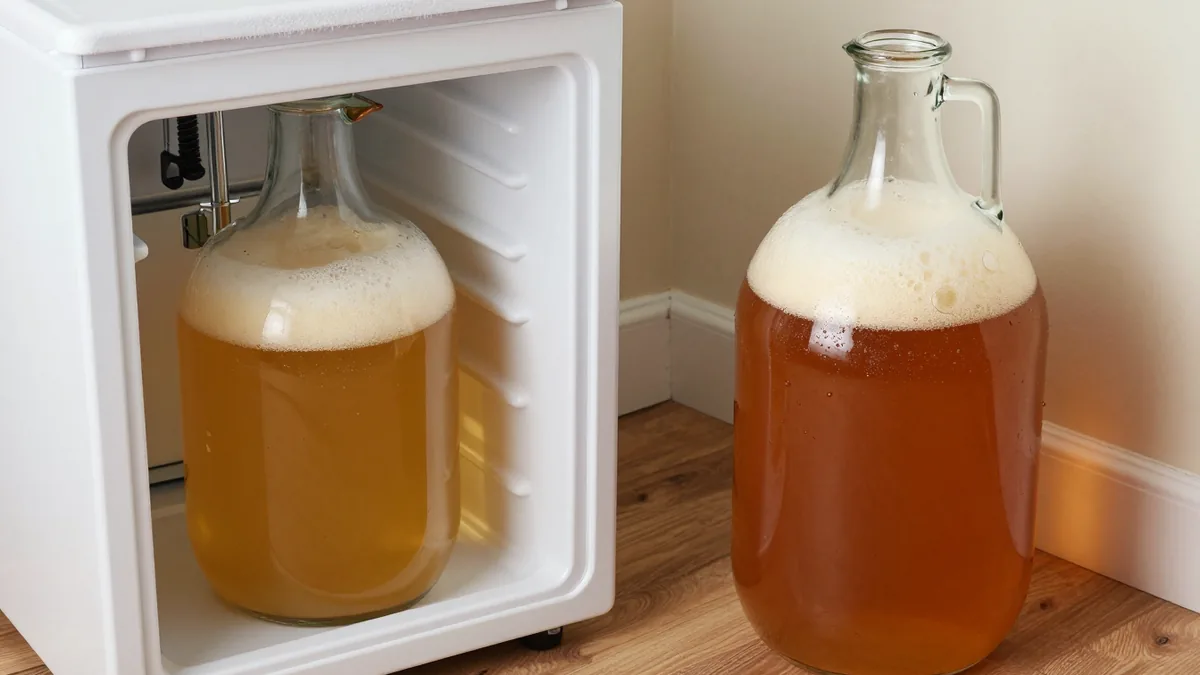
Beer foam is built by malt proteins, mainly protein Z and LTP1, bound to hop iso-alpha acids, and broken down by lipids, fat and oil residue on the glass. In a 2024 study of 16 commercial beers, wheat beers held foam 332 seconds on average vs 260 for barley beers. The Brewers Association's three glass tests (sheeting, salt, lacing) tell you if your glass is killing the head.
What a beer head is made of
A head is a layer of gas bubbles, each wrapped in a thin liquid film. The film lasts only if something sticks to the bubble surface and holds it together. In beer, that is protein from malt plus bitter acids from hops. A 2024 Foods study puts it this way: foam stability depends "mainly" on proteins/peptides from malt and iso-α acids from hops.
| Foam-positive | Role | Source |
|---|---|---|
| Protein Z | 40 kDa malt protein; heat stable, so it survives into finished beer | Foods (MDPI) via PubMed Central, Biomolecules (MDPI) via PubMed Central |
| LTP1 (lipid transfer protein 1) | 9.7 kDa, 91 amino acids; binds lipids | Biomolecules (MDPI) via PubMed Central |
| Hordein, BDAI-1 | Other barley proteins identified as foam-positive | Foods (MDPI) via PubMed Central |
| Iso-alpha acids (hops) | Bind protein Z into "a coherent and elastic adsorbed layer" | Biomolecules (MDPI) via PubMed Central |
| Foam-negative | Why | Source |
|---|---|---|
| Lipids (fats, oils) | Lower the surface tension of the bubble film, which "leads to the collapse of foam bubbles" | Biomolecules (MDPI) via PubMed Central |
| Free fatty acids | "Known to destabilize foams" | Journal of Agricultural and Food Chemistry via PubMed Central |
| Higher ethanol | Listed as foam-negative alongside lipids | Foods (MDPI) via PubMed Central |
| Glass residue | Detergent film, grease, sanitizer: "foam-killing residues" | Brewers Association |
Get beer science and style notes
How beer gets its bitterness, color and aroma, explained with numbers and sources. Free, unsubscribe from any email.
No fixed schedule. Unsubscribe from any email. 21+ only.
Why wheat beers hold their head longer
More foam protein means longer-lasting foam. The 2024 Foods study measured 6 barley beers and 10 wheat beers bought in stores. The method: degas 20 mL of beer, inject CO2 for 30 seconds, then time how long the foam takes to disappear.
- Wheat beers had 9.52–84.1% more total protein than barley beers.
- Barley beer foam lasted 260 seconds on average; wheat beer foam 332 seconds, 28% longer.
- Every wheat beer beat every barley beer. The range ran from 220 to 370 seconds.
- Protein content correlated significantly with foam stability.
This is one lab method on 16 beers, not a universal ranking.
How brewing affects foam
Brewers can lose foam protein before the beer is packaged. A 2025 Journal of Agricultural and Food Chemistry study heated purified LTP1 to mimic brewing and found that heat-damaged LTP1 "have lower foam stability than unheated LTP1". One form of the protein, LTP1b, carries bound lipids; heating releases them, and the authors note that free fatty acids "are known to destabilize foams".
Practical points from the research:
- Malt protein matters. Wheat malt adds protein, and the Biomolecules review notes that good malt solubility releases more protein Z into the wort.
- Hops help. Iso-alpha acids from the boil bind protein Z into the elastic bubble layer.
- Fat is the enemy. Lipids break bubble films, whether they come from the grain or from the glass.
Our how beer is made guide walks through the mash and boil steps where this happens.
How foam is measured
Labs use several standard methods. The 2019 Foods review of bubbles and foam lists NIBEM (an automated instrument from Haffmans), foam flashing, Rudin, Steinfurth, the shake test, Carlsberg's automated analysis, Blom, foam-lacing and image analysis.
The review points out a gap: all of these except the shake and lacing tests measure beer at 20–25°C, while people drink beer at 4–14°C depending on style. A lab number tells you how two beers compare. It does not tell you how your glass will look.
Nitro beer: why the head is creamy
Nitro beer swaps most of the carbonation for a little nitrogen. The Brewers Association's Draught Beer Quality Manual gives the numbers:
- A typical beer carries 2.2–2.8 volumes of CO2. Nitro beer carries 1.1–1.7, most often about 1.2.
- Nitrogen is forced in at the brewery at high pressure. The amount is so small it is measured "in parts per million and not volumes".
- Nitro beer is served on a 25% CO2 / 75% N2 blend through a faucet with a restrictor plate of 5 tiny holes that knocks the gas out of solution.
- The head stays creamy because air is 78% nitrogen: the N2 in the bubbles "has nowhere in particular to go", so bubbles do not grow and pop.
In bottles those volumes come from a priming dose rather than a regulator, and the bottle conditioning guide takes 5 gal (19 L) to about 2.5 volumes of CO2 with 4 oz (113 g) of corn sugar, held at 68–80°F (20–27°C) for 2–4 weeks.
The reason nitrogen behaves this way is solubility. Henry's law constants from the NIST Chemistry WebBook put CO2 at 0.035 mol/(kg·bar) in water at 25°C and nitrogen at 0.00065: CO2 is about 54 times more soluble. Applying NIST's temperature terms at 38°F, the draught manual's keg temperature, the gap widens to about 72 times. Oxygen sits in between at 0.0013, with nitrogen lowest.
The manual also warns: never pour a regular beer on the nitro blend. Its CO2 drops toward nitro levels without any dissolved nitrogen to replace it, and "It WILL go flat and there will be no creamy head." These are values for pure water. The manual notes that alcohol affects solubility and recommends blend calculators for real draught systems.
Is your glass beer clean?
The glass is the part you control. The draught manual defines a beer-clean glass as free of visible soil and also "free of foam-killing residues and lingering aromatics such as sanitizer". It gives 3 tests:
| Test | How | Clean | Not clean |
|---|---|---|---|
| Sheeting | Dip the glass in water, lift it out | Water coats it evenly | Water breaks into droplets |
| Salt | Sprinkle salt inside a wet glass | Salt sticks evenly | Patchy salt marks a greasy film |
| Lacing | Fill with beer and drink | Foam rings in parallel lines after each sip | Random lacing or none |
Run them on your own glasses with the checklist below. It flags each failed test and the cleaning step most likely to fix it.
How to keep glasses beer clean, per the manual:
- Wash with a detergent that is not fat- or oil-based. The manual notes that restaurant and bar suppliers sell detergents made for beer glasses.
- Rinse heel to toe in cold, running water.
- Air-dry. Towels "can leave lint and may transmit germs and odors."
- Machine-wash at 130–140°F, or use a 180°F machine without added sanitizer.
- Chill glasses dry at 36–40°F, never in a freezer. A frozen glass forms a sheet of ice and makes the beer foam over.
- Use a fresh glass for every pour.
The pour. Hold the glass at 45°, tilt it upright about halfway, and finish with a 1-inch collar of foam. The manual notes that foam is 25–33% beer, so a proper head is not lost beer.
Frequently Asked Questions
Why does my beer have no head?
Check the glass first: fat, oil, detergent film or sanitizer residue all kill foam. Run the sheeting or salt test. If the glass passes, look at the beer: low carbonation or low foam protein.
Does lip balm or greasy food kill foam?
Yes. Lipids lower the surface tension of the bubble film and collapse the foam, per the Biomolecules review.
Why do wheat beers have big heads?
More protein. In the Foods 2024 study, wheat beers had 9.52–84.1% more protein and their foam lasted 332 seconds on average vs 260 for barley beers.
Is nitro beer less carbonated?
Yes. Nitro beer carries about 1.2 volumes of CO2 vs 2.2–2.8 for typical beer, plus a few parts per million of nitrogen. Our carbonation guide explains volumes of CO2, and for the 2.2–2.8 range in bottles the priming sugar calculator turns a target volume into grams of corn sugar, table sugar or DME.
Should I use a frozen mug?
No. The draught manual says frozen glasses "create foaming due to a sheet of ice being formed when the beer is introduced to the glass", and extremely cold glass makes beer release CO2 fast. Chill glasses dry at 36–40°F instead. The manual prefers room-temperature glasses for craft beer, with one caution: they can make highly carbonated beer foam.
Does a wet glass hurt the head?
A rinsed glass is fine if most of the water has drained. The manual allows water mist rinsers to pre-wet and chill the glass, but says the inside "should be mostly free of excess water before pouring". Never put a wet glass in a freezer or cooler; it forms a sheet of ice.
How big should the head be?
About 1 inch, per the Brewers Association. It releases aroma and carbonation, and the foam is 25–33% beer.
Sources
- Brewers Association, Draught Beer Quality Manual, Fourth Edition, 2019, checked 2026-10-01.
- Li et al. via PubMed Central, Comparative Study on Protein Composition and Foam Characteristics of Barley and Wheat Beer (Foods, 2024), checked 2026-10-01.
- Biomolecules via PubMed Central, The Influence of Biomolecule Composition on Colloidal Beer Structure (Biomolecules, 2022), checked 2026-10-01.
- Journal of Agricultural and Food Chemistry via PubMed Central, Heat-Induced Changes in the Chemical Structure, Hydrophobicity, and Size Distribution of Free/Bound Lipid Transfer Protein 1 (Journal of Agricultural and Food Chemistry, 2025), checked 2026-10-01.
- Gonzalez Viejo et al. via PubMed Central, Bubbles, Foam Formation, Stability and Consumer Perception of Carbonated Drinks: A Review (Foods, 2019), checked 2026-10-01.
- NIST Chemistry WebBook, Carbon dioxide: Henry's Law data, checked 2026-10-01.
- NIST Chemistry WebBook, Oxygen: Henry's Law data, checked 2026-10-01.
- NIST Chemistry WebBook, Nitrogen: Henry's Law data, checked 2026-10-01.