Step-by-step brewing process from malt to beer. See mash-efficiency-and-all-grain-math
Beer is malted grain, water, hops and yeast. Barley is steeped for 38–46 hours, germinated about 4 days and kilned; the brewer mashes it at 150–155°F for about an hour, boils the wort with hops for about an hour, then ferments it. An ale is ready in about 28–35 days from brew day with bottle conditioning; a lager takes 34–79 days (How to Brew, Wyeast).
The process in one table
| Step | What happens | Time | Temperature |
|---|---|---|---|
| Malting | Barley is steeped, sprouted and dried | 7.3–9.8 days (derived) | Kiln 122–158°F |
| Mashing | Malt enzymes turn starch into sugar | About 60 minutes | 150–155°F |
| Boiling | Hops add bitterness; wort is sterilized | About 60 minutes | Rolling boil |
| Fermentation | Yeast turns sugar into alcohol and CO2 | Ale 2–6 days active, lager 4–10 | Ale 60–72°F, lager 50–55°F |
| Conditioning | Flavors clean up; lagers sit cold | Ale to 3 weeks total, lager 14–49 days cold | Lagering 33–34°F |
| Packaging | Beer is carbonated in a bottle or keg | Bottle 14 days, keg 7–10 days | Room temperature for bottles |
Times for malting, mashing and the brew day come from John Palmer's How to Brew and Brewer's Friend. Fermentation ranges come from the yeast makers. The sections below cite each one.
Get beer science and style notes
How beer gets its bitterness, color and aroma, explained with numbers and sources. Free, unsubscribe from any email.
No fixed schedule. Unsubscribe from any email. 21+ only.
The four ingredients and the 1516 law
Modern beer has four ingredients: malt, water, hops and yeast. The famous German law did not list all four.
The Historisches Lexikon Bayerns dates the Bavarian Purity Law to the Landtag in Ingolstadt in April 1516, 510 years ago. Its text: nothing shall be used in beer "but barley, hops and water alone." Yeast is missing because nobody knew it existed. The ingredient list that names yeast came later: the 1910 amendment to the Bavarian Malt Surcharge Act bans anything "other than malt (kiln- and airdried), hops, yeast and water." At the national level the rule first entered the German Beer Tax Act in 1906.
German brewers still mark it. The Deutscher Brauer-Bund has held a "Day of German Beer" on April 23 every year since 1994. For a view into a working brewery, the 19 listings in our Austin guide include Zilker, whose taproom overlooks the brewing process. Our 12-listing Charlotte guide includes Olde Mecklenburg, which describes its German-style brewing in terms of the Reinheitsgebot's four ingredients.
What each ingredient does:
- Malt supplies the sugar, color and most of the flavor. Barley has been grown for about 8,000 years (How to Brew, ch. 12). US supply is covered in US barley and malt production.
- Water is most of the beer by volume and sets the mash chemistry. See brewing water profiles.
- Hops add bitterness, aroma and some preservation. Where they grow: US hop production by variety.
- Yeast makes the alcohol and CO2, and much of the aroma.
Step 1: Malting
Raw barley is mostly hard starch. Malting wakes the seed so its enzymes can open up that starch, then stops it before the plant eats its own sugar. A maltster does this, not the brewer.
| Malting stage | Time | Condition |
|---|---|---|
| Steeping | 38–46 hours | Until the grain has absorbed almost 50% of its weight in water |
| Germination | About 4 days | Aerated and turned so growth is even |
| Kilning, lager malt | 40–92 hours (derived) | 90°F the first day, withered at 120–140°F for 12–20 hours, cured at 175–185°F for 4–48 hours |
All figures are from How to Brew, chapter 12. Base malt is dried at 122–158°F to about 4% moisture, low enough to keep the starch-converting enzymes alive. We added the three stages: 7.3–9.8 days from wet grain to finished malt.
Step 2: Mashing
The brewer crushes the malt and soaks it in hot water. That mash is where starch becomes sugar. How to Brew, chapter 14 counts 4 diastatic enzymes; two do most of the work:
- Beta-amylase works best at 131–150°F and makes maltose, the main fermentable sugar.
- Alpha-amylase works best at 150–158°F and chops long starch chains into shorter ones.
The starch is not accessible until the mash reaches 140–150°F. Beta-amylase dies fast once it is there: in a study Palmer cites, it fell to 75% of its starting activity after 30 minutes at 150°F and to 10% after 60. That is why a cooler mash gives a drier, more fermentable wort and a hotter mash a fuller one.
In practice most brewers pick one rest. Chapter 16 gives 150–155°F, held "for about an hour." Enzyme activity is robust between mash pH 4.5 and 6. The grain-to-sugar math is in mash efficiency and all-grain math.
Step 3: The boil
The sweet liquid drained off the mash is wort. It goes into a kettle and boils. Brewer's Friend budgets 60 minutes for the boil inside a 4.5-hour all-grain brew day (3.5 hours for extract with steeping grains).
The extract brewing guide keeps that 60-minute boil but trades volume for time: 6.6 lb (3 kg) of liquid malt extract in 3 gal (11.4 L), chilled to 64–70°F (18–21°C) and topped up to 5 gal (19 L) in the fermenter.
The boil does three jobs:
- Bitterness. Hop alpha acids are not bitter until heat isomerizes them. Palmer boils bittering hops "about an hour to isomerize the alpha acids" (chapter 7).
- Protein removal. Proteins clump in the hot break, which takes 5–20 minutes to form.
- Sterilizing the wort before yeast goes in.
Boil time changes bitterness a lot. In Glenn Tinseth's utilization table, a 1.060 wort gets 21.1% utilization after 60 minutes and 10.5% after 15, a 2.0x difference. The full math is in what IBU means.
Step 4: Fermentation
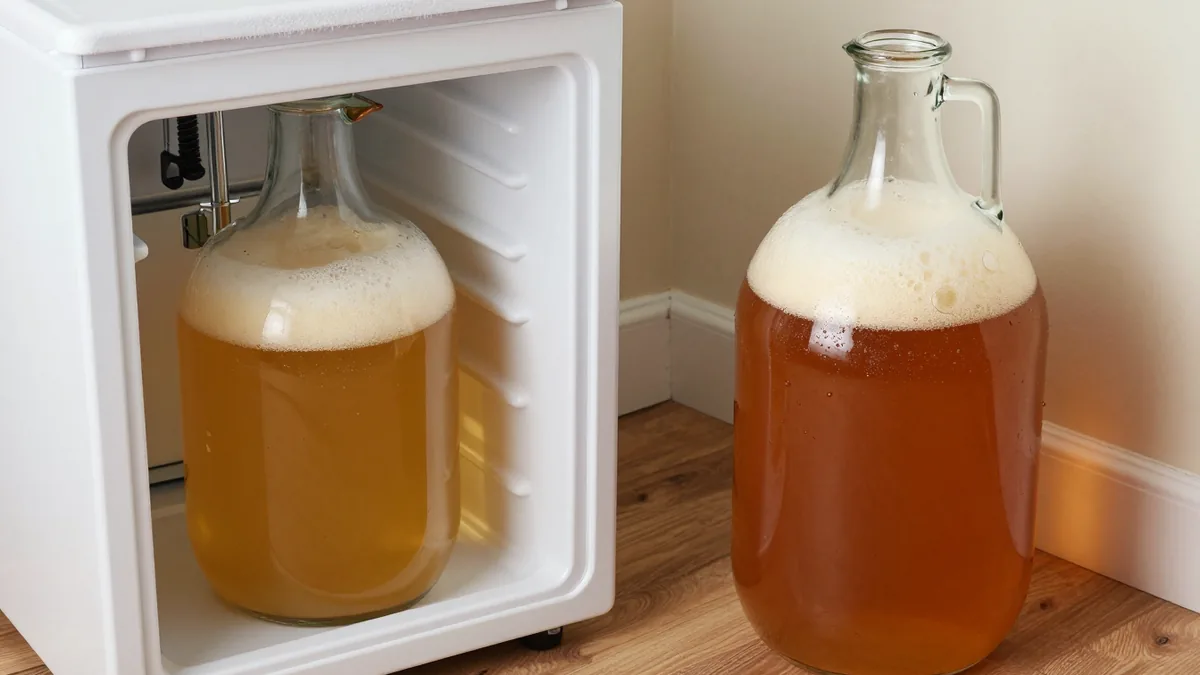
The wort is chilled, moved to a fermenter and the yeast is pitched. This is the step that splits ale from lager.
| Ale | Lager | |
|---|---|---|
| Example strain range | Wyeast 1056: 60–72°F | WLP830: 50–55°F |
| Vigorous primary | 2–6 days | 4–10 days |
| Diacetyl rest | Not usually needed | Free-rise to 65°F for 2–6 days |
Primary times are from How to Brew, chapter 8; the diacetyl rest from White Labs. That warm hold clears diacetyl, the buttery compound whose light-lager threshold is about 0.1 ppm and whose ale ceiling is 0.1–0.4 mg/L. The yeast science is in lager vs ale.
Those ranges are for the beer, not the room: Palmer puts an active fermenter up to 10°F (6°C) above the air around it, which is why our fermentation temperature control guide holds an ale at 60–72°F (16–22°C) for the first 3–4 days and lets it rise a few degrees as activity slows.
Step 5: Conditioning
Fermentation is done before the beer is. Yeast keeps cleaning up byproducts for days after the bubbling stops.
- Ale: Palmer says ales are "usually ready to bottle in 2–3 weeks" (chapter 11), which is 14–21 days in the fermenter.
- Lager: Wyeast describes a cold secondary of 1–3 weeks and then lagering of 1–4 weeks at 33–34°F.
Add the lager steps and a lager spends 20–65 days in tanks, against 14–21 for an ale.
Step 6: Packaging and carbonation
The last wait is for bubbles.
- Bottles: priming sugar goes in, then the bottles sit "at room temperature for two weeks, out of the light" (How to Brew).
- Kegs: CO2 under pressure. Craft a Brew says to hold the pressure 7–10 days for full carbonation.
Bottle conditioning is that wait with a measured dose: the bottle conditioning guide primes 5 gal (19 L) with about 4 oz (113 g) of corn sugar for roughly 2.5 volumes of CO2, then holds the bottles at 68–80°F (20–27°C) for 2–4 weeks.
Where the time goes: ale vs lager
The brew day is the shortest step. At 270 minutes, it is under a day out of a 28–35 day bottled ale. For a lager the cold stages dominate: up to 49 days of the 79-day high end.
Pick a beer type and packaging below to see the step-by-step schedule with the source for each range.
Every range in the planner is a published range, not a promise. Strong beers and cold rooms take longer.
Making it at home
US federal law allows home brewing for personal use: 100 gallons per calendar year for a household with one adult and 200 gallons with two or more (27 CFR 25.205). Equipment, costs and a first recipe are in how to start homebrewing. Style definitions are at /styles and brewing terms in the glossary.
Frequently Asked Questions
What are the four ingredients in beer?
Malt, water, hops and yeast. The 1516 Bavarian law named only barley, hops and water; yeast appears in the 1910 Bavarian text (Historisches Lexikon Bayerns).
How long does it take to make beer?
From brew day, an ale takes about 28–35 days with bottle conditioning or 21–31 days in a keg. A lager takes 34–79 days bottled or 27–75 days kegged. Malting adds 7.3–9.8 days before that, at the maltster.
What temperature do you mash at?
150–155°F for about an hour for a single-rest mash. Beta-amylase prefers 131–150°F and alpha-amylase 150–158°F.
Why is wort boiled?
To isomerize hop alpha acids into bitter compounds, to drop proteins out in the hot break, and to sterilize the wort. A 60-minute boil gives about 2.0x the hop utilization of a 15-minute one in Tinseth's table.
What is the difference between brewing an ale and a lager?
The yeast and the temperature. Ale yeast ferments around 60–72°F; lager yeast around 50–55°F, followed by weeks near 33°F.
Sources
- How to Brew (John Palmer), How to Brew, Chapter 12: Understanding Malted Barley and Adjuncts, https://howtobrew.com/section-2/chapter-12/ (checked 2026-10-01)
- How to Brew (John Palmer), How to Brew, Chapter 14: How the Mash Works, https://howtobrew.com/section-3/chapter-14/ (checked 2026-10-01)
- How to Brew (John Palmer), How to Brew, Chapter 16: The Methods of Mashing, https://howtobrew.com/section-3/chapter-16/ (checked 2026-10-01)
- How to Brew (John Palmer), How to Brew, Chapter 7: Boiling and Cooling, https://howtobrew.com/section-1/chapter-7/ (checked 2026-10-01)
- How to Brew (John Palmer), How to Brew, Chapter 8: Fermentation, https://howtobrew.com/section-1/chapter-8/ (checked 2026-10-01)
- How to Brew (John Palmer), How to Brew, Chapter 11: Priming and Bottling, https://howtobrew.com/section-1/chapter-11/ (checked 2026-10-01)
- Brewer's Friend, How long does it take to brew a batch of beer?, https://www.brewersfriend.com/2012/03/10/how-long-does-it-take-to-brew-a-batch-of-beer/ (checked 2026-10-01)
- Glenn Tinseth via Internet Archive, Glenn Tinseth, The Hop Page: hop utilization research (archived), https://web.archive.org/web/20241125151543/https://realbeer.com/hops/research.html (checked 2026-10-01)
- Wyeast, 1056 American Ale, https://wyeastlab.com/product/american-ale/ (checked 2026-10-01)
- White Labs, WLP830 German Lager Yeast, https://www.whitelabs.com/yeast-bank/wlp830-german-lager-yeast (checked 2026-10-01)
- Wyeast, Lager Brewing, https://wyeastlab.com/resource/professional-lager-brewing/ (checked 2026-10-01)
- White Labs, Tips From The Pitch: Lagers, https://blog.whitelabs.com/tips-from-the-pitch-lagers (checked 2026-10-01)
- Craft a Brew, Priming Sugar Calculator, https://craftabrew.com/pages/priming-sugar-calculator (checked 2026-10-01)
- Historisches Lexikon Bayerns, Purity Law, 1516 (Klaus Rupprecht), https://www.historisches-lexikon-bayerns.de/Lexikon/EN:PurityLaw,1516 (checked 2026-10-01)
- eCFR, 27 CFR 25.205 Production (beer for personal or family use), https://www.ecfr.gov/current/title-27/chapter-I/subchapter-A/part-25/subpart-L/subject-group-ECFR730f63bc14293bb/section-25.205 (checked 2026-10-01)