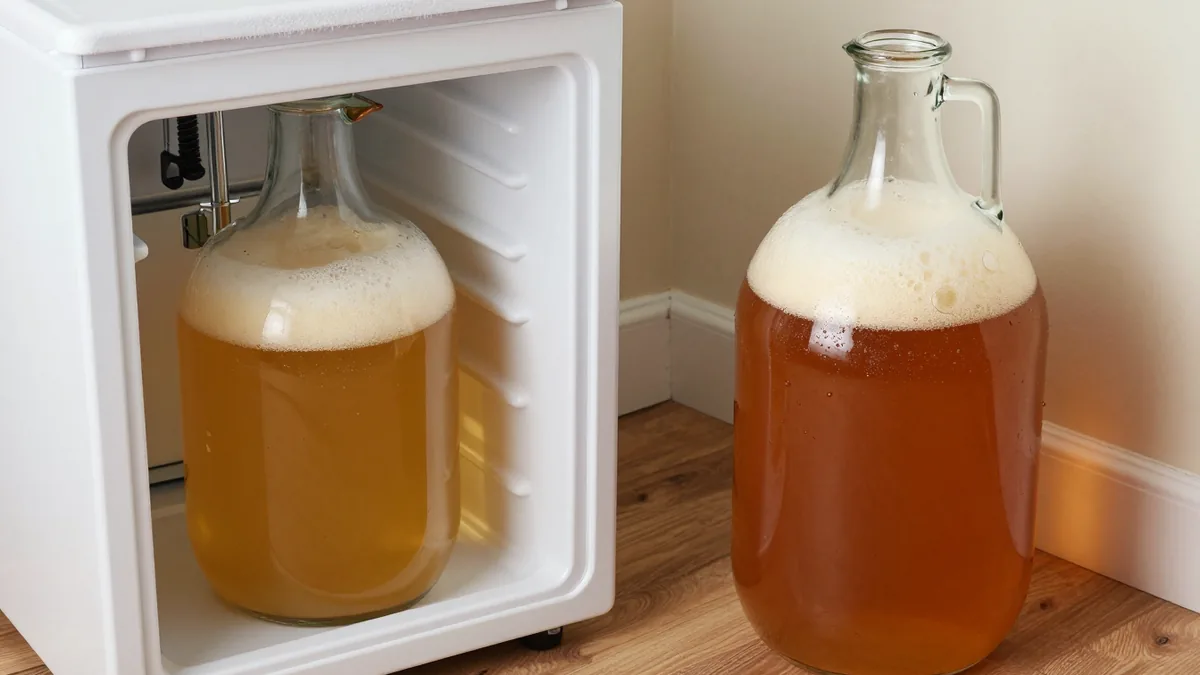
Juicy and hazy IPA style characteristics. See what-is-ibu-does-it-predict-bitterness
A hazy IPA is cloudy mainly because proteins bind hop and malt polyphenols, not because of floating yeast. In a survey of New England IPAs, turbidity ran 119–1,774 NTU (average 547) against under 30 NTU for clear IPAs, and the haze was 35.7% protein (Molecules review, 2023). The juicy aroma comes from compounds such as 4MMP, detected at about 24 times its 1.5 ng/L aroma threshold, and from yeast converting hop geraniol into β-citronellol.
What the haze is made of
The best numbers come from a survey by Maye and Smith of commercial New England IPAs, summarized in a 2023 review of dry-hopping chemistry in Molecules:
| Measure | Hazy IPAs (NEIPA) | Clear IPAs |
|---|---|---|
| Turbidity | 119–1,774 NTU | under 30 NTU |
| Average turbidity | 547 NTU |
NTU is a nephelometric turbidity unit: how much light a sample scatters sideways. The average hazy IPA scattered about 18x as much light as the clear-IPA ceiling, and even the clearest NEIPA was 4.0x it.
The same survey broke the haze particles down by composition. Protein dominates, at 10.5x the share of polyphenols:
The BJCP 2021 guideline for Hazy IPA says the same thing in plain words: haziness comes from "polyphenols from dry-hopping and proteins from starchy grains", not suspended yeast or starch. It also sets a limit: the beer "should not be cloudy or murky", and "visible floating hop matter, yeast clumps, or other particulates is a fault".
Get beer science and style notes
How beer gets its bitterness, color and aroma, explained with numbers and sources. Free, unsubscribe from any email.
No fixed schedule. Unsubscribe from any email. 21+ only.
Protein plus polyphenol: how the particles form
Beer haze comes in two kinds, per the review:
- Chill haze: particles of 0.1–1.0 µm. It forms at 0–4 °C and disappears when the beer warms to about 20 °C. Held together by weak bonds.
- Permanent haze: particles of 1–10 µm, present at any serving temperature. Held together partly by covalent bonds. Chill haze particles can grow into permanent haze.
The mechanism: polyphenols bridge between haze-active proteins. As polyphenols oxidize and polymerize they get more binding sites and build bigger particles. In most beer, 70–80% of polyphenols come from malt and the rest from hops. Hazy IPAs shift that ratio because they use far more hops. The review reports maximum protein–polyphenol haze formation at about pH 4.
Dry hopping alone moves the number. In a 2022 pilot study in Plants, turbidity rose from 11.19 to 16.32 EBC units after dry hopping, up 45.84%. In a separate study of dry-hopped beers stored 24 months, each 1 mg/L loss of flavan-3-ol polyphenols raised chill haze by 1.7 EBC units.
Oats, wheat and yeast
The BJCP grist note for the style is "more flaked grains and less caramel or specialty malts". Flaked oats and wheat bring protein and β-glucan, two of the haze builders. In unfilterable dry-hopped IPAs, Huismann and colleagues (cited in the review) traced the haze to β-glucans and proteins and suggested yeast cell-wall mannoproteins were involved.
Yeast can also make haze without staying in suspension. A 2025 study in the Journal of Agricultural and Food Chemistry added yeast RNA to lager and got stable haze particles of about 1 µm. The haze level was "linearly dependent on the concentration of RNA", and the only protein in the particles was beer protein Z. So a strain that releases more RNA can give a hazier beer even after the cells drop out.
The haze holds hop compounds
Haze is not only visual. The NEIPAs in the Maye and Smith survey carried hop compounds at levels the authors called unusual for beer:
| Compound | Range | Average |
|---|---|---|
| α-acids | 17–72 mg/L | 31 mg/L |
| Xanthohumol | 2 mg/L | |
| β-myrcene | 1.4 mg/L | |
| β-acids | 5 mg/L |
Their explanation: the haze let these compounds stay dissolved at levels not normally found in beer. They also found that most of the bitterness came from humulinones, oxidized α-acids from dry hops, not from the iso-α-acids a lab IBU test is built around. That is one reason a hazy IPA's IBU and its taste disagree; our IBU explainer covers the method.
Biotransformation: yeast changes hop aroma
The BJCP guideline calls for hazy IPAs to be "Heavily dry-hopped, partly during active fermentation" and notes that "Biotransformation of hop oils during fermentation adds to the depth and fruit complexity". The best-documented example is geraniol.
- Yeast converts hop geraniol (rose-like) into β-citronellol (lemon, lime). Takoi and colleagues at Sapporo reported the conversion runs mainly in the first 2–4 days of fermentation; in their hopped beers geraniol "drastically decreased during the first 3 days".
- β-Citronellol then rose slowly through the whole fermentation.
- Linalool, geraniol and β-citronellol act together. Only 5 µg/L of geraniol and β-citronellol was enough to add to linalool's effect, below each compound's own threshold.
This is why hazy IPA brewers add hops while yeast is still active: the yeast is a reactor, not just a fermenter.
Thiols: the passion fruit and grapefruit notes
Polyfunctional thiols are sulfur compounds measured in nanograms per liter. They matter because their thresholds are tiny. Many hop thiols are bound to precursors and released by yeast.
A 2026 Oregon State time-course study dosed 12.0 g/L of Cascade about 48 hours after pitching and tracked release:
- Most thiol release happened early in fermentation, Days 1-3.
- Dry hopping raised 3SH about 2-fold, despite a 3.5-fold increase in hop input. More hops did not mean proportionally more thiol.
- 3S4MP rose about 5-fold in dry-hopped beers.
The chart compares the concentrations reported in dry-hopped beers with published aroma thresholds. A value above 1 means the compound sits above its threshold.
We used the midpoint of each reported range and, where the review lists two thresholds, the higher one. On that basis β-citronellol sits below threshold, which is where Takoi's additive effect matters. Check your own lab numbers:
Dry-hop timing, rates and the hop creep risk that comes with them are in our dry hopping and hop creep guide.
The step-by-step is in the dry hopping guide: 3–4 oz (85–113 g) of pellets per 5 gal (19 L), a 55–65°F (13–18°C) hold, and a 1–3 day contact window.
Hazy IPA by the numbers (BJCP 2021)
| Statistic | Hazy IPA (21C) |
|---|---|
| Bitterness | 25–60 IBU |
| Color | 3–7 SRM |
| Original gravity | 1.060–1.085 |
| Final gravity | 1.010–1.015 |
| Alcohol | 6–9% ABV |
The step-by-step is in our NEIPA process guide: BYO’s 5 gal (19 L) grist is 9 lb (4.1 kg) 2-row, 2 lb (0.91 kg) Golden Promise, 1 lb (0.45 kg) flaked wheat and 12 oz (340 g) flaked oats, mashed at 152°F (67°C).
The fairly high final gravity keeps body and residual protein in the beer, which supports the haze. For a side-by-side with American IPA and pale ale, see IPA vs pale ale vs hazy IPA; style profiles are in our style index. Among the 18 listings in our Chicago guide, Old Irving's Beezer is a named hazy IPA example, not a recipe specification for the style. The seven listings in our Brooklyn guide also include Keg & Lantern, whose specialties span hazy IPAs and foeder-fermented sours.
What this means if you brew one
- Haze needs protein. Use flaked grains such as oats or wheat, per the BJCP grist note. Fining agents that strip protein work against the style.
- Hop during active fermentation for biotransformation. Geraniol conversion runs in the first 2–4 days and thiol release in Days 1-3.
- Do not chase haze with yeast or flour. BJCP calls a murky beer and visible particles faults.
- Drink it fresh and cold. Hop aroma and bitterness compounds fall during storage; see our beer freshness guide.
- More hops is not linear. Thiols rose about 2x for 3.5x the hops in the Oregon State work.
Frequently Asked Questions
Is the haze in a hazy IPA yeast?
Mostly no. The BJCP guideline says haze comes from polyphenols and proteins, not suspended yeast. Yeast RNA can add to haze by binding protein Z, per the 2025 study.
How cloudy is a hazy IPA compared with a regular IPA?
In the Maye and Smith survey, hazy IPAs measured 119–1,774 NTU, average 547. The clear IPAs measured under 30 NTU.
Does haze change the flavor?
Yes. The surveyed NEIPAs held α-acids at 17–72 mg/L and other hop compounds at unusual levels, and most of their bitterness came from humulinones.
What is biotransformation in beer?
Yeast changing hop compounds during fermentation. The clearest case is geraniol becoming β-citronellol in the first 2–4 days. Yeast also frees bound thiols, mostly in Days 1-3.
Can a hazy IPA be too hazy?
Yes, by competition standards. The BJCP guideline says the beer "should not be cloudy or murky" and that "visible floating hop matter, yeast clumps, or other particulates is a fault". Shine is the target, not murk.
Is a hazy IPA more bitter than it tastes?
Often its lab IBU reads high for its taste. The BJCP range is 25–60 IBU, but body, residual sweetness and humulinones change how that bitterness comes across.
Why does my hazy IPA clear up in the fridge over time?
The haze-building polyphenols degrade during storage, which changes the haze; in the Ferreira study that degradation tracked chill haze over 24 months. The same review reports that lower temperatures provided a higher stability of hop-derived volatile compounds, so keep it cold even if the look changes.
Sources
- BJCP, 21C. Hazy IPA (2021 Style Guidelines), checked 2026-10-01.
- Klimczak, Cioch-Skoneczny and Duda-Chodak, Effects of Dry-Hopping on Beer Chemistry and Sensory Properties: A Review (Molecules, 2023), Molecules 28(18):6648, checked 2026-10-01. Source of the Maye and Smith NEIPA data, the Huismann and Ferreira haze findings, and the aroma threshold table.
- Salamon et al., The Effect of Dry Hopping Efficiency on beta-Myrcene Dissolution into Beer (Plants, 2022), checked 2026-10-01.
- Takoi et al., Biotransformation of hop-derived monoterpene alcohols by lager yeast and their contribution to the flavor of hopped beer (J Agric Food Chem, 2010), abstract, checked 2026-10-01.
- Yding et al., Yeast RNA-Protein Interactions Generate Beer Haze (J Agric Food Chem, 2025), abstract, checked 2026-10-01.
- Samia et al., A time-course assessment of polyfunctional thiol release and yeast gene expression in dry-hopped beers (Food Chemistry: Molecular Sciences, 2026), checked 2026-10-01.